Digestive enzymes for dogs are most useful in three situations: dogs with exocrine pancreatic insufficiency (EPI) or pancreatitis who need veterinary-directed enzyme replacement, senior dogs and dogs with sensitive digestion, and dogs eating kibble or cooked diets. That last group is where enzymes make the most intuitive sense, because high heat strips food of its own natural enzymes, so a cooked meal arrives with none of its own to contribute and your dog's body does all the work. A healthy dog with a fully working pancreas still makes plenty of its own enzymes, so this is about support and getting more out of every meal, not fixing a deficiency.
Here is the one-line version, if you take nothing else away: enzymes are essential for dogs with pancreatic conditions and a smart absorption support to consider for dogs on kibble or cooked diets, since cooked food no longer carries the enzymes that raw food naturally does.
Let me be real for a second. The enzyme conversation online is so confusing. Half the internet tells you every dog is dangerously enzyme-deficient and needs a supplement yesterday. The other half tells you enzymes are a scam. Neither is honest. So here is the honest middle, backed by what the research actually shows, and where enzymes genuinely earn their place in your dog's bowl.
What do digestive enzymes actually do for dogs?
Digestive enzymes are proteins that break food down into pieces small enough for your dog's body to absorb. The three main ones do most of the work, and your dog's pancreas produces them and releases them into the small intestine after meals.
According to Tufts University's Petfoodology, the primary canine digestive enzymes are lipase, protease, and amylase, and cellulase, which breaks down plant fiber, is not naturally made in a dog's gut at all, even though it is often added to plant-based enzyme blends.
Here is what each one does:
- Protease: breaks down protein into amino acids
- Amylase: breaks down starches and carbohydrates
- Lipase: breaks down fats
- Cellulase: breaks down plant fiber (cellulose), and is not produced by dogs themselves
In a healthy dog, this system runs quietly in the background, meal after meal, without any help from you.
Does my dog actually need a digestive enzyme supplement?
It depends on the dog. A healthy dog with a fully working pancreas is not deficient, and I would rather tell you that plainly than sell you something you do not need. But "not deficient" is not the same as "no dog benefits," and this is where the picture gets more interesting.
Here's what the research tells us. A 2017 study in the Journal of Nutritional Science fed fourteen healthy adult Beagles a normal commercial dry diet, then added either a plant-based or an animal-based enzyme supplement. In those healthy dogs, there was no measurable difference in how well they digested protein, fat, or calories, because a healthy pancreas already makes enough on its own to keep up.
So a healthy dog is not going to starve without a supplement. That part of the loud marketing is overstated.
But look at what happens at the level of the food itself. A 2023 study in Frontiers in Veterinary Science used a laboratory model of the canine digestive system and found that an enzyme blend improved how thoroughly dog food broke down, raising dry matter digestibility by roughly 19 percent and protein digestibility by about 11 percent, and releasing more amino acids and peptides. Enzymes clearly act on the food and help it break down more completely. The open question is whether a given dog's own system needs that help, and for dogs whose digestion is not running at full capacity, that is exactly where added enzymes may help them get more out of a meal.
What are the signs your dog needs digestive enzymes?
There is no enzyme "deficiency" you can spot from the couch, and none of these signs confirm anything on their own. But some patterns are worth paying attention to and worth a conversation with your vet, because they can point to a digestion or absorption issue that enzymes may or may not be part of:
- Weight loss despite a normal or big appetite
- Large volume, loose, pale, or greasy stools
- Visibly undigested food in the stool
- Chronic soft stool or ongoing digestive upset
- Coprophagia (eating stool)
- A dull coat or low energy alongside any of the above
Here is the part most pet parents are never told clearly: these same signs can also mean a food intolerance, an imbalanced gut microbiome, inflammatory bowel disease, or something else entirely. Enzymes are not a catch-all answer. If your dog is losing weight or has diarrhea lasting more than a day or two, that is a vet visit, not a supplement experiment.
What about digestive enzymes for kibble-fed dogs?
This is where enzymes make the most intuitive sense, and it is worth understanding why.
Raw food carries its own natural enzymes. Cooked and extruded food does not, because heat destroys them. Kibble is made through high-heat extrusion, and along with degrading some heat-sensitive nutrients like vitamins A, D, E, K, and certain B vitamins (which is why manufacturers add vitamin premixes back in afterward), that heat also strips out the food's own enzymes. So a kibble or cooked meal arrives at your dog's gut with none of its own enzymes to contribute. Your dog's pancreas does the entire job alone, every meal, for years.
That is the real case for enzyme support on a cooked diet. You are handing the food back some of what the cooking took out, and helping your dog's system break down a meal it was not designed to eat in its natural, enzyme-rich form. Remember the lab study above: when researchers added enzymes to dog food, the food broke down significantly better. On a cooked diet, that extra help has somewhere useful to go.
One honest footnote, because you will not hear it from me otherwise: in perfectly healthy dogs, a working pancreas keeps up with kibble on its own, which is why the healthy-Beagle study did not show a digestibility jump. Added enzymes are not correcting an emergency. They are lightening the load and supporting fuller absorption, and that is most worthwhile for dogs on kibble or cooked food, seniors, and dogs with sensitive digestion, rather than a young dog thriving on a fresh raw diet who is already getting enzymes from the food.
If your dog eats kibble or a cooked diet, enzyme support is one of the more sensible additions you can consider, framed honestly as support for absorption, not a rescue.
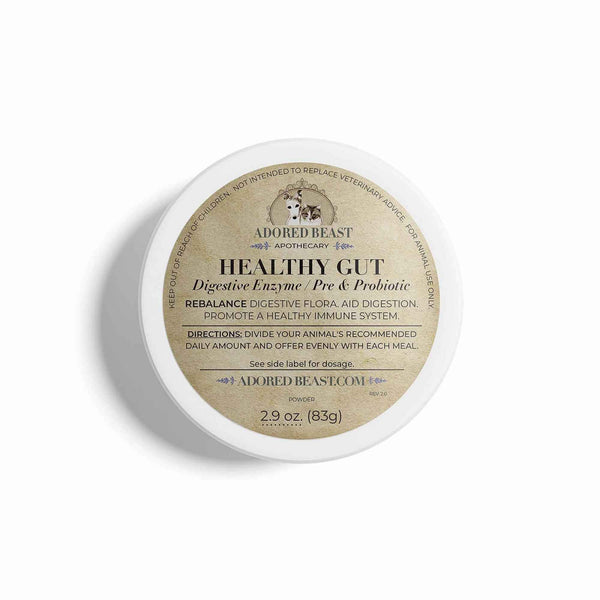
The one I keep coming back to
Healthy Gut by Adored Beast
A broad-spectrum blend built for exactly this situation: a cooked or kibble meal that arrives with none of its own enzymes. Plant enzymes sit alongside a supplement-level amount of porcine pancreatin, with a prebiotic and a 14-strain probiotic supporting the bacteria that carry out the rest of the work.
- Papain, bromelain, betaine HCL, and porcine pancreatin
- Larch arabinogalactan prebiotic plus a 30 billion CFU probiotic blend
- Made for pets on dry, wet, or cooked food, seniors, and pets who struggle to digest their food
Also available on Subscribe & Save.
When are digestive enzymes medically necessary for dogs?
This is the group where enzymes are not optional, they are essential, and it is worth understanding clearly.
Exocrine pancreatic insufficiency, or EPI, is a condition where the pancreas can no longer make enough digestive enzymes. According to a 2024 review in the Journal of Veterinary Internal Medicine, clinical signs of EPI appear only once more than 85 percent of the pancreas has stopped functioning, and affected dogs need lifelong pancreatic enzyme replacement therapy. The Merck Veterinary Manual notes that EPI is confirmed through a blood test called serum TLI (trypsin-like immunoreactivity), and that enzyme powders work better than tablets or capsules for these dogs. Certain breeds, especially German Shepherds, are more prone to it.
Pancreatitis, an inflammation of the pancreas, can also reduce enzyme output and is one of the leading paths to EPI over time.
If your dog has EPI or pancreatitis, this is veterinary territory. Enzyme replacement here is prescribed and monitored by your vet, and the products used are specific and dosed to your dog. Please do not try to manage these conditions with an over-the-counter supplement on your own. You can learn more in our guide to recurring pancreatitis in dogs.
Are plant-based or animal-based enzymes better for dogs?
It depends entirely on why you are reaching for them. Here is the honest comparison:
| Plant-based enzymes | Animal-based enzymes (pancreatin) | |
|---|---|---|
| Where they come from | Plant and fungal sources, most often papain (papaya) and bromelain (pineapple), frequently with cellulase added. | Pancreatic tissue, usually porcine pancreatin, supplying the same lipase, protease, and amylase a dog's own pancreas releases. |
| What healthy-dog research shows | No measurable change in protein, fat, or calorie digestibility in healthy adult dogs (2017, Journal of Nutritional Science). | Same result in the same study. Neither type moved the needle in dogs whose pancreas was already keeping up. |
| Where each earns its place | Everyday absorption support alongside a cooked or kibble meal that carries no enzymes of its own. | High-potency, vet-directed enzyme replacement for EPI or pancreatitis. Supplement-level amounts also appear in daily broad-spectrum blends. |
| Worth knowing | Cellulase breaks down plant fiber and is not made in a dog's gut at all, yet it is still commonly included (Tufts Petfoodology). | For dogs with EPI, powders work better than tablets or capsules, and the high-potency versions typically come through a vet (Merck Veterinary Manual). |
Here is the part that trips people up: you are usually not choosing one or the other. Many of the better broad-spectrum blends combine both, which is the case with Healthy Gut, where plant enzymes like papain and bromelain sit alongside a modest amount of porcine pancreatin. That covers more bases than either type alone.
For a dog with EPI, high-potency prescription pancreatin from your vet is the standard, and nothing over the counter replaces it. For everyday absorption support in a dog without a pancreatic condition, a broad-spectrum blend that pairs plant enzymes with a supplement-level amount of animal-based pancreatin is a sound choice. Animal-based enzymes are not off-limits outside the prescription world. If your dog has ongoing digestive issues, looping in your vet before you start anything is always the right move.
How enzymes, probiotics, and gut health fit together
Here is what I have learned digging into this: enzymes are only one piece of the gut puzzle, and often not the most important one.
The gut is home to a huge share of your dog's immune system. Veterinary immunology texts describe gut-associated lymphoid tissue as the largest immune tissue in the body, often cited as around 70 percent of the immune system. So supporting the gut is about far more than breaking down one meal.
This is backed up in an unexpected place. That 2024 JAVMA review on EPI notes that many dogs still have digestive signs even after they start enzyme replacement, and that this is increasingly linked to an imbalanced gut microbiome. In other words, giving enzymes alone, without tending to the bacteria in the gut, often is not enough. The microbiome matters.
That is exactly why I lean toward blends that support the whole picture rather than enzymes in isolation. Healthy Gut by Adored Beast is the one I keep coming back to for this, because it is genuinely broad-spectrum: plant enzymes like papain and bromelain alongside porcine pancreatin, plus betaine HCL, a larch arabinogalactan prebiotic, and a 30 billion CFU probiotic blend. That combination supports both the breakdown of a cooked meal and the gut bacteria that carry out the rest of the work, which makes it a natural fit for kibble-fed and cooked-diet dogs whose food no longer carries its own enzymes. If your focus is more on rebalancing the microbiome itself, a species-specific probiotic like Fido's Flora can be a strong foundation, and for a sensitive, inflamed gut that needs calming, Gut Soothe is worth a look. If you are thinking bigger picture about the diet itself, our guide to gut health and the raw diet transition walks through how a fresh, enzyme-rich diet supports the gut from the ground up. None of these are a fix for a medical condition. They are support tools for the body's own work.
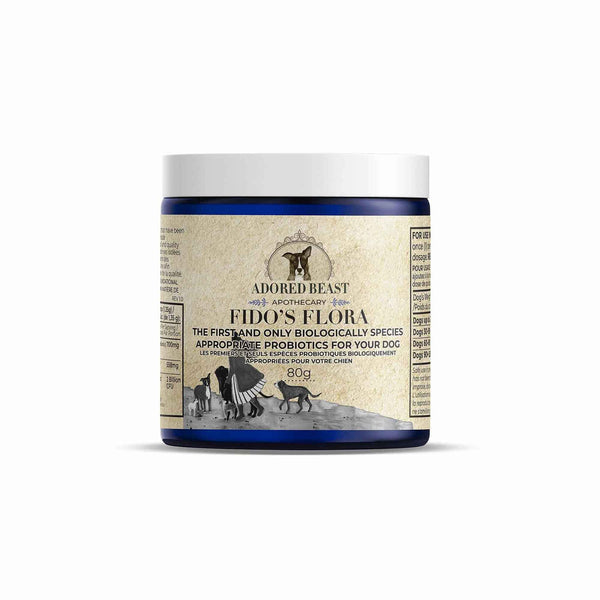
If the microbiome is your bigger concern
Fido's Flora by Adored Beast
When the issue looks less like a meal that will not break down and more like a gut population that is out of balance, this is the foundation I would start from. It is the first canine species-specific probiotic, built around strains that belong in a dog rather than borrowed from human formulas.
- 16 strains, including two canine-specific strains
- Humic and fulvic acids plus a larch arabinogalactan prebiotic
- A common choice during and after a course of antibiotics
Also available on Subscribe & Save.
Which gut support fits your dog?
Three different dogs, three different starting points. This is the short version of how I would choose between them.
| Healthy Gut | Fido's Flora | Gut Soothe | |
|---|---|---|---|
| The dog it is for | Eats kibble, wet, or cooked food. Seniors, and dogs who seem to get less out of a meal than they should. | Needs the microbiome itself rebalanced, including during and after antibiotics. | Has a sensitive, easily upset, or inflamed gut, or is moving onto a new diet. |
| Digestive enzymes included | Yes. Papain, bromelain, betaine HCL, and porcine pancreatin. | No. This one is about the bacteria, not the breakdown. | No. This one is about calming an irritated gut. |
| What else is in there | 14-strain probiotic blend at 30 billion CFU with a larch arabinogalactan prebiotic. | 16 strains including two canine-specific strains, plus humic and fulvic acids. | Slippery elm, marshmallow root, deglycyrrhizinated licorice, L-glutamine, and aloe. |
| Start here if | The food is cooked and you want more of it absorbed. | The gut flora is the thing that needs rebuilding. | The gut is irritated and needs settling first. |
None of these are a replacement for veterinary care. If your dog has EPI or pancreatitis, enzyme replacement is prescribed and monitored by your vet.
The honest bottom line on digestive enzymes for dogs
If your dog eats kibble or a cooked diet, enzyme support is one of the more sensible things you can add, since cooked food no longer carries the enzymes raw food does. Pairing enzymes with probiotics, the way Healthy Gut does, supports fuller absorption and a more balanced gut at the same time.
If your dog has EPI or pancreatitis, enzymes are essential, and that is a conversation with your vet, not a shelf decision.
And if your dog is young, thriving, and already eating a fresh, enzyme-rich raw diet, it is getting a lot of what it needs from the food itself, so there is less to add.
You know your dog better than anyone. You are not powerless, and you are not behind. You are your pet's biggest advocate, and asking these questions already makes you a next level pet parent.
Much Love, Larry
Sources
- Villaverde C, Manzanilla EG, Molina J, Larsen JA. "Effect of enzyme supplements on macronutrient digestibility by healthy adult dogs." Journal of Nutritional Science, 2017. View source
- "Modulation of digestibility of canine food using enzyme supplement: an in vitro simulated semi-dynamic digestion study." Frontiers in Veterinary Science, 2023. View source
- Szkopek D, et al. "A review: Pancreatic enzymes in the treatment of chronic pancreatic insufficiency in companion animals." Journal of Veterinary Internal Medicine, 2024. View source
- "Exocrine Pancreatic Insufficiency in Dogs and Cats." Merck Veterinary Manual, updated 2025. View source
- "Exocrine pancreatic insufficiency in dogs and cats." Journal of the American Veterinary Medical Association (JAVMA), 2024. View source
- Tran QD, Hendriks WH, van der Poel AFB. "Effects of extrusion processing on nutrients in dry pet food." Journal of the Science of Food and Agriculture, 2008; and "A literature review on vitamin retention during the extrusion of dry pet food." Animal Feed Science and Technology, 2021. View source
- "Digestive Enzyme Supplements: Breaking Down the Evidence." Tufts Petfoodology, Cummings Veterinary Medical Center, 2017. View source
- Garden OA. "Gastrointestinal Immunology" (veterinary immunology text, citing Vighi et al., 2008). View source
Disclaimer: This blog may contain affiliate links, and PAWDEGA may earn a small commission at no extra cost to you if you purchase through them. It may also link to products on our website, and this content is for educational purposes, not a replacement for veterinary advice.