Postbiotics for dogs are the compounds your dog's gut bacteria produce when they ferment fiber, including short-chain fatty acids such as butyrate, which the cells lining the colon use as their main fuel source. You can buy them in a jar, as inactivated bacteria or bacterial fragments. Or you can build them, by feeding the prebiotics and probiotics that let your dog's own gut make them fresh, every day, in the amounts that gut actually needs.
I have read the ingredient panel of every postbiotic that has crossed my desk, and there is not one on PAWDEGA's shelves. That is a decision, and this article is the reasoning behind it. When I put that position to Julie Anne Lee, DCH, the homeopath behind Adored Beast and one of the first people to research the canine microbiome, she had arrived in the same place from thirty years of her own work.
Postbiotics are real and they matter enormously, but for most dogs the better route is feeding the prebiotics and probiotics that let the gut produce its own, rather than buying the end product in a jar.
In this article
- What are postbiotics for dogs?
- Postbiotics vs prebiotics and probiotics
- Does the research support postbiotic supplements for dogs?
- Why there is no postbiotic on our shelves
- When a postbiotic supplement is actually worth it
- How to support your dog's own postbiotic production
- What if your dog's gut is already struggling?
- What to look for on a label
What are postbiotics for dogs?
A postbiotic is what is left after the work is done.
Your dog's beneficial bacteria eat fermentable fiber. In the process they release compounds: short-chain fatty acids, organic acids, peptides, bacterial cell wall fragments. Those compounds are the postbiotics, and they are where a lot of the benefit of a healthy gut actually sits. Butyrate, one of the best studied, is the primary energy source for colonocytes, the cells lining the colon, and research links it to epithelial barrier integrity and to calmer immune signalling in the gut.
Here is the part almost nobody selling a postbiotic mentions. In 2021 the International Scientific Association for Probiotics and Prebiotics set the definition: a postbiotic is a preparation of inanimate microorganisms and their components that confers a health benefit. That definition specifically excludes purified products, including isolated short-chain fatty acids. So a product marketed as a postbiotic because it contains purified butyrate does not meet the consensus definition of the word printed on its own label.
That is not a technicality I enjoy pointing out. It is the reason this category is so hard to shop.
Postbiotics vs prebiotics and probiotics: what is the difference?
Three words, one system. If you want the longer version, we have written a full explainer on prebiotics and probiotics for dogs. The short version:
Scroll sideways to see the full table.
| Term | What it is | Where it comes from |
|---|---|---|
| Prebiotic | Fermentable food for beneficial bacteria | Larch, chlorella, fermentable plant fiber |
| Probiotic | Live beneficial bacteria added to the gut | Supplements, kefir, fermented vegetables |
| Postbiotic | The compounds those bacteria make once fed | Fermentation in your dog's own colon |
| Postbiotic supplement | Inactivated bacteria or their components | A jar, made in a facility |
Read that last row next to the third one. The first three are a living process. The fourth is a snapshot of that process, taken in a factory, based on what we currently know how to measure.
Does the research support postbiotic supplements for dogs?
Partly, and less than the marketing suggests. Here is what the research tells us, honestly.
The postbiotic literature has grown fast, but a bibliometric review of the field found that review articles have been published at a rate wildly out of proportion to the underlying primary research. A lot of what looks like a body of evidence is the same small set of studies being discussed over and over.
In dogs specifically, there are a few real trials worth knowing about:
- A 2024 randomised, placebo-controlled canine trial run by the ingredient manufacturer ADM gave 36 lab-housed dogs either a live probiotic or a heat-killed version of the same strain for 90 days. The finding that got the headlines is worth reading closely: the dead form performed broadly similarly to the live form. Similar to a probiotic is not the same as better than a working gut.
- A 2026 study in Veterinary Sciences gave 36 healthy dogs a chew containing both prebiotics, baobab pulp and acacia gum, and postbiotics, inactivated Lactobacillus acidophilus plus yeast fractions, for 28 days. Fecal butyrate rose. Two barrier and inflammation markers improved. Stool scores did not change at all, because the dogs were already healthy, and the authors said plainly that this was maintenance of a healthy gut rather than a fix for a problem.
- Laboratory work on heat-killed Lactobacillus rhamnosus and reuteri in canine immune cells showed real immune signalling effects, but that was cells in a dish, not dogs in a home.
Look closely at the second study, because it is the strongest one and it makes my point for me. That chew contained prebiotic fiber and a postbiotic. Butyrate went up, and the authors attributed the rise to microbial fermentation of the added fiber, alongside a measurable shift toward fiber-fermenting bacteria and butyrate producers in the dogs' own microbiomes. The gut made the butyrate. The fiber is what let it.
Why there is currently no postbiotic on PAWDEGA's shelves
This next part is my judgment call rather than a research finding, and I want to be clear about which is which. It comes from over 10 years of feeding Milka and from the standard we hold every product to before it is listed, which is that we read every single ingredient of every product and I have to be able to explain what each one is doing.
My objection is not that bottled postbiotics do nothing. It is that they isolate the end product of a process we do not fully understand, based on the handful of compounds we currently know how to test for. A healthy microbiome is doing something more responsive than that, moment to moment. What a dog's colon needs at breakfast is not what it needs six hours later, after a walk, after a different meal. A jar delivers the same fixed thing to every dog every day, and it decides in a facility what your dog should be producing. Julie reached the same conclusion, and she has been researching this since 1994.
Her phrase for it was that we are missing the dance, and I have not found a better one. We can photograph the outcome. We cannot yet bottle the choreography.
The other thing I keep coming back to is what a postbiotic asks of you. It asks you to stop wondering whether the gut is working, and to top up the output instead. That is the opposite of how I think about Milka. She is a senior now, and my whole approach with her has been to build the inputs and let her body do what it knows how to do. Gut health sits underneath almost everything in that approach, including the integrity of the gut lining itself.
When is a postbiotic supplement actually worth it?
Let's be real for a second. I am skeptical of the category, not opposed to it, and there are situations where the case for it is reasonable:
- A gut that cannot hold live cultures. Postbiotics are heat stable and do not need to survive stomach acid to do their job. For a dog with significant gut disease where live cultures have repeatedly not established, that stability is a genuine argument.
- Shelf life and travel. Inactivated preparations are more robust than live ones. If cold chain or storage is a real constraint for you, that matters.
- Alongside, not instead. The strongest canine evidence we have came from a product that paired postbiotics with fermentable prebiotic fiber. Nobody has shown a postbiotic outperforming a well-fed gut on its own.
What I would not do is buy a postbiotic because the word is new. And I would not buy one that lists a purified short-chain fatty acid and calls that a postbiotic, because as we saw above, the consensus definition of the term excludes exactly that.
How do you support your dog's own postbiotic production?
This is the routine I run and the one I give pet parents who write in. Four things, in this order. It is a routine for a well dog, not a protocol for a sick one.
- Feed a functional prebiotic, not a sugar. Fermentable fiber is the raw material, and this is where I part ways with most of the category. Inulin and fructooligosaccharides do one job, and they behave like sugar doing it, which is the last thing I want in a bowl alongside yeast or skin issues. Larch arabinogalactan and chlorella feed bacteria and bring antioxidant and immune activity of their own. Julie formulates on the same principle, which is why her products are the ones I stock.
- Give diverse strains, not a single one. The number one veterinary-prescribed probiotic contains one strain, and that is the single most common thing I have to explain to pet parents. The analogy I use came from Julie and I have never improved on it: you rototill a wildflower meadow, plant only sunflowers, and expect a meadow back. Canine microbiome research consistently associates lower microbial diversity with gastrointestinal disease.
- Rotate. Do not sit on the same strains for years. The rotation I recommend, and the one Julie moves dogs onto after any corrective work, is Fido's Flora, then The Wolf, then a soil or spore-based probiotic such as Soil & Sea. Each round establishes a different set of colonies.
- Add real fermented food. Raw goat milk kefir, fermented vegetables, green tripe. In a prey diet a dog would have been eating fermented plant matter out of the gut of the animal it ate.
If your dog has had a course of antibiotics, this matters more, not less. Canine studies show broad-spectrum antibiotics knock down microbial diversity and that an altered community can persist for four to six weeks after the last dose, with some dogs slower than that. We have written separately about rebuilding the gut after a course of antibiotics.
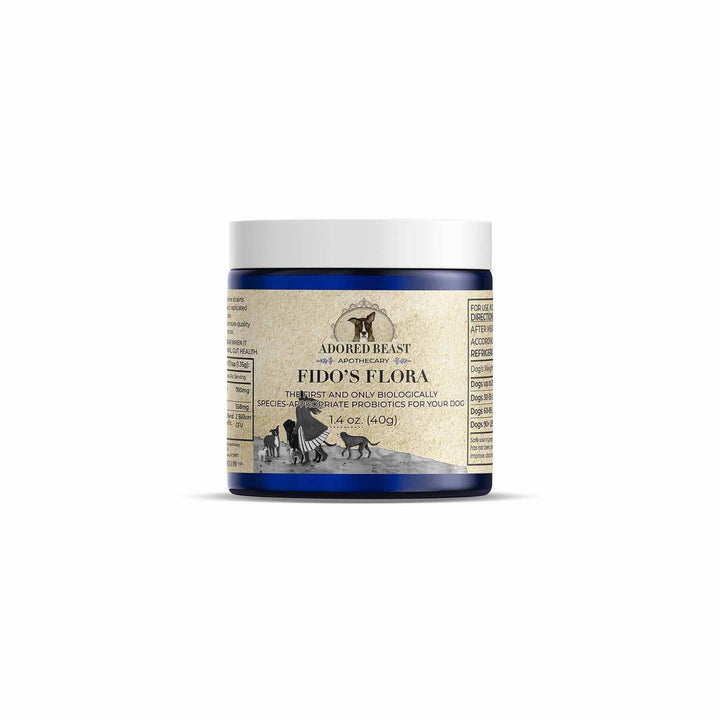
The one I feed Milka
Fido's Flora
This is the one that made me stop looking at postbiotic jars, and it is what goes into Milka's bowl. It is built the way I have argued a gut supplement should be built: diverse strains paired with a prebiotic that has a job of its own, so the fermentation happens where it is supposed to happen, inside your dog.
- 16 strains, including two canine-specific strains isolated for dogs
- Larch arabinogalactan as the prebiotic, no inulin, no fructooligosaccharides
- No maltodextrin, cellulose or other filler, so a quarter teaspoon does the work
- Two sizes, so you can choose by dog size and how long a jar needs to last
What if your dog's gut is already struggling?
Everything above assumes a reasonably settled gut. If your dog is dealing with ongoing loose stool, vomiting or a long history of digestive trouble, my answer changes, and so does Julie's. Strains alone are not the priority when the gut wall itself is irritated. Soothing herbs go in first, and the flora work continues underneath.
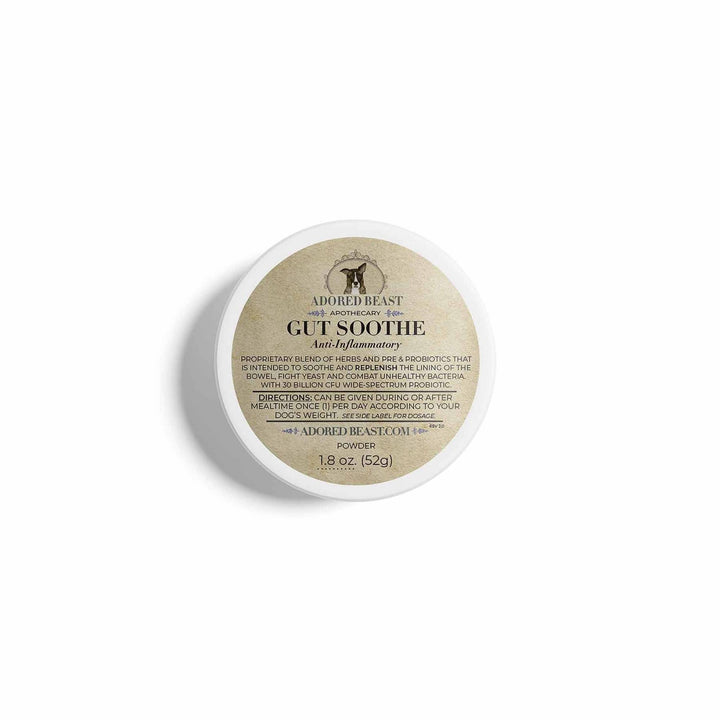
For a gut that needs settling first
Gut Soothe
The same 14-strain pre and probiotic base, with slippery elm, marshmallow root, L-glutamine and aloe alongside it. This is what I point pet parents to when the digestive history is long, and what I reach for during a diet transition.
See Gut SootheWhat should you look for on a label?
You read labels already. This is the exact order I work through when a gut product is put in front of me, whether the jar says probiotic or postbiotic on the front:
- Is there a prebiotic at all? A probiotic with no prebiotic has sent bacteria into a gut with nothing to eat.
- What is the prebiotic? If it is inulin or fructooligosaccharides, it is doing one job. Larch and chlorella bring more.
- How many strains? One strain is a sunflower field. I want eight at minimum, and I would rather see fourteen or more.
- What is the serving size, against the strain count? A tablespoon delivering eight billion colony forming units is mostly filler. A quarter teaspoon delivering thirty billion is not.
- Is maltodextrin, cellulose or silicon dioxide on the list? Bulking agents let a small amount of active ingredient fill a big jar.
- If it says postbiotic, what is actually in it? Inactivated whole cells or cell components fit the consensus definition. A purified short-chain fatty acid does not.
And the question underneath all of it, the one worth asking about any supplement in your cupboard: is this doing something my dog's own body would do better if I fed it properly? Sometimes the honest answer is that you can stop buying something.
So which should you actually buy?
If you are standing in front of the two options, this is the decision in one place.
Scroll sideways to see the full table.
| The question | A postbiotic supplement | Pre and probiotics that build them |
|---|---|---|
| Best suited to | A gut that cannot hold live cultures | Almost any dog, as a daily routine |
| Key difference | A fixed, shelf-stable dose | The gut produces what it needs, daily |
| Evidence in dogs | A few short trials, mostly industry run | Decades of fiber and fermentation work |
| What to do next | Ask a holistic vet whether it fits | Start with Fido's Flora, then rotate |
I am not a veterinarian and none of this is medical advice. Every dog is different, and for anything ongoing I would work alongside a holistic or integrative vet who knows your dog.
The word postbiotic is going to be on a lot of packaging over the next few years, and it describes something genuinely important. It is also the part of the system I am least willing to buy, and the reason nothing in that category has made it onto our shelves. Feed the gut well and it makes them for you, in the right amounts, for the dog in front of you. If a postbiotic ever clears the standard above, I will stock it and I will tell you why. Until then, this is where I stand.
Warmly,
Charly
Sources
- Salminen S. et al. ISAPP consensus statement on the definition and scope of postbiotics. Nature Reviews Gastroenterology & Hepatology, 2021. Link
- Vinderola G., Sanders M.E., Salminen S. The Concept of Postbiotics. Foods, 2022, via ISAPP. Link
- Parada Venegas D. et al. Short chain fatty acid mediated gut epithelial and immune regulation. Frontiers in Immunology, 2019. Link
- Yi C. et al. Effects of a novel prebiotic and postbiotic dietary supplement on gut microbiota, intestinal barrier markers and inflammation in healthy dogs. Veterinary Sciences, 2026. Link
- ADM. Journal of Animal Science publishes canine clinical trial on probiotic and postbiotic forms of BPL1, 2024. Link
- Postbiotics: Mapping the Trend. Bibliometric analysis of postbiotic reviews, 2024. Link
- Immunomodulating effects of heat-killed Lactobacillus rhamnosus and Lactobacillus reuteri on peripheral blood mononuclear cells from healthy dogs. Veterinary Sciences, 2025. Link
- Conserved signatures of the canine faecal microbiome associated with metronidazole and recovery. Scientific Reports, 2024. Link
- Pilla R., Suchodolski J.S. The role of the canine gut microbiome and metabolome in health and gastrointestinal disease. Frontiers in Veterinary Science, 2020. Link
- Prebiotic fiber blend supports growth and development and favorable digestive health in puppies. Frontiers in Veterinary Science, 2024. Link
- Julie Anne Lee DCH on prebiotics, probiotics and postbiotics. Next Level Pet Parent Podcast. Watch the episode