A positive giardia result does not automatically mean metronidazole. Most dogs carrying giardia show no signs of illness at all, and the parasite guidelines many US veterinarians work from state that in dogs with clinical signs carrying a non-zoonotic strain, a high-fiber diet with probiotics may be sufficient. Where medication is used, the safety picture deserves a much closer look than it usually gets: a 2025 follow-up study found dogs given metronidazole as puppies carried measurably more chronic gut and skin problems years later, and its authors state plainly that metronidazole should not be a first-line choice in young dogs with giardia. This is a decision worth making carefully, with a veterinarian who will look at the whole dog. Ideally a holistic or integrative vet. Below is the full picture, and the gut, absorption, detox, and immune support we use at PAWDEGA for dogs dealing with giardia.
On this page
- How serious is a positive giardia result?
- Does my dog actually need medication for giardia?
- What are the risks of metronidazole in dogs?
- Does the medication always work?
- Can you address giardia in dogs naturally?
- What we use at PAWDEGA for a dog with giardia
- Why the gut is the long game
- Why does my dog keep testing positive for giardia?
- Can I catch giardia from my dog?
- What to ask your vet before you start anything
- The honest bottom line
- Sources
Let's be real for a second.
You have a positive test result in your hand, probably a prescription alongside it, and a nagging feeling that nobody has actually explained the decision to you. They told you what the parasite is. They told you what the drug is called. What they did not do is sit down and walk you through how sick your dog actually is, whether the drug is necessary in your dog's specific case, what it does on the way through, or what happens in the months afterwards.
That conversation is the one that matters. So let's have it.
How serious is a positive giardia result?
Far less serious than the word "parasite" makes it sound, in most dogs.
VCA Animal Hospitals notes that the majority of infected dogs show no diarrhea, no vomiting, and no other signs of illness at all. Prevalence in dogs runs somewhere between 5 and 35% depending on age, and can approach 100% in breeding colonies. Read that again. A third of dogs in some populations are carrying this and living perfectly normal lives.
So the first question is not "how do I get rid of this." The first question is "is my dog actually unwell?"
A healthy adult dog with firm stools and a positive result is a completely different situation from a twelve-week-old puppy with watery diarrhea and weight loss. I want to be clear about that second dog, because this is where honesty matters more than ideology: puppies, seniors, and immune-compromised dogs can get genuinely, dangerously sick from giardia. Dehydration in a small puppy moves fast. If that is your dog, this is a same-day veterinary conversation, not a supplement decision.
For everyone else, there is room to think.
Does my dog actually need medication for giardia?
Not every dog with a positive result does, and this is the part almost nobody explains.
The Companion Animal Parasite Council, which publishes the parasite guidelines many US veterinarians work from, sets out a decision framework rather than a blanket rule. Dogs showing clinical signs should receive medication. Dogs with no signs at all who carry a strain capable of infecting humans should also receive it. But dogs with no signs carrying a dog-specific strain may not require medication at all.
Giardia comes in genetic groups called assemblages, labelled A through H. Dogs mainly carry assemblages C and D. Humans are almost exclusively susceptible to A and B. Some laboratory PCR tests can identify which assemblage your dog is carrying, which is worth asking your vet about, because it changes the answer.
And then there is the line in the CAPC guidance that I think deserves far more attention than it gets. For dogs with clinical signs carrying a non-zoonotic assemblage, CAPC states that a high-fiber diet with probiotics may be sufficient.
Sit with that for a moment. That is a mainstream veterinary body, not a supplement company, describing a nutritional approach as a legitimate option for a symptomatic dog. Nobody read that sentence out to you at the appointment. It is sitting in the guidelines your vet works from.
What are the risks of metronidazole in dogs?
This is where I want to be careful and specific, because vague warnings help nobody and overstated ones get dismissed. Here is what is actually documented.
Reported adverse effects in dogs include neurologic disorders, lethargy, weakness, neutropenia, hepatotoxicity, hematuria, nausea, loss of appetite, vomiting, and diarrhea. Clinician's Brief advises that the total daily dose should not exceed 65 mg/kg because of the risk of neurotoxicity, and that neurologic effects, while possible with acute high doses, are more common with longer moderate to high-dose courses.
The neurotoxicity signal is closer to normal dosing than most pet parents realise. In 2018, a team across four veterinary referral hospitals published a review of 26 dogs with metronidazole toxicity in the Australian Veterinary Journal. The signs were significant: cerebellovestibular ataxia in 22 of the 26 dogs, abnormal eye movement in 13. The median dose in those cases was 21 mg/kg twice daily. The authors concluded that they had found evidence of neurotoxicity at much lower doses than previously reported, and recommended caution above 40 mg/kg per day, regardless of how long the course runs.
Now hold that next to the giardia dosing. The FDA-approved metronidazole oral suspension for giardia in dogs is 25 mg/kg twice daily for five days. That is 50 mg/kg per day. It sits above the threshold those authors flagged.
I want to be fair about the limits of that comparison, because you deserve the real version. The dogs in that study were on the drug for a median of 35 days, far longer than a five-day giardia course, and most cases of this kind involve weeks to months of therapy. A short course is not the same exposure. The authors also note the signs resolved in a median of three days once the drug was stopped, so this is generally reversible when caught. And one more detail worth knowing: 14 of those 26 dogs, more than half, were on metronidazole for diarrhea in the first place.
Then there is the microbiome, which is the part I care about most. The 2025 University of Zurich follow-up study, run with the Gastrointestinal Laboratory at Texas A&M, tracked 49 dogs that had confirmed giardia with acute gut illness before nine months of age against 50 matched controls, with a median follow-up of about four and a half years. Chronic gut signs later in life showed up in 29% of the giardia group against 10% of controls. Itching showed up in 33% against 8%. Severe illness in the acute phase combined with metronidazole was linked to a higher likelihood of chronic gut signs, while in dogs given fenbendazole alone, illness severity showed no such link.
The authors state directly that metronidazole should not be a first-line choice in young dogs with giardia, because its effect on anaerobic bacteria can cause substantial and possibly long-lasting disruption to the gut microbiome.
That study was retrospective and built on owner questionnaires, there was no skin testing to confirm what was causing the itching, and the authors are explicit that they have not established cause. Anyone telling you it proves metronidazole caused chronic disease is overreading it. But it is real, peer-reviewed, current work from a serious institution, and it points the same direction as everything above.
One correction while we are here, because you will see it repeated on holistic pages and it will cost you credibility with your vet. People often claim these drugs are not approved for veterinary use at all. That changed in October 2023, when the FDA approved Ayradia, a metronidazole oral suspension, specifically for giardia in dogs. It was the first approved animal drug for this parasite in any species. Plenty of metronidazole prescribing still happens off-label using human generics, and that distinction is worth understanding, but "not approved for animals" is no longer accurate.
Does the medication always work?
No, and this is the piece of the picture that changed how I think about the whole thing.
Treatment-refractory giardiasis, meaning the parasite persisting despite an appropriate course of the right drug, is a documented and growing concern in both human and veterinary medicine. A 2026 case-control study in the Journal of Small Animal Practice describes exactly this, and notes recent work in which fenbendazole showed limited efficacy in a hospital population, with cysts still being shed two to four days after the course ended, too soon for reinfection to explain it.
In a survey of US veterinarians on canine giardiasis, a majority reported having encountered treatment-refractory cases. Today's Veterinary Practice notes that reports of drug resistance are increasing, while being appropriately careful that much of it is currently anecdotal and perception-based. CAPC itself lists drug resistance among the reasons a course fails, alongside reinfection, inadequate drug levels, immunosuppression, and the parasite sequestering in the gallbladder or pancreatic ducts.
So the framing most pet parents are handed, drug equals solved, was never accurate. Which means the real question is not "drug or no drug." It is what you are doing for the whole dog, in every scenario.
Can you address giardia in dogs naturally?
Here is where I am going to give you my honest position and label it clearly as mine, rather than dressing it up as something it is not.
What the published canine evidence supports: CAPC's own statement that a high-fiber diet with probiotics may be sufficient in symptomatic dogs with a non-zoonotic strain. And from the Zurich data, that of the 14 dogs which went on to develop chronic gut signs, 12 improved with a change of diet. Nutrition is doing real, documented work in this picture.
What it does not support: any claim that a specific herb or supplement clears the parasite in dogs. You will find pages listing garlic, Oregon grape, cloves, goldenseal, or grapefruit seed extract with dosages by bodyweight. I went looking for the canine studies behind those. They are not there.
And there is one study I have to put in front of you, because leaving it out would be dishonest. In 2009, Cornell researchers ran a crossover trial in twenty adult dogs with long-standing giardia, giving each dog a single probiotic strain, Enterococcus faecium SF68, for six weeks and a placebo for six weeks. Nothing moved. Not cyst shedding, not fecal antigen, not gut immunity.
Two things about that study matter enormously, though.
The first is what it actually tested. One strain, on its own, in isolation, as a standalone parasite intervention. That is not the same thing as a whole-food, multi-strain, multi-pathway nutritional approach, and it is not what CAPC is describing either. A negative result for one ingredient used one way is not a verdict on nutrition.
The second is buried in the paper, and it is the single most useful sentence I found in all of this research. Cyst shedding dropped in both groups late in the trial, and the authors note that had they run only one group, they might have wrongly concluded the probiotic was working.
Read that again, because it explains the entire internet.
Giardia shedding rises and falls on its own. A dog can shed heavily one week and lightly the next with nothing changing. So when someone gives a tincture, retests two weeks later, and the count has fallen, it looks like proof. It is not proof. It is also, and this cuts both ways, exactly why a single failed retest does not mean an approach is not working.
So here is my position, as mine. I believe the body handles this parasite far better than we give it credit for when the gut, the immune system, the liver, and the diet are all properly supported, and that a great many dogs are put on drugs they did not need for a result that was never going to make them ill. I have watched dogs come through giardia well on the approach below. That is our experience across a lot of pet parents, not a controlled trial, and I am not going to present it as one. What I will not do is tell you to refuse a prescription for a dog who genuinely needs one, or pretend a supplement is a drug. Take this to a holistic or integrative vet, who will weigh the whole dog rather than only the test result, and make the call together.
| Option | What the evidence shows | Source |
|---|---|---|
| High-fiber diet with probiotics | In symptomatic dogs carrying a non-zoonotic assemblage, CAPC states this may be sufficient. | CAPC Giardia Guidelines |
| A change of diet once chronic gut signs appear | Of the 14 dogs that went on to develop chronic gut signs, 12 improved with dietary change. | Zurich, JVIM 2025 |
| A single probiotic strain used alone as a parasite intervention | Six weeks of E. faecium SF68 in 20 dogs changed nothing: not shedding, not antigen, not gut immunity. Note this tested one strain in isolation, not a whole-food nutritional approach. | Cornell, JVIM 2009 |
| Garlic, Oregon grape, cloves, goldenseal, grapefruit seed extract | No published canine trial. The bodyweight dosages circulating online have no study in dogs behind them. | No canine evidence located |
| Metronidazole | An FDA-approved oral suspension exists for dogs at 25 mg/kg twice daily for five days. Neurotoxicity has been documented at a median of 21 mg/kg twice daily, with authors urging caution above 40 mg/kg per day. Zurich authors say it should not be first-line in young dogs. | FDA CVM 2023; Tauro et al. AVJ 2018; Zurich, JVIM 2025 |
| Fenbendazole | In the Zurich data, illness severity in dogs given fenbendazole alone showed no link to later chronic gut signs. Limited efficacy and persistent shedding after a course have also been reported. | Zurich, JVIM 2025; JSAP 2026 |
| Any medication, assumed to be the end of it | Refractory cases are documented and increasing. A majority of surveyed US vets report encountering them. CAPC lists drug resistance among the causes of failure. | JSAP 2026; US vet survey 2022; CAPC |
What we use at PAWDEGA for a dog with giardia
Four products, working on four different jobs. The reasoning behind each one is straightforward: giardia attaches to the small intestine and damages the absorptive surface, so the gut lining, the microbiome, nutrient status, and the body's own clearance pathways all need support at the same time. None of these are medication. They are human-grade whole foods and supplements with no synthetics, and the body reads them as nutrition.
In order of priority:
Where we start
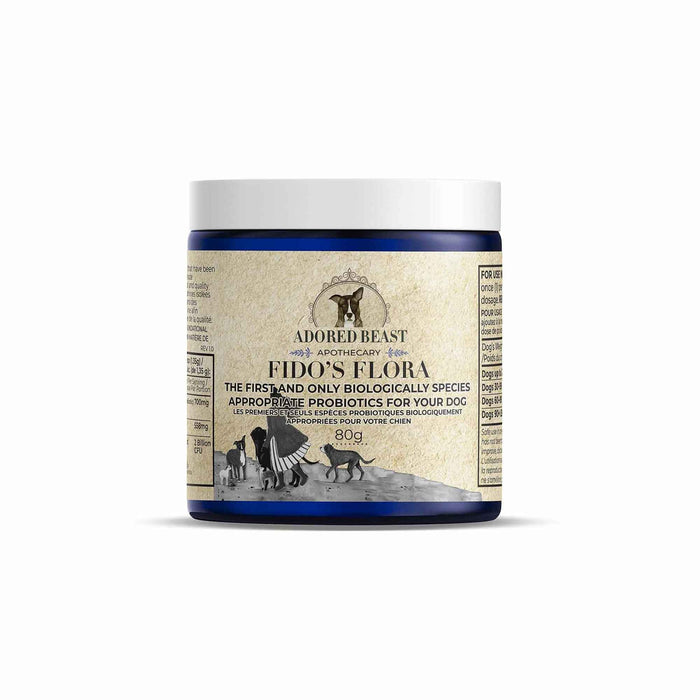
Fido's Flora, Canine Specific Pre & Probiotic
The world's first canine-specific pre and probiotic. A 16-strain blend with two dog-specific strains, fulvic and humic acids, and larch arabinogalactan as the prebiotic fiber. This is the foundation of the whole approach, and it is the one I would start today whatever you decide about medication. If your dog is on a course, give it separated by a few hours from the dose.
Shop Fido's FloraAvailable on Subscribe & Save, which is worth considering given we suggest running it for several months.
| Product | The job it does | What is in it | How long we suggest |
|---|---|---|---|
| Fido's Flora | Microbiome and immune foundation | 16 strains including two canine-specific, fulvic and humic acids, larch prebiotic | At least 4 months |
| Faith's Cleanse & Detox | Liver and kidney clearance pathways | An all-herb whole-food powder with no pesticides, parasiticides, or synthetic chemicals. Not for pregnant or lactating animals. | At least 4 months |
| Canine Gut Soothe | Stool quality and the irritated gut lining | Multi-strain probiotic with larch prebiotic fiber, slippery elm, deglycyrrhizinated licorice, L-glutamine, marshmallow root | Daily until the jar is finished |
| Phyto Synergy | Nutrient status while absorption is compromised | Marine algae whole food, absorbed readily rather than relying on a damaged small intestine | Ongoing |
A word on why Canine Gut Soothe earns its place specifically: it pairs a multi-strain probiotic with larch arabinogalactan, a prebiotic fiber. Fiber plus probiotics is precisely the combination CAPC describes as potentially sufficient in symptomatic dogs with a dog-specific strain. That is not us stretching a guideline to fit a product. It is the same two things.
On Phyto Synergy, the logic is absorption. Giardia interferes with the small intestine's absorptive surface, so a dog can be eating well and still coming up short. Marine algae is nutrient dense and readily absorbed. It is a food, not a medicine, and we have written honestly about what marine algae does and does not do.
If stools stay loose and unformed, Organic Healthy Poops adds further fiber and enzymes for regularity. And whatever else you do, food is doing the heaviest lifting here. Twelve of the fourteen dogs in the Zurich study who developed chronic gut signs improved with a change of diet. A fresh, species-appropriate diet outranks every supplement on this page.
You can combine all of these. They are not drugs competing for the same receptor, they are nutrition working on different pathways at once, which is exactly why we suggest them together rather than one at a time.
Free guide
Why Is My Dog Still Sick? The Truth About Pancreatitis, EPI & SIBO
If the infection is behind you and the digestive trouble is not, this is the next question worth asking. The guide walks through the chronic gut conditions that get missed after a gut insult, what the overlapping signs look like, and what to raise with your vet. Enter your email and we will send it over.
Form not loading? You can also grab it here.
Why the gut is the long game
Here is what most pet parents are never told when they walk out with a prescription: the parasite is the short chapter. The gut is the long one.
Nearly a third of the dogs in that Zurich study were still dealing with gut problems years later. A third were itching. Giardia attaches to the small intestine and damages the brush border, the absorptive surface. That barrier damage, combined with a disrupted microbiome, can lead to a loss of oral tolerance, meaning the immune system starts reacting to ordinary food proteins that used to pass through unnoticed.
Gut barrier breaks down. Immune system gets confused. Skin starts talking.
If you have read our post on dog gut health as the root of whole-body wellness, that pathway will be familiar. The gut and the skin are in constant conversation. A dog that itches after a rough puppyhood is often not showing you two separate problems.
I cannot tell you that Milka ever had a giardia result. What I can tell you is what her first year looked like: chronic gut trouble and angry, itchy skin, at the same time, dismissed as normal Frenchie problems. When I read this study, that pattern was uncomfortably familiar. And I noticed something else. The most common breed in both groups of that study was the French Bulldog.
This is also why, if your dog has been through a course of prescription medication, the work does not stop when the bottle is empty. Once your dog is off prescription medication, the aftercare is where the years ahead get decided.
Aftercare, once any prescription course is finished

Leaky Gut Protocol
If your dog has already been through metronidazole or fenbendazole, this is where I would put my energy. It is a staged five-part kit rather than a single jar: Rebalancer first, then Liver Tonic, Healthy Gut, Gut Soothe, and Gut Seal together until the kit is finished. Built for the barrier and the microbiome, which is exactly what both the parasite and the drug leave disrupted.
- Formulated to address gut trauma at the root rather than chase symptoms
- Two options sized for dogs over and under 20 lbs
- Runs as a full course, which suits the months-not-weeks view the research supports
Beyond that kit, rotating between The Wolf, Soil & Sea, and Healthy Gut keeps the microbial community diverse over the long haul.
Why does my dog keep testing positive for giardia?
Three reasons, and the first one catches almost everybody.
The test may be reading a ghost. Cornell's Riney Canine Health Center advises against retesting for giardia antigen after a course of medication, because antigen can linger in the stool after the infection itself has resolved. A false positive sends you into another round of medication your dog does not need. If your vet wants to recheck, ask about a method that looks for cysts rather than antigen alone.
Your dog may be reinfecting themselves. Cysts are infectious the moment they leave the body. They survive months in cool, damp conditions. Your dog walks through the yard, lies down, grooms a paw, and starts over. This is the most common explanation by far, and it is the one you have the most control over.
Or the course genuinely did not work. As above, refractory cases are real, and CAPC also lists the parasite sequestering in the gallbladder or pancreatic ducts as a cause of failure. Another identical round of the same drug is not automatically the answer, and this is a good moment for a second opinion.
Breaking the reinfection loop is unglamorous and it is the whole game:
- Bathe your dog at the end of any medication course, or weekly if you are not medicating, paying attention to the rear, to remove cysts sitting in the coat.
- Pick up stools immediately, every time, indoors and out.
- Steam-clean or disinfect hard floors, crates, and bowls. Household disinfectants and steam are the effective options.
- Wash bedding and soft toys hot, repeatedly.
- Let sunlight work on the yard. Outdoor cysts are killed mainly by direct sun drying them out, so standing water and permanently shaded damp corners are the problem areas.
- Keep water bowls fresh and discourage drinking from puddles, ponds, and streams.
If you have several dogs, expect to manage the household rather than the individual. And know that dogs do not develop immunity after an infection, so the environmental work matters permanently, not just this month.
Can I catch giardia from my dog?
Almost certainly not, and I want to take this worry off your plate.
The CDC states that you are unlikely to get a giardia infection from your dog or cat, because the types that make people ill are usually not the same types that infect dogs and cats. That lines up with the assemblage picture: dogs mainly carry C and D, humans are susceptible to A and B.
Sensible hygiene still applies. Wash your hands after handling stools, wear gloves for yard work, and be more careful if anyone in your home is pregnant, elderly, very young, or immune-compromised. But you do not need to panic about your family.
What to ask your vet before you start anything
You are not being difficult by asking these. You are being a good advocate, and any vet worth working with will welcome them. A holistic or integrative vet will usually go through them with you unprompted.
- Is my dog actually showing clinical signs, or is this an incidental positive on a healthy dog?
- Can we find out which assemblage this is? If it is a dog-specific strain and nobody in the house is vulnerable, the calculation changes.
- CAPC says a high-fiber diet with probiotics may be sufficient in symptomatic dogs with a non-zoonotic strain. Does my dog fit that description?
- If we do medicate, why this drug rather than the other? Given my dog's age, is fenbendazole the more suitable choice here?
- What dose in mg/kg, and for how long? Worth knowing where it sits relative to the cautions above.
- What are we doing for the microbiome during and after? If the answer is nothing, that is the gap this article exists to fill.
- How will we recheck, and with which test method? Antigen or cyst-based.
If you would like help thinking through the support side specifically, our team is happy to talk it through with you.
The honest bottom line
A positive giardia result is not a failure on your part. It is one of the most common parasites dogs encounter, and it is often picked up from a puddle, a boarding kennel, a shelter, or a patch of grass another dog used first.
Most dogs carrying it are not sick. The guidelines your vet works from already allow for a nutritional route in defined situations. The drug most commonly reached for carries a documented neurotoxicity signal at doses not far from standard, has been named by researchers as a poor first choice in young dogs, and does not always work anyway.
So slow down. Ask the questions. Find a vet who will look at your whole dog rather than only the test result. And whichever route you take, support the gut properly, because that is the part that decides how the next few years go.
Rebuild the gut. Watch the skin. Manage the environment.
You have far more power here than anyone told you at that appointment.
This content is for educational purposes and is not a replacement for veterinary advice. I am not a veterinarian. Every dog is different, so please work alongside your vet, ideally a holistic or integrative vet, on any confirmed infection, and never stop or change a prescribed medication without speaking with them first. If your dog is a young puppy, a senior, or immune-compromised, or is losing weight or becoming dehydrated, seek veterinary care straight away.
Sources
- Giardia Guidelines. Companion Animal Parasite Council, updated 2026. capcvet.org
- Long-Term Follow-Up After Acute Gastroenteritis Caused by Giardia Infection in Juvenile Dogs. Walz KC, Suchodolski JS, Werner M, Grimm F, Schnyder M, Zablotski Y, Unterer S. Journal of Veterinary Internal Medicine, 2025;39(4):e70123. doi.org/10.1111/jvim.70123
- Metronidazole-induced neurotoxicity in 26 dogs. Tauro A, Beltran E, Cherubini GB, Coelho AT, Wessmann A, Driver CJ, Rusbridge CJ. Australian Veterinary Journal, 2018;96(12):495-501. doi.org/10.1111/avj.12772
- Metronidazole. Clinician's Brief. cliniciansbrief.com
- Nitroimidazoles Use in Animals. Merck Veterinary Manual, Pharmacology. merckvetmanual.com
- FDA Approves First Treatment for Giardia duodenalis in Any Animal Species. U.S. Food and Drug Administration, Center for Veterinary Medicine, 2023. fda.gov
- Risk factors for recurrence of Giardia duodenalis infection in dogs: a case-control study. Mourou et al. Journal of Small Animal Practice, 2026. doi.org/10.1111/jsap.70017
- Update on Giardiasis: Diagnostics, Treatment, and Management. Today's Veterinary Practice, 2023. todaysveterinarypractice.com
- Survey of U.S. based veterinarians' knowledge, perceptions and practices about canine giardiasis. Veterinary Parasitology: Regional Studies and Reports, 2022. sciencedirect.com
- Influence of Enterococcus faecium SF68 Probiotic on Giardiasis in Dogs. Simpson KW, Rishniw M, Bellosa M, Liotta J, Lucio A, Baumgart M, Czarnecki-Maulden G, Benyacoub J, Bowman D. Journal of Veterinary Internal Medicine, 2009;23(3):476-481. doi.org/10.1111/j.1939-1676.2009.0283.x
- Giardia: Infection, treatment and prevention. Cornell University College of Veterinary Medicine, Richard P. Riney Canine Health Center. vet.cornell.edu
- About Giardia and Pets. Centers for Disease Control and Prevention, updated 2026. cdc.gov
- Giardia in Dogs. VCA Animal Hospitals. vcahospitals.com
- Fenbendazole in Dogs: Applications, Dosing, Uses, Safety. Clinician's Brief, 2025. cliniciansbrief.com