Phytoplankton for dogs is a microscopic marine algae, fed in tiny daily amounts as a broad-spectrum, whole-food source of trace minerals, amino acids, chlorophyll, and antioxidant pigments. Its real strength is nutrient density in a form the body absorbs easily, which matters most for dogs whose digestion does not work well. Here is the part most pages skip: phytoplankton is not a meaningful source of omega-3 for dogs, and it is not a medicine for any health condition. The clearest way to hold it: phytoplankton is a nutrient-rich food, not a fix.
Let's be real for a second. If you have gone looking into phytoplankton, you have probably read that it is the "king of all supplements," that it has more omega-3 than fish oil, and that it fights cancer. You want to do right by your dog. You read the labels. You try to sort the real from the hype.
Here is what most pet parents are never told clearly: a lot of what gets said about phytoplankton is marketing, not evidence. That does not make it useless. It makes it misunderstood. So let's walk through what it actually does, what it does not do, and how to feed it in a way that makes sense.
In this guide
- What does phytoplankton actually do for dogs?
- Is phytoplankton a good source of omega-3 for dogs?
- Can phytoplankton help dogs with cancer?
- How much phytoplankton should I give my dog, and is it safe?
- Why is phytoplankton so expensive?
- What is Adored Beast Phyto Synergy?
- The bottom line on phytoplankton for dogs
What does phytoplankton actually do for dogs?
The real phytoplankton benefits for dogs come down to nutrient density, not one headline nutrient. Phytoplankton is one of the most nutrient-dense foods on earth, and that is not hype. Research on marine microalgae shows it carries protein and essential amino acids, a wide spread of trace minerals and vitamins, and antioxidant pigments like carotenoids and chlorophyll. Microalgae also run their own internal antioxidant system built around superoxide dismutase, one of the body's key defenses against oxidative stress.
What that can look like in a real dog:
- Skin and coat support, from the antioxidant pigments and micronutrients
- A source of amino acids, the building blocks behind so many everyday body processes
- Antioxidant support against the oxidative stress of daily life and aging
- An absorbable way to fill small nutritional gaps, even in dogs whose guts struggle to break food down
That last point matters. A rat feeding study found that the nutrients in whole microalgae biomass were absorbed and carried into blood and tissues, which supports the idea that phytoplankton's nutrition is genuinely bioavailable. Adored Beast describes phytoplankton as being absorbed almost immediately because the cells are so small. That specific mechanism is more the maker's description than settled science, but the broader truth holds: this is an easy-to-absorb whole food, which is exactly why dogs need so little of it.
I add a pinch to Milka's food most mornings. Not because it is a magic fix for anything. Because it is one of the easiest ways I know to add real, whole-food nutrition to her bowl.
Is phytoplankton a good source of omega-3 for dogs?
No. And this is where I part ways with almost every other article you will read.
Phytoplankton does contain the omega-3 fatty acids EPA and DHA. But you feed it by the pinch, around 1/16 of a teaspoon. At that serving size, the actual amount of omega-3 your dog receives is very small. If your goal is a meaningful omega-3 dose, phytoplankton is the wrong tool.
Omega-3s do matter for dogs. Controlled veterinary studies have found that dogs with arthritis given marine omega-3s tend to move more comfortably, and EPA and DHA have been associated with skin, heart, and cognitive support. To reach those levels, you want a product actually dosed for omega-3, like an algae or fish oil. An algae-based omega-3 such as Potent-Sea is built for that job, and it is a far cleaner fit for it than any phytoplankton powder.
So please do not frame this as phytoplankton vs fish oil, as if they compete for the same spot. They do different jobs:
| Marine phytoplankton | Omega-3 oil (fish or algal) | |
|---|---|---|
| Best used for | Broad-spectrum trace minerals, amino acids, antioxidants | Delivering a real EPA and DHA dose |
| Typical serving | About 1/16 tsp, a pinch | Dosed by body weight, often hundreds of mg |
| Omega-3 delivered | Minimal at that serving | Substantial, this is its whole purpose |
| Think of it as | A daily whole-food topper | A targeted supplement |
One is a broad-spectrum micronutrient food. The other delivers a targeted dose of omega-3. Many dogs do well with both, for different reasons.
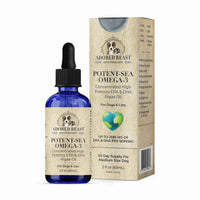 |
Actually looking for omega-3? Phytoplankton is not a high-dose omega-3 source. If that is your goal, a dosed algae oil is the right tool. Potent-Sea delivers concentrated EPA and DHA, free from the heavy metals and rancidity concerns of fish oil. Shop Potent-Sea |
Can phytoplankton help dogs with cancer?
This is a real area of interest, and it deserves an honest answer instead of a sales pitch in either direction.
Here is the promising part. Marine microalgae are rich in specific bioactive compounds, especially carotenoid pigments like fucoxanthin. In laboratory and animal research, these compounds have shown real activity against cancer cells: slowing their growth, triggering cell death, and in some models helping conventional cancer drugs work better. Fucoxanthin in particular has become an active area of study for exactly this reason. This is genuine, published science, and it is part of why phytoplankton has earned a reputation as far more than a green powder.
Here is the honest boundary. That research uses concentrated, isolated compounds, studied in cells and in rodents. It has not yet been studied in dogs, and it has barely reached human clinical trials. So the early signals are genuinely encouraging, and at the same time we cannot yet say what feeding whole phytoplankton does for a dog living with cancer. Promising is not the same as proven, and any brand that blurs that line is not being straight with you.
Where does that leave you? If your dog is facing cancer, phytoplankton may have a real place as part of a nutrient-dense, whole-food diet that supports the whole body through a hard season. A growing number of holistic and integrative vets include foods like this as part of supportive care, alongside your veterinary team and oncologist, never instead of them. That is the honest, hopeful, and responsible way to hold it.
How much phytoplankton should I give my dog, and is it safe?
There is no official phytoplankton dosage for dogs, so the product's own guidance is your starting point. Most phytoplankton products, including Adored Beast Phyto Synergy, suggest around 1/16 teaspoon once a day, mixed into food, for both dogs and cats. A little goes a long way. A 15g jar can last around 50 servings.
A few honest safety notes:
- Go slow at first. Too much too fast can cause mild digestive upset in some dogs. Start under the full dose and build up over a week.
- Mind the thyroid. Marine algae carry iodine, and excess iodine can disrupt a dog's thyroid regulation. Phytoplankton is far lower in iodine than kelp, but if your dog has thyroid disease or takes thyroid medication, check with your vet first.
- Sourcing is not optional. This is the big one, and it leads straight into the next question.
Why is phytoplankton so expensive?
Short answer: because clean, pure phytoplankton is genuinely hard and costly to produce, and the cheap stuff can carry real risks.
There is a published veterinary case report of a dog that developed serious liver damage after several weeks on a commercial blue-green algae supplement. Testing found the product was contaminated with microcystins, natural toxins that some algae produce. The dog recovered once the supplement was stopped. That is not a scare story. It is a documented reason that where your phytoplankton comes from matters more than almost any claim on the front of the label.
Growing marine microalgae for supplements at scale is a real engineering challenge, and cost is one of the main hurdles researchers point to. Clean water, controlled growing conditions, careful strain selection, and toxin testing all add up.
When you pay more for a quality phytoplankton, you are paying for:
- Controlled, contaminant-free growing conditions
- Water filtered of heavy metals
- Specific, tested strains rather than whatever happens to grow
- Screening for the exact toxins that harmed the dog in that case report
That is the difference between a price tag and actual value.
What is Adored Beast Phyto Synergy?
Adored Beast Phyto Synergy is 100% pure marine phytoplankton, formulated by homeopath Julie Anne Lee, DCH. What sets it apart is how it is made. Adored Beast grows it on land, using ocean water filtered of heavy metals, with strains chosen alongside scientists rather than pulled from open water. Growing it on land also means it takes no food source from the ocean, which fits a more sustainable, whole-body approach to wellness.
I keep Phyto Synergy in the rotation for Milka the same way I would think about it for any dog: as foundational, whole-food nutrition that supports the body, not as a hero ingredient that does the work on its own. That is the honest frame, and it is the one PAWDEGA will always give you.
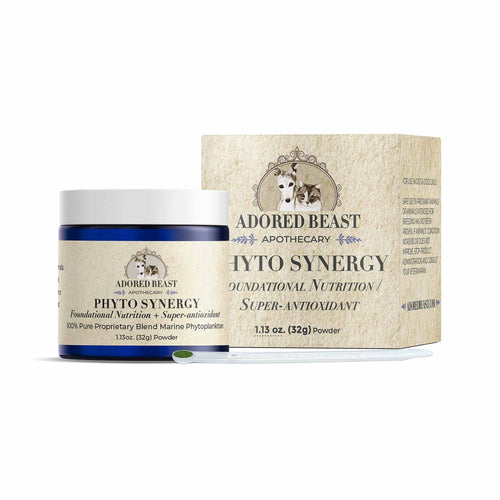 |
The one I feed Milka Adored Beast Phyto Synergy 100% pure marine phytoplankton, grown on land and filtered of heavy metals. A whole-food source of trace minerals, amino acids, and antioxidants to support everyday wellness, formulated by Julie Anne Lee, DCH. A pinch a day, and one jar lasts a long time. Shop Phyto Synergy |
The bottom line on phytoplankton for dogs
Phytoplankton is a legitimately impressive whole food. It is nutrient-dense, easy to absorb, and a lovely daily addition to a fresh diet. It is not a high-dose omega-3 source, and it is not a medicine. Feed it for what it truly is, choose a clean one, and you have added something real to your dog's bowl.
You are not powerless, and you do not need every miracle claim on the internet to be true in order to do right by your dog. You need good information and a clear head. That is what we are here for.
Much love, Larry
Sources
- "Microalgae as a novel, non-animal source of long-chain omega-3 fatty acids and vitamin D," MASSPROVIT project, Open Access Government, 2025. Link
- "Omega-3 fatty acids of microalgae as a food supplement: a review," Algal Research (ScienceDirect), 2021. Link
- "Evaluation of Marine Microalga Diacronema vlkianum Biomass Fatty Acid Assimilation in Wistar Rats," Marine Drugs / PMC, 2018. Link
- "Fish Oil for Dogs: Benefits, Dosage, and Vet Pick" (referencing canine osteoarthritis omega-3 trials, incl. Roush et al., JAVMA 2010), PetMD, 2025. Link
- "Fucoxanthin, a Marine-Derived Carotenoid... A Promising Bioactive Compound for Cancer Therapy," Marine Drugs / PMC, 2020. Link
- "Carotenoids from Marine Microalgae as Antimelanoma Agents," Marine Drugs, 2022. Link
- "Seaweed in Pet Food: Natural Iodine, Minerals, and Thyroid Caution" (citing NRC 2006, AAFCO), VetKriter, 2026. Link
- "Hepatopathy following consumption of a commercially available blue-green algae dietary supplement in a dog," BMC Veterinary Research / PMC, 2015. Link
- "A perspective of microalga-derived omega-3 fatty acids: scale up and engineering challenges," Critical Reviews in Food Science and Nutrition, 2025. Link
- Phyto Synergy product information (manufacturer description), Adored Beast Apothecary. Link
Disclaimer: This blog may contain affiliate links, and PAWDEGA may earn a small commission at no extra cost to you if you purchase through them. It may also link to products on our website, and this content is for educational purposes, not a replacement for veterinary advice.