IBD in dogs, short for inflammatory bowel disease, is ongoing inflammation of the digestive tract that causes vomiting, diarrhea, weight loss, or appetite changes lasting longer than three weeks, and it is identified by ruling other causes out rather than by a single test. Here is the part that changes everything: as of 2026, veterinary specialists recommend a properly run food trial as the first step, before biopsies and before steroids, because most affected dogs turn out to be food-responsive.
If your dog has been told they have IBD, food is not the last resort. Current veterinary consensus says food is the first thing to change.
On this page
- What is IBD in dogs?
- Why are vets moving away from the term "IBD"?
- Why is food the first thing to change?
- How do you run a food trial properly?
- What should you feed a dog with IBD?
- Where do supplements actually fit?
- What should you ask your vet to check?
- How long can a dog live with IBD?
- Hydrolyzed diet or clean novel protein, side by side
- What I would do first
- Sources
I want to be honest with you about why that sentence matters so much to me.
When Milka was a puppy, we did everything we were told. Countless vet visits. "Premium" kibble. Expensive meds. But nothing worked. We still woke up at night to the sound of her throwing up. Nobody suggested that her food might be the problem. When we finally changed it, against advice, her gut settled within days. She is a healthy senior now.
Milka was never told she had IBD. Her gut was milder than that. But I have spoken with hundreds of pet parents whose dogs were, and the story rhymes every single time: nobody put food first.
The veterinary field has now caught up.
What is IBD in dogs?
IBD describes chronic inflammation of the gastrointestinal lining that keeps causing symptoms for three weeks or longer, once parasites, infections, organ disease, and cancer have been ruled out. It is not one disease with one cause. It is a pattern of persistent gut inflammation with several possible drivers, including genetics, the gut microbiome, the immune system, and diet.
The inflammation can sit anywhere along the tract, in the stomach, the small intestine, the large intestine, or several places at once, which is why two dogs with the same label can look completely different.
Why are vets moving away from the term "IBD"?
In January 2026, a specialist panel endorsed by the American College of Veterinary Internal Medicine published new consensus guidelines in the Journal of Veterinary Internal Medicine and recommended that the profession stop calling this IBD, and call it chronic inflammatory enteropathy, or CIE, instead.
Their reasoning is worth understanding, because it directly affects what happens to your dog.
The Merck Veterinary Manual puts the problem plainly: most dogs with chronic gut signs will never need immunosuppressant drugs, so a name that implies they will is misleading. "IBD" borrows its meaning from human medicine, where the condition is usually managed with medication first. In dogs, that assumption sends people down the steroid path far too early.
Under the newer framework, the umbrella term is CIE, and dogs are sorted by what they actually respond to.
| Group | What defines it | How common | What it means for you |
|---|---|---|---|
| Food-responsive | Signs settle on a diet change alone, with no drugs needed | 38 to 89 percent in the 2026 consensus, 50 to 65 percent in the AVA summary | Many hold remission of at least three months on diet alone. These dogs tend to be younger and less severely affected. |
| Immunosuppressant or steroid-requiring | Signs settle only once immune-suppressing medication is added | A minority of dogs with chronic gut signs | A biopsy will not tell you in advance. Research has found these dogs can look identical to food-responsive dogs under the microscope. |
| Non-responsive | No meaningful short-term response to any of the standard approaches | 15 to 40 percent | This is the group that needs specialist input, and the group most likely to have low albumin or protein-losing enteropathy behind it. |
Two things stand out here. First, you cannot tell which group your dog is in before trying. Not from symptoms, not from bloodwork, and, notably, not from a biopsy either, since research has found that food-responsive and steroid-requiring dogs can look identical under the microscope. Second, dogs in the food-responsive group tend to be younger and less severely affected.
Why is food the first thing to change for dogs with IBD?
Because the numbers are strong, and because the food trial does two jobs at once.
The 2026 consensus reports that between 38 and 89 percent of dogs with CIE are food-responsive, and that many hold long-term remission of at least three months on dietary management alone. The panel's recommendation is direct: food trials are the preferred first step in dogs suspected of having CIE, before invasive procedures, as long as the dog is clinically stable and still eating.
A separate clinical summary from the Australian Veterinary Association, drawing on the work of veterinary gastroenterology researchers Jergens and Heilmann, puts the figure at 50 to 65 percent of dogs responding to a food change that can be maintained long term.
Here is the elegant part. Because subtype is defined by response, the food trial is not only management. It is information. A dog who settles on a well-run food trial has answered the question, and has done it without anesthesia, without biopsies, and without steroids.
The same consensus also advises against reaching for antibiotics as a general first move. The authors note that dogs commonly relapse soon after the course ends, and that antibiotics can leave behind long-lasting disruption to the gut microbiome. That is a meaningful shift, and if your dog has been through repeat rounds of metronidazole with the same relapse pattern each time, our guide to SIBO in dogs walks through why that cycle repeats.
How do you run a food trial properly?
Most food trials fail for one reason: leakage. One dental chew, one grandparent handing over toast, and the data is gone. Here is the structure that actually produces an answer.
- Pick one protein your dog has never eaten. Novel means novel. If they have had chicken in any food, chew, or medication, chicken is out. Rarer proteins like goat, rabbit, venison, or bison are where I would look first.
- Feed it as the only thing that enters their mouth. No other proteins, no flavored chews, no table scraps, no flavored supplements. Check the flavoring on any medication.
- Hold for a minimum of two weeks before you judge anything. Some improvement should show in this window.
- Continue to six weeks for the full picture. Maximum response often takes four to six weeks, and some dogs need longer than that. Early improvement that then plateaus is not failure.
- Score it, do not guess it. Track stool consistency, vomiting frequency, appetite, weight, and energy weekly. Vets use scoring systems called the CIBDAI and CCECAI for exactly this reason. Your notes make your next vet appointment far more useful.
- If there is no response, run a second trial with a different protein. One failed trial rules out one protein, not food itself. A second novel protein, plus a look at fat level, is the next move before escalating to anything invasive.
What about the hydrolyzed prescription diets for dogs?
Your vet may well offer one, and you deserve to understand what it is before you decide. A hydrolyzed diet takes a protein and breaks it into fragments small enough that the immune system is less likely to recognize it. Most of the published food trials in this condition used hydrolyzed or novel-protein diets, so the research base genuinely includes them, and I am not going to pretend otherwise.
Here is where we differ from the standard advice. Those diets deliver a sound immune logic through a heavily processed, largely starch-based carrier, and that is not what we build around at PAWDEGA. The mechanism that matters in a food trial is protein novelty and strict control, not processing. One rare protein your dog has never eaten, fed complete and fed clean, gives you the same information.
If your vet has already started a hydrolyzed diet and your dog is genuinely better on it, that is a real result and I would not undo it without talking to them first. Nothing about IBD in dogs is worth destabilizing a dog who has finally settled. But if you are at the starting line and choosing, a clean novel protein is where I would begin.
What should you feed a dog with IBD?
The evidence points at three properties rather than a specific brand: one protein source, high digestibility, and complete nutrition. Fat level, fiber, and digestibility are all recognized as characteristics that matter, and many dogs do better with fat kept moderate.
Now the part I am not going to skate over, because you deserve the real answer.
We are advocates of raw food diets. And the 2026 consensus specifically names raw meat-based diets as a risk factor for Campylobacter and as a source of zoonotic risk, and recommends fecal culture for dogs eating them. That is in the guidelines. Pretending otherwise would make me exactly the kind of brand I built PAWDEGA to be an alternative to.
So here is my honest position. For a dog with active, unstable gut inflammation, the priority is a single clean protein, complete nutrition, and strict control over what goes in, and that is achievable raw, freeze-dried, or gently cooked. What matters most is not raw versus cooked. It is whether the diet is one protein, complete, appropriately digestible, and fed with zero cheating. If you go the raw route with a dog in this situation, do it with your vet informed, with sensible handling hygiene, and with a low-fat, single-protein recipe rather than a rotation.
Our freeze-dried raw recipes are built as complete, limited-ingredient, mostly single-protein formulas, including rarer options like goat, rabbit, and bison that many dogs have never eaten before. That last point is the useful one for a food trial.
Where I would start a food trial
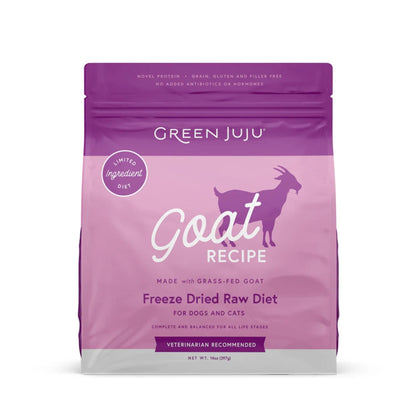
Goat Recipe, Freeze-Dried Raw
Goat is one of the rarest proteins in the pet food aisle, which is exactly what makes it useful here. This one is a single-protein, complete and balanced, limited-ingredient diet: goat heart, goat with bone, goat liver, goat kidney, organic parsley, organic kelp, and vitamin E. Ninety-two percent goat, eight percent plants. No synthetic vitamins and minerals, no grains, no fillers, and no added flavorings to leak into your trial data.
Because it is complete, it can be fed as the whole diet for the full six weeks rather than as a topper, which is the part most trials get wrong. Green Juju lists elimination diets as one of the situations these recipes are built for. Rehydrated, it sits at roughly 9.5 percent fat, so if your vet has flagged fat level for your dog, that is the number to take to them.
If your dog has already eaten goat, the same range includes Rabbit and Bison.
See the Goat RecipeWhere do supplements actually fit?
Supporting, not leading. And with honest evidence labels attached.
Probiotics have the strongest research behind them. In a 2014 study published in PLOS One, twenty dogs with long-standing IBD were randomized to either a multi-strain probiotic or a combination of prednisone and metronidazole. Clinical scores and gut inflammation improved in both groups, and the probiotic group additionally showed increased regulatory immune cell markers and a shift in gut bacteria toward Faecalibacterium, a beneficial group. A 2017 randomized controlled trial in Gut Microbes followed thirty-four dogs on standard therapy with or without a probiotic for eight weeks, and found better gut barrier protein expression in the dogs receiving the probiotic. Worth being precise here: both trials used specific human-derived multi-strain formulations, not products in general. A probiotic is not a probiotic. Species and strain matter.
For daily support, Fido's Flora is a canine species-specific pre and probiotic, and Gut Soothe combines pre and probiotics with soothing herbs for dogs whose guts are visibly reactive.
Antioxidant status is measurably lower in affected dogs. A 2017 study in The Veterinary Journal compared eighteen dogs with IBD against twenty healthy dogs and found antioxidant markers significantly lower and oxidant markers significantly higher in the IBD group. That is an association, and it is a good reason to support the antioxidant side of the equation with something like Phyto Synergy. It is not evidence that supplementing antioxidants changes the course of the disease, because that trial has not been run in dogs.
Gut lining support sits in a similar honest bracket. Increased intestinal permeability is a real, measurable thing in dogs, but the popular framing around it gets overstated constantly. I unpacked what is genuinely established and what is marketing in our honest guide to leaky gut in dogs, and for dogs where gut lining support is the goal, the Leaky Gut Protocol formulated by Julie Anne Lee, DCH is the structured option we point people to.

What should you ask your vet to check?
These are worth raising specifically, because they change the plan and are easy to skip.
- Cobalamin (vitamin B12). Low B12 is common in affected dogs and is a recognized negative prognostic marker. Dogs whose low B12 is not corrected often do not respond well to management of the underlying gut problem. Both oral and injectable supplementation correct it.
- Albumin. Low albumin points toward protein-losing enteropathy, which needs a different and more urgent approach.
- Folate and vitamin D. Both appear on the list of markers linked to worse outcomes.
- Body and muscle condition scoring. The consensus flags malnutrition risk explicitly, especially in protein-losing cases.
- Fecal testing for parasites. Deworming and parasite exclusion belong before any conclusion about chronic inflammation.
How long can a dog live with IBD?
For most dogs, this is a manageable long-term condition rather than a shortened life, and many stay in remission on food management alone.
The honest caveats: 15 to 40 percent of dogs do not respond in the short term to any of the standard approaches, and protein-losing enteropathy carries a much poorer outlook, with a reported median survival under six months in most breeds, though Yorkshire Terriers have done considerably better in the data. Relapses happen, and they are most often set off by dietary indiscretion, which is to say the trash can and the barbecue.
There is also a real-world variable that explains a lot of the confusion online. A 2022 study of 814 dogs at two Swedish animal hospitals found only 11.4 percent were food-responsive, compared with the 38 to 89 percent range in the consensus. Those hospitals see referred cases, the dogs whose food trials already failed. If your vet sounds more pessimistic than the internet does, that is often why. It says something about which dogs they see, not about your dog.
And if you are reading that non-responder number and recognising your own dog in it, the questions usually shift. Pancreatitis, EPI, and SIBO all sit behind chronic gut signs that never quite resolve, and they are the differentials most often reached for late. I put everything I know about that trio into a free guide, because it is the conversation I have most often with pet parents who have already been through two food trials.
Hydrolyzed diet or clean novel protein, side by side
If your vet has offered a hydrolyzed prescription diet and you are weighing it against a clean single novel protein, this is the comparison as I understand it. Both sit inside the research base. They differ in the carrier, not in the mechanism that gives you your answer.
| Hydrolyzed prescription diet | Clean single novel protein | |
|---|---|---|
| How it works | Protein is broken into fragments small enough that the immune system is less likely to recognize it | One whole protein the dog's immune system has never met before |
| In the research | Yes. Most published food trials in this condition used hydrolyzed or novel-protein diets | Yes. Novel-protein diets sit inside that same body of trials |
| The carrier | Heavily processed and largely starch-based, which is not what we build around at PAWDEGA | Minimally processed, limited ingredient, organ-rich, complete and balanced |
| What actually gives you the answer | Protein novelty and strict control, not the processing | Protein novelty and strict control, not the processing |
| Where I land | If your dog is already on one and genuinely better, I would not undo it without talking to your vet first | If you are at the starting line and choosing, this is where I would begin |
| Who decides | You do, with your vet, ideally a holistic or integrative vet. Both routes need six weeks and zero cheating to mean anything. | |
What I would do first
If you have been handed this label and you feel overwhelmed, start here.
Run one clean food trial, properly, for six weeks, with one novel protein and absolutely nothing else. Ask for B12 and albumin to be checked. Write down stool, vomiting, appetite, and weight every week. Add probiotic support alongside the food rather than instead of it.
You are not powerless here. The single most powerful lever in this condition is the one that sits in your kitchen, and current veterinary consensus now agrees with you on that.
I am rooting for you and your dog, every step of the way.
Much love, Larry
Please keep in mind that I am not a veterinarian, and this is not medical advice. Every pet is unique, so I always recommend working alongside your vet, ideally a holistic or integrative vet, especially for anything ongoing or serious.
Sources
- Heilmann RM, Jergens AE, Kathrani A, et al. "ACVIM-endorsed statement: consensus statement and systematic review on guidelines for the diagnosis and treatment of chronic inflammatory enteropathy in dogs." Journal of Veterinary Internal Medicine, 2026. https://doi.org/10.1093/jvimsj/aalaf017
- Won C. "Updated guidance on canine chronic inflammatory enteropathy discourages antibiotic use, encourages dietary trials." AVMA News, 2026. https://www.avma.org/news/updated-guidance-canine-chronic-inflammatory-enteropathy-discourages-antibiotic-use-encourages
- "ACVIM panel recommends replacing 'IBD' with 'chronic inflammatory enteropathy' in dogs." AAHA Trends, 2026. https://www.aaha.org/trends-magazine/publications/acvim-panel-recommends-replacing-ibd-with-chronic-inflammatory-enteropathy-in-dogs/
- "Chronic Enteropathies in Small Animals." Merck Veterinary Manual, 2025. https://www.merckvetmanual.com/digestive-system/diseases-of-the-small-intestine-in-small-animals/chronic-enteropathies-in-small-animals
- "Treating the Canine Chronic Enteropathy Patient." Australian Veterinary Association member resource, undated. https://www.ava.com.au/member-updates/treating-the-canine-chronic-enteropathy-patient/
- Rossi G, Pengo G, Caldin M, et al. "Comparison of microbiological, histological, and immunomodulatory parameters in response to treatment with either combination therapy with prednisone and metronidazole or probiotic VSL#3 strains in dogs with idiopathic inflammatory bowel disease." PLOS One, 2014. https://journals.plos.org/plosone/article?id=10.1371/journal.pone.0094699
- White R, Atherly T, Guard B, et al. "Randomized, controlled trial evaluating the effect of multi-strain probiotic on the mucosal microbiota in canine idiopathic inflammatory bowel disease." Gut Microbes, 2017. https://www.tandfonline.com/doi/full/10.1080/19490976.2017.1334754
- Rubio CP, Martinez-Subiela S, Hernandez-Ruiz J, et al. "Serum biomarkers of oxidative stress in dogs with idiopathic inflammatory bowel disease." The Veterinary Journal, 2017. https://pubmed.ncbi.nlm.nih.gov/28283081/
- Holmberg J, Pelander L, Ljungvall I, et al. "Chronic Enteropathy in Dogs: Epidemiologic Aspects and Clinical Characteristics of Dogs Presenting at Two Swedish Animal Hospitals." Animals, 2022. https://doi.org/10.3390/ani12121507
- "Prevalence of food-responsive enteropathy among dogs with chronic enteropathy in Japan." Journal of Veterinary Medical Science, 2016. https://pmc.ncbi.nlm.nih.gov/articles/PMC5053946/
- "Decoding chronic enteropathy in canine patients." dvm360, 2026. https://www.dvm360.com/view/decoding-chronic-enteropathy-in-canine-patients
- "How to manage chronic inflammatory enteropathies for young canines, in general practice." dvm360, 2026. https://www.dvm360.com/view/how-to-manage-chronic-inflammatory-enteropathies-for-young-canines-in-general-practice