Lion's mane for dogs is a functional mushroom used to support brain, nerve, and cognitive health, especially in senior dogs. Its active compounds, hericenones and erinacines, have been shown in laboratory and human research to support nerve growth factor, a protein that helps maintain and repair neurons. But here is the part most pet parents are never told: those compounds are locked inside the mushroom's tough cell walls, so how lion's mane is prepared decides whether your dog absorbs anything at all. A properly extracted lion's mane tincture delivers the active compounds. A raw mushroom or a plain, non-extracted powder mostly does not.
So before you buy the first jar of mushroom powder you see, let's talk about what lion's mane can and cannot do for your dog, what the research actually shows, and how to feed it so it earns its place in your dog's routine.
I've been thinking about this a lot lately. Milka, my French Bulldog, is a healthy senior now. Her snout is going white. She still bosses us around on our daily walks, but I notice the small things a little more these days. And if you've been feeling a little anxious about your dog getting older, or wondering whether you're doing enough for their brain as they age, you're not alone. I feel it too.
On this page
- What does lion's mane do for dogs?
- Can lion's mane help senior dogs with cognitive decline?
- Is lion's mane safe for dogs?
- How do you feed lion's mane to a dog for real medicinal value?
- How long until you see results with lion's mane?
- The bottom line on lion's mane for dogs
- Lion's mane tincture or the Clarity blend, which should you choose?
- Sources
What does lion's mane do for dogs?
Lion's mane, known scientifically as Hericium erinaceus, is one of the most talked-about medicinal mushrooms in holistic pet care, and for good reason. It works differently from most functional mushrooms. Where mushrooms like reishi and turkey tail are known mainly for immune support, lion's mane is known for the nervous system.
Here's what the research tells us. Lion's mane produces two families of compounds, hericenones in the fruiting body and erinacines in the mycelium. A review published in the journal Mycology documented that these compounds can support the production of nerve growth factor, or NGF. NGF is essential for the survival, maintenance, and repair of neurons. This matters because NGF naturally declines with age, in dogs as in people.
The lion's mane benefits for dogs that come up most often are:
- Cognitive and nerve support. The NGF connection is why lion's mane is associated with focus, mental sharpness, and healthy aging of the brain and nervous system.
- Immune support. Lion's mane is rich in beta-glucans, the same water-soluble compounds that make other medicinal mushrooms valuable for immune balance.
- Mood and calm. Some early human research has associated lion's mane with reduced feelings of anxiety, though this has not been studied directly in dogs.
Let's be real for a second about the evidence. A lot of the strongest data comes from human and rodent studies, not dogs. A 2025 systematic review in Frontiers in Pharmacology looked at erinacines specifically and confirmed the neuroprotective activity, while making clear that the work so far is preclinical, meaning cell and animal models. The mechanisms are consistent across mammals, which is encouraging, but honesty matters here. This is a mushroom with a compelling story and a growing research base, not a finished one.
Can lion's mane help senior dogs with cognitive decline?
This is the question I hear most, and it's the reason lion's mane for senior dogs has become so popular.
Cognitive decline in dogs has a name: canine cognitive dysfunction, sometimes called CCD or "doggie dementia." It is more common than most pet parents realize. A 2025 study in the journal Animals reported that CCD likely affects somewhere between 14 and 35 percent of dogs over the age of eight. The signs are the ones that quietly break your heart: disorientation, getting stuck in corners, changes in the sleep-wake cycle, more anxiety, house-soiling accidents, and wandering at night.
There is real reason to be interested in lion's mane here. In a well-known 2009 human trial published in Phytotherapy Research, older adults with mild cognitive impairment who took lion's mane scored better on cognitive measures than those given a placebo. One detail from that study is worth holding onto: when participants stopped taking it, their scores dropped again. That tells us consistency matters.
What about dogs specifically? In late 2025, MycoDog reported results from a 12-week study of its Clarity blend in 30 senior dogs showing signs of cognitive decline. The study was run by Veterinary Health Research Centers, used the DISHAA cognitive assessment framework, and tracked inflammation and neuroprotection biomarkers in clinic. It reported that 81 percent of the dogs improved or stabilized their cognitive scores, with an average reduction of 39 percent in cognitive dysfunction scores.
That is genuinely exciting, and I want to be straight with you about what it is and what it isn't. It is a company-run study, not yet peer-reviewed or published in a journal. And it tested a full mushroom and adaptogen blend, not lion's mane on its own, so we cannot say lion's mane alone produced that result. What we can say is that lion's mane is a central ingredient in that kind of cognitive-support blend, and the early signal is worth paying attention to. That is the honest version. You deserve the honest version.
Is lion's mane safe for dogs?
For most dogs, yes. Lion's mane is generally well tolerated. Veterinary sources note that the most common issue is mild digestive upset, usually when a dog starts too fast or at too high a dose. Serious reactions are rare.
Two safety points I never skip:
- Never feed your dog wild-foraged mushrooms. When quality brands say "wild harvested," they mean a mushroom responsibly harvested in nature and then properly processed and extracted in production. It does not mean you should pick mushrooms on a walk and feed them. Many wild mushrooms are toxic, and getting it wrong is dangerous.
- Skip human products with added ingredients. Human supplements can contain sweeteners, flavorings, or fillers that don't belong in your dog's body. Choose a product formulated for dogs.
As always, loop in your veterinarian, especially if your dog is a senior, is on medication, or has an existing health condition. Lion's mane supports the body. It works best alongside good veterinary care, never instead of it.
How do you feed lion's mane to a dog for real medicinal value?
This is where most pet parents accidentally waste their money, so stay with me. It comes down to one word: extraction.
Why extraction matters
Mushroom cell walls are made of chitin, a fiber your dog cannot digest. The active compounds, including beta-glucans, are trapped inside those walls. If the chitin never breaks down, the good stuff passes right through your dog. A 2026 review on mushroom beta-glucans explains that hot-water extraction is what breaks down the cell wall to release the water-soluble beta-glucans, while an alcohol step is needed to pull out the compounds that don't dissolve in water. Combining both is called dual extraction, and it captures the full range of what lion's mane has to offer.
A quick word on fruiting body vs mycelium. The same review found that fruiting bodies tested significantly richer in beta-glucans than mycelium, roughly 32 percent versus 12 percent in one mushroom compared side by side. Mycelium isn't worthless, but a lot of cheap products are mycelium grown on grain, which can be high in starch and low in the compounds you're actually paying for. This is why the label matters so much.
Here is how the common forms of lion's mane compare:
| Form | What you are actually getting | Can your dog absorb the active compounds? | Verdict |
|---|---|---|---|
| Raw or culinary mushroom | Whole mushroom, cell walls fully intact | Mostly no. Chitin cell walls are not digestible for dogs | Not a brain-support strategy. Never feed wild-foraged mushrooms |
| Plain, non-extracted powder | Dried and milled mushroom with no extraction step | Mostly no. The beta-glucans stay locked inside the cell wall | This is where most money gets wasted |
| Mycelium grown on grain | Mycelium plus the grain substrate it was grown on | Partly, but from a weaker starting material. Roughly 12 percent beta-glucans vs 32 percent for fruiting body in one side-by-side comparison | Often high in starch and low in what you are paying for |
| Dual-extracted liquid tincture, or a labeled extract powder | Fruiting body extracted in both hot water and alcohol | Yes. The compounds are already released and ready to absorb | The form worth paying for |
This is exactly why I reach for a liquid extract. A dual-extract lion's mane tincture is already processed so the active compounds are bioavailable, and it mixes straight into food. For a senior dog whose brain support is the goal, the extraction quality is not a detail. It is the whole point.
The lion's mane I use
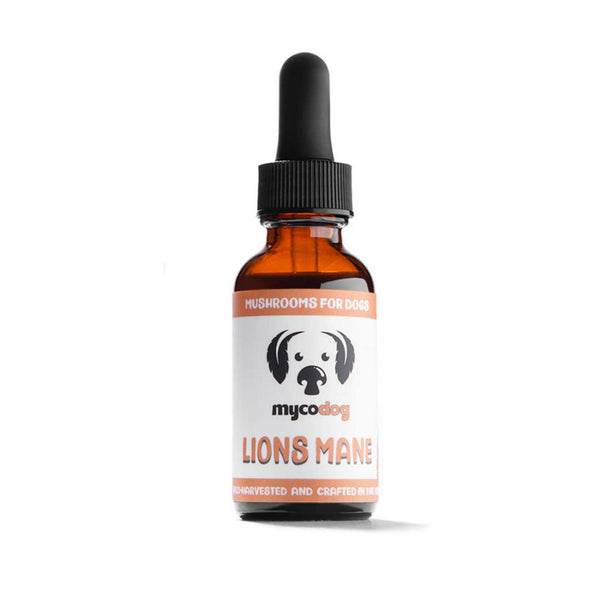
Lion's Mane Mushrooms | Liquid Dual Extract
MycoDog · 1 fl oz · $29.99
- Dual-extracted from the fruiting body and stems, so the compounds are bioavailable
- At least 350 mg of mushroom extract per 1 mL, roughly 30 servings per bottle
- No grain, no mycelium, no fillers. Grown in the forest, not in a lab
- Label lists 1 dropper daily, or 2 droppers for senior dogs. Mixes straight into food
How to give lion's mane to dogs, step by step
- Choose a dual-extracted product. A liquid tincture or a properly extracted powder, not a raw culinary powder.
- Match the dose to your dog's weight. Follow the product's label for lion's mane dosage for dogs. There is no established universal dose, so start at the low end of the range.
- Add it to food. A liquid extract stirs easily into a raw or fresh meal. I add supplements directly into Milka's food so they become part of the routine, not a battle.
- Go slow. Introduce it over a week or two and watch for any change in digestion.
- Stay consistent. Remember that human research showed benefits faded once supplementation stopped. This is a daily, long-game kind of support.
- Talk to a holistic vet. Especially for seniors or dogs on other medications.
If your goal is broader cognitive support and you'd rather use a ready-made formula, the MycoDog Clarity blend for brain and focus pairs lion's mane with other mushrooms and adaptogens chosen for the aging brain. It is the same blend used in the senior dog study mentioned above.
If your dog is already showing signs
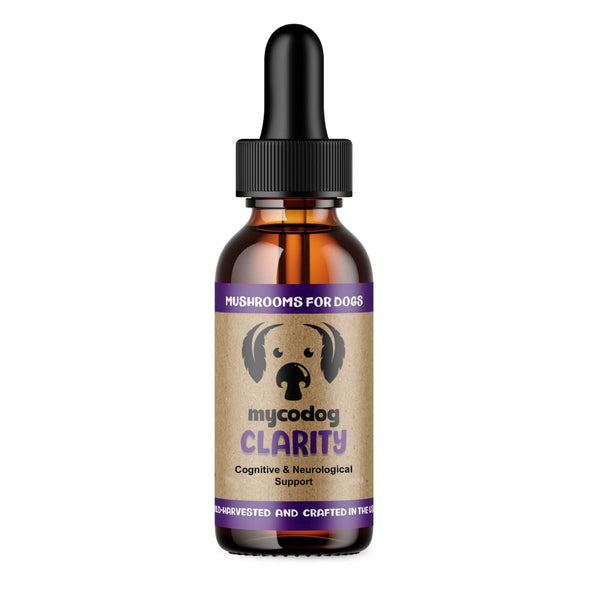
CLARITY, Mushrooms for Brain & Nervous System Support
MycoDog · 2 fl oz · $49.99
- Lion's mane, reishi, and cordyceps with bacopa monnieri and ashwagandha
- Triple-extracted from fruiting bodies, at least 350 mg of mushroom extract per 1 mL
- The same blend used in the 12-week senior dog study described above
- Available on Subscribe & Save at 15% off, for the kind of consistency this support needs
How long until you see results with lion's mane?
Give it time. Because lion's mane works by supporting the body's own repair processes rather than acting like a fast-acting drug, most pet parents think in terms of weeks and months, not days. The human trials ran 12 to 16 weeks. Consistency is what builds the benefit, and stopping tends to reverse it. If you're going to do this, do it steadily.
Brain support also works best as one part of a whole-body routine. If you are building a plan for an aging dog, it is worth reading our guide to MCT oil for dogs and what the brain research actually shows alongside this one, and our guide to chaga mushroom for dogs if immune and antioxidant support is also on your mind. You can see how the different mushrooms compare across the full range of medicinal mushroom tinctures for dogs.
The bottom line on lion's mane for dogs
Here's what I keep coming back to. Watching a dog get older is one of the tender, complicated privileges of loving them. You can't stop time. But you're not powerless either, and you're your dog's biggest advocate.
Lion's mane won't turn back the clock. What it may do, based on a promising and still-growing body of research, is support the brain and nervous system your dog leans on to stay themselves for as long as possible. Feed it in a form your dog can actually absorb. Be consistent. Stay honest about what we know and what we're still learning. And keep showing up for them, the way they've always shown up for you.
I'm rooting for you, and your dog, every step of the way.
Much love, Larry
Lion's mane tincture or the Clarity blend, which should you choose?
Both are triple- or dual-extracted MycoDog tinctures that go straight into food. The difference is how targeted you want to be.
| Lion's Mane Liquid Dual Extract | CLARITY | |
|---|---|---|
| Best for | Pet parents who want lion's mane on its own, or who rotate single mushrooms | Senior dogs already showing signs of cognitive decline |
| What is in it | Lion's mane, from fruiting body and stems | Lion's mane, reishi, cordyceps, plus bacopa monnieri and ashwagandha |
| Extraction | Dual extract | Triple extract |
| Strength | At least 350 mg mushroom extract per 1 mL | At least 350 mg mushroom extract per 1 mL |
| Bottle size | 1 fl oz, about 30 servings | 2 fl oz |
| Daily amount on the label | 1 dropper, 2 droppers for seniors | 1 dropper, 2 droppers for seniors |
| Price | $29.99 | $49.99 |
| Subscribe & Save | Not available | Yes, 15% off |
| Shop Lion's Mane | Shop CLARITY |
Sources
- Ma, B. J., et al. "Hericenones and erinacines: stimulators of nerve growth factor (NGF) biosynthesis in Hericium erinaceus." Mycology, 2010. https://doi.org/10.1080/21501201003735556
- "Unveiling the role of erinacines in the neuroprotective effects of Hericium erinaceus: a systematic review in preclinical models." Frontiers in Pharmacology, 2025. https://www.frontiersin.org/journals/pharmacology/articles/10.3389/fphar.2025.1582081/full
- Mori, K., et al. "Improving effects of the mushroom Yamabushitake (Hericium erinaceus) on mild cognitive impairment: a double-blind placebo-controlled clinical trial." Phytotherapy Research, 2009.
- "Attitudes of Australian Veterinary Professionals to Diagnosing and Managing Canine Cognitive Dysfunction." Animals, 2025. https://www.ncbi.nlm.nih.gov/pmc/articles/PMC11945432/
- "Study: Mushroom supplement improves cognitive function in senior dogs" (MycoDog Clarity study, Veterinary Health Research Centers). Petfood Industry, November 2025. https://www.petfoodindustry.com/nutrition/research-notes/news/15771281/study-mushroom-supplement-improves-cognitive-function-in-senior-dogs
- "New insights into extraction, isolation and characterization of β-glucan from edible and medicinal mushrooms." Bioactive Carbohydrates and Dietary Fibre (ScienceDirect), 2026. https://www.sciencedirect.com/science/article/pii/S266615432600061X
- McLeod, L., DVM. "Benefits of Lion's Mane for Dogs." Lolahemp, 2025. https://lolahemp.com/blogs/dog-health/lions-mane-mushroom-benefits-for-dogs
Disclaimer: This blog may contain affiliate links, and PAWDEGA may earn a small commission at no extra cost to you if you purchase through them. It may also link to products on our website, and this content is for educational purposes, not a replacement for veterinary advice.