Milk thistle for dogs is a liver-supporting herb whose active compounds, known collectively as silymarin, help protect liver cells from oxidative stress. Here is the part most pet parents are never told: every positive clinical result in dogs published to date comes from milk thistle inside a formula, paired with other supporting ingredients, not from milk thistle given on its own. The herb is real. The isolated bottle is where the evidence gets thin.
That single sentence is worth sitting with, so let me say it plainly: milk thistle is better understood as one instrument in a liver formula than as a solo remedy.
I learned this the long way around.
On this page
- Why I started looking into this at all
- What does milk thistle actually do for a dog's liver?
- Why do milk thistle dosage charts contradict each other?
- Is milk thistle better on its own or in a blend?
- Can you give milk thistle to a healthy dog every day?
- How do you know every herb in your blend is earning its place?
- How long should a dog stay on milk thistle?
- What we use with Milka
- The short version
- Single herb vs. blend, side by side
- Sources
Why I Started Looking Into This At All
When Milka was eight, her ALT came back elevated on routine bloodwork. No symptoms. No change in her energy, her appetite, her walks. Nothing you would notice.
So we did what most of us do. We added support. Then we added more. Liver supplements. Detox products. All of it daily, all at once, because surely more help meant more improvement.
A few weeks later we retested...
Her numbers were higher.
We pulled almost everything, kept one gentle herbal tonic, and her ALT came back down over the following months. That whole story, and the distinction that explains it, lives in our post on the difference between liver detox and liver support for dogs. I am not going to repeat it here.
What I want to answer here is the question that came after it. The one I could not find a straight answer to anywhere: should you be giving your dog milk thistle by itself, or milk thistle as part of a blend?
What Does Milk Thistle Actually Do for a Dog's Liver?
Milk thistle seed contains a group of flavonolignans called silymarin. The most active of these is silybin, sometimes labelled silibinin. Silymarin works mainly as an antioxidant and a cell membrane stabiliser, which is why it has been studied for decades in livers under chemical stress.
Here is what the canine research tells us.
A 2021 study in BMC Veterinary Research followed 15 dogs with an existing liver disorder given a commercial liver product containing silybin. Over 28 days, ALT, AST and GGT all came down, alongside a drop in miR-122, a marker highly specific to liver tissue in dogs. That is a real, measured improvement in liver markers.
A 2011 randomised trial in the Journal of Veterinary Internal Medicine looked at dogs receiving a chemotherapy drug known to stress the liver. Dogs given a silybin and SAMe combination alongside it saw liver enzyme rises in 68 percent of cases, compared with 84 percent of dogs receiving the drug alone. The unsupported dogs also had significantly larger increases in ALT, AST, ALP and bilirubin, and were significantly more likely to have their course delayed or stopped.
Notice what both of those studies have in common. Neither one tested milk thistle by itself.
Why Do Milk Thistle Dosage Charts Contradict Each Other?
This is the thing that sent me down a rabbit hole, and I think it is the single most useful thing in this post.
Search for a dose and you will find, on page one, figures like 2 mg per pound, 7 to 20 mg per pound, 5 to 20 mg per kilogram, and up to 200 mg per 10 pounds. Those numbers look like a field that cannot agree with itself.
They are not disagreeing. They are measuring four different substances.
The Four Forms of Milk Thistle, and Why the Numbers Are Not Interchangeable
| Form | What it actually is | What that means for dosing |
|---|---|---|
| Whole ground seed | The entire milk thistle seed, minimally processed | Lowest concentration of active compounds by weight, so the milligram figure is the highest of the four |
| Standardised extract | Concentrated to a stated silymarin percentage, commonly 65 to 80 percent | The middle ground, and the form most "mg per pound" charts are built on |
| Isolated silybin | The single most active compound pulled out of the silymarin complex | A much smaller number for the same effect. One peer-reviewed canine study used 12.75 mg of silybin per 10 kg of body weight |
| Silybin bound to phosphatidylcholine | Silybin complexed with a fat-soluble carrier to aid absorption | The smallest number of the four, because far more of it is absorbed |
Four different substances, four different numbers. A dose written for one form does not transfer to another.
That last row is where the blend argument stops being philosophy and starts being pharmacology.
In a 2007 study in the Journal of Veterinary Pharmacology and Therapeutics, eight beagles were given either a silybin-phosphatidylcholine complex or a standardised milk thistle extract containing the same amount of silybin. Same active compound. Same quantity. The complexed version produced roughly three times the total silybin exposure in the blood over 24 hours, and a peak blood level close to three times higher.
Read that again. Identical milk thistle content, three times the amount actually reaching the dog, because of what it was paired with.
Worth noting honestly: that study involved eight dogs, and it was carried out by a company that sells a silybin product. I am not going to pretend it is a large independent trial. But the finding matches what we see in human and rodent absorption research, and the mechanism is not controversial. Silymarin absorbs poorly on its own. What sits next to it in the bottle changes how much of it your dog ever uses.
Is Milk Thistle Better on Its Own or in a Blend?
Here is my honest read of the evidence, including the parts that do not flatter my own position.
What the research supports:
- Absorption is the bottleneck, and pairing addresses it. Milk thistle on its own is poorly absorbed. The 2007 canine work above shows how dramatically a carrier changes that.
- Every positive canine clinical outcome on record involves a formula. The 2021 liver disorder study, the 2011 chemotherapy trial, and a 2025 healthy dog study all tested milk thistle alongside something else.
- Complementary mechanisms are real. Silymarin stabilises cell membranes and scavenges free radicals. SAMe feeds a different pathway entirely. Bile-supporting herbs like dandelion root do something else again. These are not redundant jobs.
What the research does not support, and where I want to be straight with you:
No study has yet put a herbal blend head to head against milk thistle alone in dogs with liver disease. Nobody has run that trial. And in the one head-to-head comparison that does exist, the 2021 study's healthy dog arm, pure silybin and the commercial formula performed broadly comparably. So I cannot tell you a blend is proven superior. What I can tell you is that all the evidence we have lives on the formula side, and none of it lives with the single herb.
That is a meaningful difference, and it is not the same as proof. I would rather you have the accurate version.
Can You Give Milk Thistle to a Healthy Dog Every Day?
This is where I would push back gently on how milk thistle is usually marketed.
A 2025 study in Veterinary Sciences is the most interesting thing I have read on this, partly because the six dogs in it were French Bulldogs, which made me sit up for obvious reasons. They received a combined Ginkgo biloba and milk thistle seed extract at either 1 or 2 grams daily for 21 days.
The results were genuinely mixed, and the mixed part is the useful part.
ALT came down. Albumin, a protein the liver makes, went up. Both encouraging. But the antioxidant markers, superoxide dismutase and the glutathione ratio, did not move at all. Not at either dose. Antioxidant activity is the mechanism most commonly claimed for milk thistle, and in these dogs it was not measurable. The lower dose also performed as well as the higher one.
The 2021 study adds another wrinkle. In healthy dogs, ALP dropped in the supplemented groups, but GGT rose significantly, and bilirubin rose in the formula group. Markers moved in both directions.
So when someone tells you milk thistle is a harmless daily addition for any dog, the research does not quite say that. It says the picture in a healthy liver is unclear, and that more is not reliably better. Several animal herbalists take the position that milk thistle belongs with a liver under actual stress rather than in the bowl every day forever, and having watched Milka's numbers climb on a stack of well-intentioned products, I find that position hard to argue with.
How Do You Know Every Herb in Your Blend Is Earning Its Place?
If my whole argument is that blends work better, then I owe you the other side of that coin.
A blend means more herbs. More herbs means more things you are responsible for knowing. "Combination formula" is not automatically a mark of quality, and a longer ingredient list is not the same as a better one.
So here is the check I run now. I call it the three-question blend check.
- Can I name the job of every single herb? If an ingredient is in there and you cannot say what it contributes, that is worth a question to the brand, not a shrug.
- Does anything in here duplicate something else I am already giving? Overlap is how pet parents accidentally end up doing what we did with Milka.
- Has this herb been looked at for liver safety specifically? For anything going into a liver formula, this matters more than usual. The NIH maintains a free public database called LiverTox that catalogues liver-related findings for individual herbs and compounds. It is written for clinicians, but it is readable, and it is the single best tool a pet parent has here. Worth knowing that a caution recorded in humans, at human doses, over months of use, does not automatically transfer to a small dose in a dog, and that dose and duration matter enormously. The point is to know and to ask, not to reject any herb with a footnote.
None of this is meant to make you anxious. It is meant to make you the person in the room who read the label properly.

Free guide
The Holistic Pet Wellness Blueprint
That three-question check works on one bottle. The harder version of the question is everything else on the shelf. The Blueprint is the standard we hold products to before anything earns a place in Milka's bowl, so you are measuring against something instead of deciding one label at a time.
Sent straight to your inbox. Unsubscribe whenever you like.
How Long Should a Dog Stay on Milk Thistle?
The honest answer is that this depends on why they are on it, and it is a conversation for your vet rather than a chart. For a dog with elevated liver enzymes, that conversation matters more, not less, because the supplement and the monitoring schedule need to be decided together.
What the research offers is that both canine studies showing improvement in liver markers ran for 28 days, and the 2025 healthy dog study ran 21 days with a withdrawal period after. Many holistic practitioners work in cycles rather than continuously, using a defined stretch of weeks followed by a break, then reassessing with bloodwork.
Which brings me to the piece none of this works without. You cannot tell whether liver support is helping if you have no baseline to compare it to. One number from one blood draw tells you very little. A trend across several tells you a story. That is exactly why we are so insistent about running annual bloodwork even on a dog who seems perfectly healthy. Without Milka's history of normal panels, her elevated ALT would have been a frightening number with no context.
What We Use With Milka
I want to be careful here, because I am not going to pretend one bottle is the answer for every dog's bloodwork.
What I will tell you is what we landed on after the stacking mistake. We use Adored Beast's Liver Tonic, which is a herbal blend rather than a single herb: dandelion root, greater celandine, milk thistle and barberry in a glycerine base, with no synthetics or fillers. Dandelion root supports bile flow. Milk thistle brings the silymarin. They are doing different jobs, which is the entire point of this post.
It is formulated to support the liver, kidneys, gallbladder and pancreas together, on the reasoning that these organs share the workload and supporting one in isolation makes less sense than supporting the system. For a healthy dog, the guidance is a 30 to 60 day stretch, two to three times a year, rather than permanently. That cycling approach is one of the reasons I trust it.
It is one example of what a considered blend looks like. There are others. What matters is that you know why each thing in the bottle is there.
The blend we use
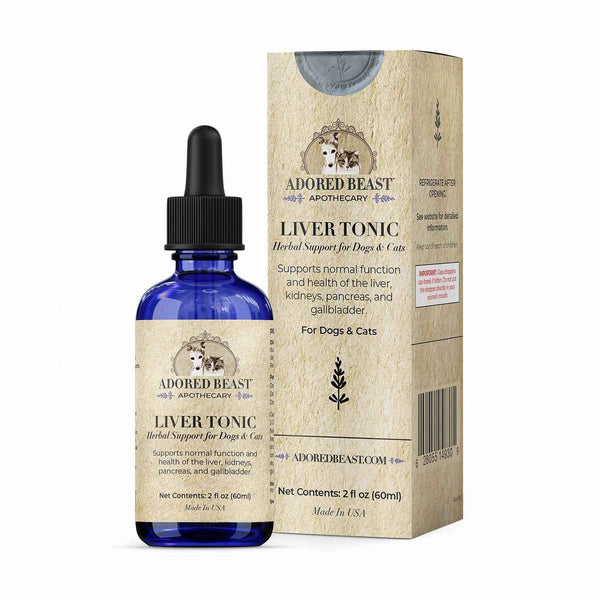
Liver Tonic by Adored Beast Apothecary
Why it fits this post: it is the four-herb blend described above, not a single-herb bottle. Dandelion root for bile flow, milk thistle for the silymarin, plus greater celandine and barberry, in an organic vegetable glycerine base. Zero synthetics, zero fillers, zero additives.
- Formulated to support the liver, kidneys, gallbladder and pancreas as one system
- Often used alongside or after antibiotics, steroids, NSAIDs, and flea and tick medication
- Given twice daily by weight: 0.25ml for pets up to 4 lbs, 0.5ml for 5 to 60 lbs, 1.0ml for dogs over 60 lbs. Refrigerate after opening
- For a healthy dog, used as a 30 to 60 day stretch, two to three times a year, rather than every day forever
- Available on Subscribe & Save if you are cycling it through the year
If your dog has elevated liver enzymes or is on any medication, decide the timing and length with your vet, ideally a holistic or integrative vet, rather than from a chart.
The Short Version
The best liver supplement for dogs is probably not a single ingredient. If you are standing in front of two options, a bottle of milk thistle and a liver formula containing milk thistle, and your dog has a reason to be on liver support:
- The formula is where the canine evidence actually is.
- Absorption is the real constraint, and what milk thistle is paired with changes how much of it your dog uses.
- The dosage numbers you find online are not comparable to each other unless you know which form each one refers to.
- Daily forever, for a dog with a healthy liver, is not something the research supports.
- Know the job of every herb in the blend. If you cannot, ask.
You know your dog better than any lab report does. Ask your vet the harder questions, keep the records, and give the liver steady support rather than a dramatic intervention.
If you want the standard we apply to every product before it reaches Milka, not only the liver ones, it is in The Holistic Pet Wellness Blueprint, free.
Single Herb vs. Blend, Side by Side
Every row below is drawn from the studies discussed earlier in this post, including the row that does not favour the blend.
| Milk thistle on its own | Milk thistle inside a liver formula | |
|---|---|---|
| Canine clinical evidence | No canine trial has tested it alone in dogs with liver disease | Every positive canine result on record, 2011, 2021 and 2025, used a formula |
| Absorption | Silymarin is poorly absorbed on its own | In the 2007 beagle study, the complexed form gave roughly three times the silybin exposure at the same dose |
| Pathways covered | Antioxidant and cell membrane stabilising | Adds separate jobs, such as SAMe's pathway or bile support from dandelion root |
| What you have to verify | One ingredient, and which of the four forms it is | Every herb on the label, using the three-question blend check |
| Proven better? | No head-to-head trial exists in dogs with liver disease | Not proven superior. In the 2021 healthy dog arm, pure silybin and the formula performed broadly comparably |
The honest summary: the evidence sits on the formula side, and that is not the same thing as proof.
Sources
- Bioavailability of a silybin-phosphatidylcholine complex in dogs. Journal of Veterinary Pharmacology and Therapeutics, 2007. pubmed.ncbi.nlm.nih.gov/17348898
- Effects of silybin supplementation on nutrient digestibility, hematological parameters, liver function indices, and liver-specific mi-RNA concentration in dogs. BMC Veterinary Research, 2021. doi.org/10.1186/s12917-021-02929-3
- Prospective randomized clinical trial assessing the efficacy of Denamarin for prevention of CCNU-induced hepatopathy in tumor-bearing dogs. Journal of Veterinary Internal Medicine, 2011. pubmed.ncbi.nlm.nih.gov/21689156
- Effects of Gingko biloba and Milk Thistle Extracts on Biomarkers of Antioxidants Status and Liver Function in Healthy Dogs. Veterinary Sciences, 2025. doi.org/10.3390/vetsci12080763
- Greater Celandine. LiverTox, National Institute of Diabetes and Digestive and Kidney Diseases, NIH. ncbi.nlm.nih.gov/books/NBK548684
DISCLAIMER: This content is for informational purposes only and is not intended to be a substitute for professional veterinary advice, diagnosis, or treatment. Every animal's health situation is unique, so always work alongside your vet, ideally a holistic or integrative vet, for anything ongoing or serious. Our content may include affiliate and/or sponsored links, which means your support helps move our mission forward. As content creators, we earn from qualifying purchases.