Vaccine reactions in dogs are usually mild and short lived, and the research shows they are more common in small dogs, in a handful of specific breeds, and on visits where several vaccines are given at once. Titer testing can show whether your dog is still carrying antibodies to the core viruses, and a positive result can support a decision to wait rather than revaccinate. What a titer cannot do is measure the whole immune system. A low result is not proof your dog is unprotected, and in the United States it is not a legal substitute for the rabies vaccine.
Here is the one line to carry with you: a titer measures the antibodies circulating in your dog's blood on the day of the draw, not the immune memory sitting behind them, which is why a low titer is not the same thing as low immunity.
And here is the part that rarely gets said out loud. The large safety studies count what shows up within three days. A health concern that appears weeks, months or years after a dose is close to impossible to tie back to that dose with any certainty, so it tends to get filed as coincidence rather than looked into. Nobody has followed dogs across a full lifetime of repeat doses to measure what year after year adds up to. That is an open question rather than a proven harm, and you are allowed to weigh an open question when you make a decision for your own dog.
What this post covers
- What causes vaccine reactions in dogs, and how common are they
- Why the leaflet says healthy animals only
- Does my dog need every vaccine on the list
- What titer testing actually tells you
- Is an antigen test the same as a titer test
- What a low titer result means
- Can a titer replace the rabies vaccine
- Where nosodes fit, honestly
- Should the flea and tick dose be given at the same visit
- What to ask at the next appointment
If you are here because something happened after a shot, start with this. You did not do anything wrong. You took your dog in for a routine appointment. You said yes to what was recommended, the way almost all of us do. Nobody handed you the product insert and read it aloud to you first.
I want to be clear about where I stand, because this subject gets flattened into two camps and I am in neither one. I am not anti-vaccine. Vaccines changed what a puppy's first year looks like, and parvovirus and distemper still kill dogs. What I am against is saying yes without being given enough to decide. Those are different positions, and the second one is the one most pet parents are never offered.
What causes vaccine reactions in dogs, and how common are they?
A vaccine works by asking the immune system to respond to something. A reaction is that response going further than anyone wanted. Most of the time it stays small: soreness at the injection site, a firm lump, a mild fever, a dog who sleeps more and eats less for a day.
The numbers are worth knowing, because they are more specific than the reassurance you usually get. In a 2005 study of more than 1.2 million vaccinated dogs, researchers at Purdue recorded adverse events in roughly 38 dogs per 10,000 vaccinated, about one in 260. The rate climbed as body weight fell, and every additional vaccine given in the same office visit pushed the rate up again.
The same lead author repeated the work in 2023 across more than 4 million dogs and over 15 million vaccination visits. Events were recorded after 19.4 visits per 10,000, so lower than the older study. The pattern held, though. Rates rose as the number of vaccines in one visit went from one to four, rates were highest in dogs under 5 kg, and among individual vaccines the rabies vaccine carried the highest rate. Two breeds sat at the top with odds more than four times that of mixed breed dogs: Dachshunds and French Bulldogs. Of the events recorded, around 45 percent were classed as mild and about 15 percent as severe, which is the proportion I would want if I were the one reading this at midnight.
I have a French Bulldog. Milka is a senior now, and reading that line landed differently than a statistic usually does.
Now the limitation, and it matters more than it sounds. Both of those studies counted what was recorded within three days. That window is good for catching the sharp reactions and blind to everything else. So when a pet parent says the lumps, the loose stool or the skin flare started a fortnight later, she is describing something the study design was never built to see.
Proving a link at that distance is genuinely hard, and it is worth understanding why rather than taking anyone's word for it. By week three your dog has eaten sixty meals, been outside dozens of times, and very possibly had a chemical flea and tick dose handed over at the same appointment. Pulling one thread out of that is difficult work that mostly does not get funded. The difficulty is a reason the question stays open. It is not an answer to it.
Get to a vet immediately, not tomorrow, for facial or muzzle swelling, hives, repeated vomiting, pale gums, difficulty breathing, collapse or wobbling. Those can move fast.
Why does the vaccine leaflet say healthy animals only?
This is the part I wish someone had pointed at years ago, because it is printed on the product and almost nobody reads it out loud.
Since 2015, USDA labelling for veterinary vaccines uses a single standard effectiveness statement, and the wording runs along the lines of the product having been shown to be effective for the vaccination of healthy animals of a given age against a given disease. Healthy is not decoration. It describes the animals the product was tested in.
Writing in Clinician's Brief, board certified veterinarian Dr. Tamara McArdle puts the consequence plainly: vaccines are labelled for healthy patients, vaccine trials typically enrol only healthy animals, and giving one to a pet with a health concern is extra label use resting on the clinician's judgement. It happens constantly, because dogs who are unwell are booked in for their shots like everyone else.
So this becomes a question you are allowed to ask out loud. If your dog is running a temperature, mid flare, on steroids, recovering from surgery, or in the middle of something nobody has got to the bottom of yet, say so before the needle comes out, and ask whether today is the right day. A vet can note it and reschedule. Never stop a prescribed medication to make a vaccine appointment work. That decision belongs with your vet, and it is a conversation, not a confrontation.
Does my dog need every vaccine on the list?
No, and this is the single most useful thing in this post. Veterinary vaccines are sorted into two groups, and they are not held to the same standard.
Core vaccines are the ones the World Small Animal Veterinary Association says every dog should have, everywhere. Non core vaccines are risk based, chosen after considering an individual dog's lifestyle and how common the disease actually is where that dog lives. The 2024 WSAVA guidelines are blunt about the other half of it too: vaccines should not be given needlessly, and core vaccines should not be given more often than necessary in adults, because there is an abundance of published evidence that the duration of immunity from modern modified live core vaccines runs to many years.
Scroll sideways to see the full table.
| Vaccine | Category | Interval in the guidelines |
|---|---|---|
| Distemper (CDV) | Core, every dog | No more often than every 3 years |
| Parvovirus (CPV) | Core, every dog | No more often than every 3 years |
| Adenovirus (CAV) | Core, every dog | No more often than every 3 years |
| Rabies | Core, and set by law | 1 to 3 years, your state decides |
| Leptospirosis | Non core, risk based | About 1 year where it is chosen |
| Bordetella | Non core, risk based | About 1 year where it is chosen |
| Lyme (Borrelia) | Non core, risk based | About 1 year where it is chosen |
| Parainfluenza | Non core for most pet dogs | Annually in most products |
Read that rabies row carefully, because your state, and sometimes your county, overrides everything else in the table. Local law is the reason two dogs in two states can be on entirely different schedules and both be correct.
The non core rows are where geography does the deciding. Leptospirosis pressure is not the same in a wet rural county as in a high rise apartment. Tick pressure in New England is not tick pressure in Arizona. This is the whole argument for educating yourself about your own city, state or country rather than accepting a schedule built for an average dog who lives nowhere. Ask which diseases are actually circulating near you, and ask what your dog's day looks like: daycare, boarding, hiking, standing water, travel.
What is titer testing, and what does it actually tell you?
A titer test is a blood draw. The lab dilutes the serum in steps and looks for the point at which antibodies to a given virus stop being detectable, and reports that as a ratio. Higher means more antibody was circulating that day.
Here is what most pet parents are never told. The 2022 AAHA canine vaccination guidelines deliberately decline to publish protective titer values, because the amounts of antibody measured in the underlying work were not tied to clinical outcomes. So there is no universal number that means safe. AAHA also says routine titer testing to decide on revaccination is not usually advised, with named exceptions, and the exceptions are the interesting part: dogs with a history of adverse responses to vaccination, suspicion of vaccine related autoimmune disease, and pet parents who are hesitant about revaccinating.
If your dog has reacted before, you are not going outside the mainstream guidance by asking for a titer. You are standing inside it. That sentence is worth taking to the appointment.
Is an antigen test the same as a titer test?
They are not the same thing, and both are useful. They answer different questions, and the words get used loosely enough that plenty of pet parents leave an appointment thinking they got one when they got the other.
Scroll sideways to see the full table.
| Question | Antigen test | Antibody titer test |
|---|---|---|
| What it looks for | Pieces of the pathogen itself | Your dog's antibodies to that pathogen |
| What it answers | Is this dog infected right now | Has this dog mounted a response |
| Typical sample | Faeces, swab or blood | Blood serum |
| When it is the right test | A sick dog with suspect symptoms | A well dog, deciding on a booster |
| What it cannot tell you | Anything about immune status | Whether antibody equals protection |
There is a second split inside titer testing that matters more for your wallet and your decision. Some practices run a rapid in-clinic kit and hand you a result the same visit. Reference laboratories run virus neutralisation or haemagglutination inhibition, which the guidelines regard as the reference standard.
A 2025 study in Veterinary Sciences put three commercially available in-clinic kits head to head against virus neutralisation. All three were reliable for parvovirus antibodies. For distemper and adenovirus, two of them returned false positives, which would label an unprotected dog as protected, while the third missed antibodies in some dogs, which sends a dog for a booster she may not have needed. Both errors matter, in opposite directions.
How I read that: an in-clinic kit is a fast, reasonable screen. When the answer is going to change what you actually do, ask for the reference laboratory.
What does a low titer result mean?
Less than you have been led to believe, and this is where a lot of unnecessary vaccinating happens.
Antibodies are one visible layer of immunity. Underneath sit memory B cells, which are not measured by a titer at all and which can persist for years after circulating antibody has faded. AAHA's own position on interpreting serology is that once maternal antibody has gone, any detectable antibody means a response happened, that the presence or absence of antibody does not necessarily reflect cell mediated immunity, and that a titer, almost regardless of the amount, is not necessarily an indicator of protection or susceptibility.
Veterinary immunologist Dr. Richard Ford has made the same point for practising vets: when a titer comes back negative for distemper, parvovirus or adenovirus in an adult dog with a vaccination history, that dog should not be assumed to be susceptible. Antibody levels drift down without further contact with the virus. The memory does not necessarily drift with them.
One genuine exception, and it runs the other way. A puppy who tests negative after finishing her initial series is a different situation entirely. That result suggests the series has not taken yet, and it needs a conversation with your vet about another dose rather than a shrug.
Can a titer replace the rabies vaccine?
No. I would rather be blunt than have you find this out at a licensing office or after a bite incident.
The 2022 AAHA guidelines state that antibody levels have not been established as correlates of protection for rabies, and that serologic testing is not considered a substitute for vaccination. The law agrees, in writing. Florida's rabies statute, chapter 828 of the Florida Statutes, says outright that evidence of circulating rabies virus neutralising antibodies may not be used in place of current vaccination.
What does exist in some places is a medical exemption. A licensed veterinarian examines the dog and certifies in writing that vaccinating would endanger her health because of illness, age, infirmity or another medical reason, and the requirement is waived, usually with review each year. The Florida statute spells that out, and so do a number of others.
How many states allow it depends on who is counting, and the tallies genuinely disagree: the Animal Legal and Historical Center at Michigan State counted 16 as of 2023, while other trackers list 17 or 18 as newer laws have come in. County rules can sit on top of state ones. So do not take a number from a blog post, including this one. Look up your own state, then ask your vet whether your dog's history would meet the bar. An exemption is for a documented medical reason, not a preference, and an exempt dog usually carries tighter confinement conditions because she is not protected.
What about nosodes?
You will meet them the moment you start looking for alternatives, so let's be real for a second. A nosode is a homeopathic preparation made from diseased material and diluted, and it is often presented as a natural stand in for a vaccine. I am not going to tell you what you want to hear on this one.
The 2024 WSAVA guidelines say nosodes cannot be expected to protect against infectious disease, that evidence of safety and efficacy is very scant, and that the small number of published studies show them lacking efficacy. The one controlled canine trial anyone cites was run by holistic veterinarian Dr. Susan Wynn with the late Dr. Ronald Schultz, one of the most respected duration of immunity researchers in the field. Of seven unvaccinated dogs given a parvovirus nosode and then challenged, five died. Among the unvaccinated controls, five of six died. The nosode did not hold.
Dr. Wynn's own conclusion was that she does not recommend nosodes as a sole strategy, and Dr. Jean Dodds, who has spent a career arguing for minimal vaccination protocols, says the same. When the people most sympathetic to a thing will not stand behind it, that tells you something.
So here is my line, and it is the distinction this whole post rests on. A homeopathic remedy used to support a dog's body after a vaccine is a completely different proposition from a homeopathic product sold in place of one. I will not offer you the second. Parvovirus kills puppies, and I am not willing to gamble your dog on a preparation that failed the only controlled test it was given.
I will tell you what I have actually done, because you deserve the real picture rather than a tidy one. Milka has had rabies nosodes. We were preparing for international travel, her export titer had come back a hair above the passing mark, and watching a number sit that close to the line is not a comfortable feeling. A year later, before travelling again, we used rabies nosodes and her next result came back at more than double the threshold. I want to be careful about what that does and does not show. It is one dog, there was no control, and two titers a year apart are two snapshots rather than a trend. I am telling you because you asked what I do in my own house, not because one French Bulldog is evidence. If you want to go this route, work with a holistic or integrative vet on the dosing rather than guessing, and know that no titer and no nosode replaces the rabies vaccine your state requires of you.
The first one is a different question, and it is the one I get asked most: the vaccine is happening, or it already happened, so what do I do for her body now?
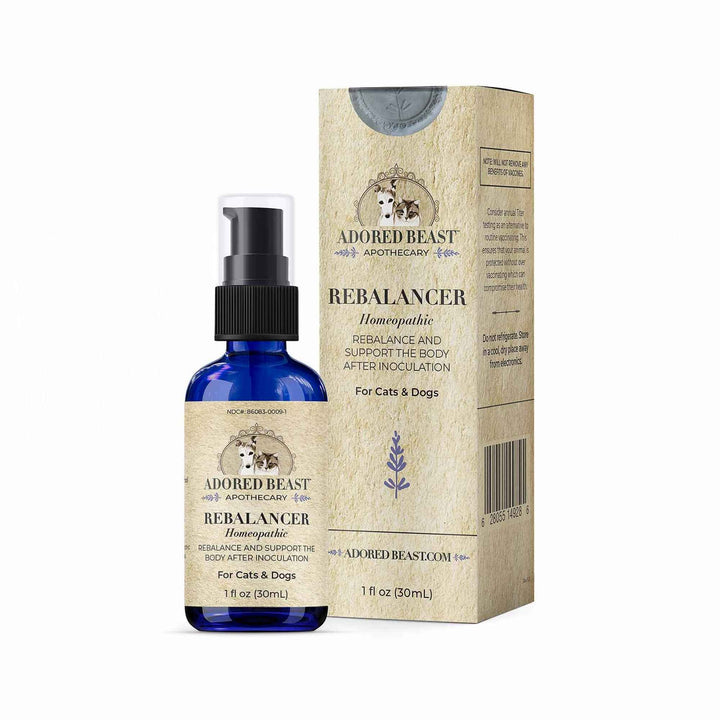
What sits in my cupboard for Milka
Rebalancer by Adored Beast Apothecary
A homeopathic remedy made for one narrow job: supporting the body around a vaccine, without working against what the vaccine is there to do. It is what I reach for in the days after a shot.
I want to be straight with you about the evidence, because you have already been let down once by a confident claim. Homeopathy does not carry the trial base that vaccines carry, and I am not going to pretend otherwise two paragraphs after saying it about nosodes. I use this one because of what I have seen in my own house over years, and because the ingredient list is four lines long and I can read every one of them. That is my experience, offered as experience.
- Active ingredients: Silicea 30C and Thuja Occidentalis 12C
- Zero synthetics, zero fillers, zero additives
- Made for dogs, cats and horses
- Separate label dosing for adults, and for puppies and kittens
- Safe use in pregnant or breeding animals has not been established
Whatever you choose, the organs doing the clearing are the ones to look after, and that is a general principle rather than a vaccine specific one. I have written about why detox and support are not the same thing, because the word detox gets thrown around with no mechanism attached to it, and you deserve better than that.
Should the flea and tick dose be given at the same visit?
This is the question almost nobody thinks to ask, and I think it is one of the most useful ones in this post.
The annual appointment is rarely one thing. It is shots, often a wormer, and a chemical flea and tick dose handed over at the desk on the way out. Several products, one afternoon, one small body processing all of it at once.
Both Moore studies found reaction rates climbing with each additional vaccine given in a single visit. Here is the detail worth noticing: the 2005 study deliberately left out visits where an injectable heartworm product had been given alongside the vaccines, because co-administration muddies the picture. Researchers removed that variable on purpose. Which means the combination most of us actually run at home, vaccines plus a chemical flea and tick product on the same day, is the one nobody has measured.
On that chemical dose itself, the FDA publishes a fact sheet on flea and tick products in the isoxazoline class, and you are entitled to both halves of what it says. The agency considers these products safe and effective. The agency is also alerting pet parents and veterinarians to neurologic adverse reactions, including muscle tremors, lack of coordination and seizures in some dogs and cats, and notes that seizures can occur in animals with no prior history. That document exists, it is public, and your appointment may never have mentioned it.
So, practically. If you are going to use both, space them out rather than stacking them. A couple of weeks between the vaccine and the pest product is a reasonable gap, and it earns you something valuable: if a problem turns up, you know which product to look at. Ask for this at the desk. It costs the practice nothing.
If you want off the chemical route altogether, I will be straight with you about what natural pest protection does, because overselling this is how pet parents end up with a dog full of ticks. Botanical repellents work by making your dog harder for a pest to find and settle on. They do not clear an infestation that is already running, and the herbal spot on we stock says exactly that on its own packaging. They ask more of you: reapplication on schedule, a check over her coat after every walk, and a real plan for peak season rather than good intentions. In an area with heavy tick pressure and Lyme circulating, have that conversation with your vet rather than going with nothing at all. I have written up the layered natural flea and tick plan we actually use, including what to do when something is already on board.
What do I do at the next appointment?
You are not there to argue. You are there to consent properly, which is a normal thing to do and which most vets will meet you halfway on. This is the sequence I would use.
- Ask for the vaccination history in writing. Which products, which dates, which lot numbers. You cannot reason about a schedule you have never seen.
- Ask which of today's vaccines are core and which are lifestyle based for where you live and how your dog spends her week.
- Ask to split the visit. Reaction rates rose with each additional vaccine given in one visit in both Moore studies, and spacing them out also makes it clear which product caused a problem if one does.
- Ask them not to stack the flea and tick dose on top. If a pest product is going home with you, take it home and give it a fortnight later, so one visit is not several products at once.
- Say it if your dog is unwell today. Fever, flare, steroids, post surgery, or something unexplained. The label was written for healthy animals.
- Ask for a titer if she has reacted before. AAHA names a history of adverse responses as an indication for antibody testing, so this is a guideline backed request.
- Ask for the reference laboratory when the result will actually change your decision, rather than the in-clinic kit alone.
- Ask how a reaction gets reported. Reactions are reported to the manufacturer and to the USDA, and it only happens if someone files it.
- Ask about a written exemption if your state allows one and your dog's history might qualify.
- Support her body around the dose, whatever you decide, and keep a written note of the date so that a flare three weeks later is not a memory you are second guessing.
One pattern worth knowing about: for some dogs the first sign after a vaccine is not a lump or an upset stomach. It is itchy skin, licking, or ears that start smelling again. If that sounds like your dog, this free guide walks through the allergy and yeast side of it.
If your vet will not engage with any of that, it is reasonable to get a second opinion from someone who will. We keep a list of holistic and integrative vets who consult online, and a titer conversation is exactly the kind of thing they are used to having. Regular bloodwork for a healthy dog also gives you a baseline, so that a change after any dose is something you can actually see rather than something you feel.
And if the reaction that brought you here was to something else you were handed as routine, the same questions apply there. I went through this whole argument once before with what pet parents are not told about flea and tick medication side effects, and the shape of it is identical.
You are not difficult for asking. You are doing the part of the job that nobody else in that room can do for your dog. Over-vaccination is a real problem, dogs are still being given more than the guidelines call for, and none of that requires you to swing to the opposite extreme and protect her from nothing.
Informed consent is the whole thing. Ask the questions, get the record, understand your own state, and make the call with your eyes open.
I'm rooting for you, and for her, every step of the way.
Much love, Larry
I am not a veterinarian and this is not medical advice. Every pet is unique, so please work alongside your vet, ideally a holistic or integrative vet, on anything ongoing or serious. Rabies vaccination requirements are set by law and vary by state and county.
Sources
- Moore GE, Guptill LF, Ward MP, et al. Adverse events diagnosed within three days of vaccine administration in dogs. Journal of the American Veterinary Medical Association, 2005;227(7):1102-1108.
- Moore GE, Morrison J, Saito EK, et al. Breed, smaller weight, and multiple injections are associated with increased adverse event reports within three days following canine vaccine administration. Journal of the American Veterinary Medical Association, 2023;261(11):1653-1659.
- Weese JS. Canine vaccine adverse events, Worms & Germs Blog, Ontario Veterinary College, 2023. Summary of the severity breakdown in the Moore 2023 dataset. Link
- Ellis J, Marziani E, et al. 2022 AAHA Canine Vaccination Guidelines, American Animal Hospital Association, 2022. Utilization and interpretation of serologic titers and Interpreting vaccine labels
- Squires RA, Crawford C, Marcondes M, Whitley N. 2024 guidelines for the vaccination of dogs and cats, WSAVA Vaccination Guidelines Group. Journal of Small Animal Practice, 2024. Link
- Janowitz L, Abd El Wahed A, Truyen U, Hofmann-Lehmann R, Spiri AM. Antibody titer testing in dogs: evaluation of three point-of-care tests for canine core vaccine antigens compared to virus neutralization. Veterinary Sciences, 2025;12(8):737. Link
- Ford RB, quoted in Understanding the use of antibody titers in veterinary practice. dvm360. Link
- McArdle T. Vaccinations in atypical veterinary patients. Clinician's Brief. Link
- USDA APHIS, veterinary biologics labelling policy and the single-tier effectiveness statement, 2015 onward. Link
- Florida Statutes, chapter 828, rabies vaccination of dogs, cats and ferrets, including the medical exemption clause and the clause on circulating antibodies. Searchable at leg.state.fl.us.
- US Food and Drug Administration. Fact sheet for pet owners and veterinarians about potential adverse events associated with isoxazoline flea and tick products. Link
- Animal Legal and Historical Center, Michigan State University College of Law. Rabies vaccination and exemption laws for dogs. Link
- Dodds WJ. Review of the 2024 WSAVA vaccination guidelines, including the Wynn and Schultz parvovirus nosode trial, Hemopet. Link
- Wynn SG. Discussion of nosode trials, Journal of the American Veterinary Medical Association, 1998.