Dogs can eat salmon, and it is one of the better proteins you can put in a bowl, but only wild caught, and only in rotation. Farmed salmon carries a heavier load of persistent pollutants than wild does, and it now carries roughly half the omega-3 it did twenty years ago, because the feed changed from marine ingredients to plant oils. Wild caught salmon for dogs is the only version worth feeding, and even wild caught salmon belongs in the rotation rather than in the bowl every day, because the ocean it came out of is not clean either.
If you already read labels, this is probably not the question you thought you were asking. You wanted to know whether salmon is a good protein. It is. The harder question is which salmon, and almost nothing written for pet parents answers that one honestly.
In this article
Is salmon good for dogs?
Can dogs eat salmon and get something real out of it? Yes, and the reason is specific rather than general. Salmon is a fatty cold-water fish, which means it delivers EPA and DHA, the two long-chain omega-3 fatty acids that most land proteins barely contain. It also brings selenium, vitamin D and vitamin B12.
The omega-3 case is not marketing. In a randomised, double-blinded, controlled trial published in the Journal of the American Veterinary Medical Association, dogs with osteoarthritis were fed either a typical commercial food or a food containing fish oil omega-3. Force-plate analysis at 90 days showed improved weight bearing in 82% of the dogs on the fish oil food, against 38% on the control food. The mean change in peak vertical force was 5.6% in the test group and 0.4% in the control group. That is an objective instrument measuring a real difference, not a survey of how pet parents felt about it.
So the case for feeding salmon is genuinely good. Which is exactly why the sourcing question deserves more attention than it usually gets. You are feeding this fish for the omega-3. If the salmon you chose no longer carries much of it, you have bought the calories and left the reason behind. I went deeper on that trade-off in why the source of your dog's omega 3 matters more than the label on the bottle.
Is wild caught salmon for dogs actually better than farmed?
Yes, on both halves of the question, and the second half is the one almost nobody writes about.
The contaminant half. In 2004, researchers analysed more than two metric tons of farmed and wild salmon from around the world and published the results in Science. Total PCBs, dioxins, toxaphene and dieldrin were consistently and significantly more concentrated in the farmed fish than in the wild fish as a group. European-raised salmon carried the heaviest loads. That study is the origin of most of what you have read about farmed salmon, and it still stands.
The half that is newer, and more useful. Norway's Institute of Marine Research tracked nearly 7,000 farmed Atlantic salmon fillets and over 900 feed samples from 2006 to 2021. Two things moved at once. Contaminants fell, which is real progress and I will say so plainly. But the nutrients fell with them, because the reason contaminants dropped is that the feed shifted away from marine ingredients toward plant oils. Marine ingredients made up close to 90% of salmon feed in the 1990s and around 22% by 2020. EPA, DHA, selenium and vitamin D all declined in the fillet. A 150 gram portion delivered 1303% of the adequate intake for EPA and DHA in 2006; by the 2014 to 2021 window that figure had fallen to 683%. Oleic acid, a fatty acid typical of vegetable oil, rose from 23% of total fatty acids to 39%.
Read that again, because it is the whole argument. Farmed salmon has become cleaner by becoming less of a fish. It is closer to a vegetable-oil-fed animal than it was, and the omega-3 you are buying salmon for is the exact thing that left.
Scroll sideways to see the full table.
| What you are comparing | Wild caught | Farmed |
|---|---|---|
| Diet of the fish | Ocean prey, plankton, crustaceans | Formulated pellets, mostly plant oils |
| PCBs and dioxins | Lower as a group | Higher as a group, falling since 2006 |
| EPA and DHA trend | Stable, set by the ocean food chain | Roughly halved from 2006 to 2021 |
| Selenium and vitamin D | Retained | Declined over the same window |
| Mercury category | FDA and EPA Best Choices list | FDA and EPA Best Choices list |
| Parasite risk if fed raw | Real, regional, handled by freezing | Lower on formulated feed |
One honest note on that mercury row, because it cuts against the usual scare copy. Both wild and farmed salmon sit in the FDA and EPA Best Choices category, the lowest-mercury group. Mercury is not the problem with salmon. The lipid-soluble pollutants are, and they concentrate in exactly the fat you are feeding the fish for.
Can dogs eat raw salmon?
Only if it has been frozen properly first. This is the one place where I will not soften anything, because the failure mode here is fatal and fast.
Raw or undercooked salmonids can carry a fluke, Nanophyetus salmincola, which can itself carry the bacterium Neorickettsia helminthoeca. When a dog eats that fish, the result is salmon poisoning disease. According to the Merck Veterinary Manual, signs usually appear about 5 to 7 days after the fish is eaten, and up to 90% of affected dogs die within 7 to 10 days without veterinary care. It responds well to doxycycline when a vet catches it in time, which is why the actual danger is not the organism, it is the delay. In the United States the disease is concentrated in the coastal Pacific Northwest, and cases have also been reported in Northern California, most often after a dog ate raw trout or salmon caught locally.
Freezing handles it, and here is the detail almost every article gets wrong. The FDA Food Code standard for destroying parasites in fish served raw is minus 4 degrees Fahrenheit, which is minus 20 Celsius, held for 7 days. A typical home freezer runs at about minus 18 Celsius. That is warmer than the threshold. So "I froze it for a week in the kitchen freezer" is not the same thing as the standard, and if you are sourcing fish yourself, that gap is worth knowing about before you rely on it.
Which is why, for most pet parents, the sensible answer is not to run a freezing protocol at home at all. It is to let someone else carry that step, verify it, and hand you a shelf-stable version of the same fish.
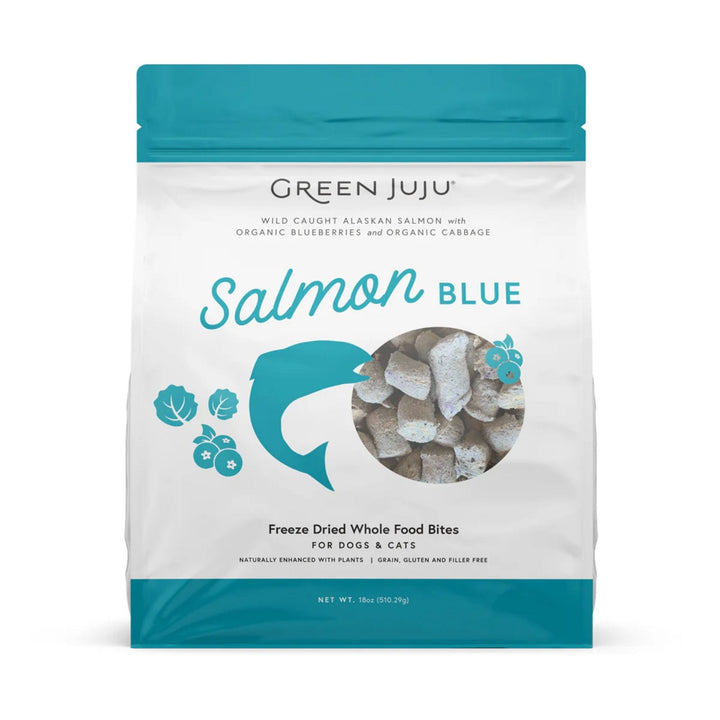
The salmon I actually keep in the house
Salmon Blue Whole Food Bites
Not because it is salmon. Because of where the salmon is from and what happened to it afterwards. This is wild caught Alaskan salmon, raw freeze-dried rather than cooked, so the omega-3 you are buying it for survives the process instead of being driven off by heat.
- 85% wild caught Alaskan salmon, 15% organic plants
- Whole ingredient list: salmon, organic purple cabbage, organic blueberries, organic fenugreek, mixed tocopherols
- No synthetic vitamins or minerals, no flavourings, no grains, no fillers
- 34 kcal per quarter cup, which makes the 10% rule below easy to work out
- Crumbles over a meal as a topper, or stays whole as a high-value training reward
How much salmon can a dog eat?
Keep salmon, and anything else fed alongside a complete diet, to no more than 10% of your dog's daily calories. Beyond that you start unbalancing the diet the other 90% was formulated to deliver.
On frequency, my answer is a few times a week rather than daily, and the reason is the ocean rather than the fish. Persistent organic pollutants do not break down quickly and they accumulate up the food chain into fatty tissue. Salmon is a fatty fish. Rotation is not caution for its own sake, it is the practical way to get the omega-3 without asking one food to carry the whole load.
How to feed salmon to a dog safely, step by step:
- Choose wild caught. If the label does not say so, assume it is farmed.
- Never feed it raw unless it has been commercially frozen to the parasite-destruction standard. Cooked plain, or raw freeze-dried from a source that handled the freezing step, are both fine.
- No bones. Salmon bones are brittle and can splinter or lodge.
- Nothing on it. No salt, oil, garlic, onion, marinade or seasoning of any kind.
- Cap it at 10% of daily calories, and work that out from the calorie figure on the bag rather than by eye.
- Rotate it with other proteins across the week instead of feeding it every day.
- Introduce it slowly over several days if your dog has a sensitive stomach or has never had fish.
And one thing I will say even though it costs us a sale. If you already feed a complete raw diet built on sardine, your dog is getting cold-water omega-3 every single day and does not need a salmon topper on top of it. Adding one is not harmful, it is unnecessary. Feed the rotation for variety if your dog enjoys it, not because a blog told you there was a gap.
What about the toxins that get through anyway?
This is the part I care about most, and it is the part the "buy wild caught and you are done" articles stop short of.
Choosing wild caught lowers the load. It does not zero it, because there is no clean ocean left to catch a clean fish out of. Add everything else a modern dog meets in a week, the bowl, the water, the floor cleaner, the pavement, and the honest position is that some load is arriving regardless of how carefully you shop. You cannot shop your way out of that entirely. What you can do is support the body's ability to bind and clear it.
That is what zeolite does, and the mechanism is chemistry rather than mystique. Clinoptilolite zeolite is a volcanic mineral with a microporous honeycomb structure carrying a net negative charge. It holds beneficial trace minerals such as calcium, magnesium and potassium inside that framework. In the gut it swaps them out for positively charged particles it has a stronger affinity for, including heavy metals, which then leave with the stool. The process is called cation exchange.
The evidence is real but I want to be straight about its limits. In a 90-day study published in Biological Trace Element Research, mice given lead alongside a modified clinoptilolite showed lead reductions of 84% to 91% across carcass, liver and kidneys compared with mice given lead without it. A separate 12-week study in rats examined how activated clinoptilolite affected metal distribution across blood, bone, liver, kidney, intestine and brain. Those are rodents, not dogs. I am not aware of a controlled canine trial, and I would rather tell you that than imply one exists. What we have is a well-described mechanism, consistent animal data, and a long history of use. That is enough for me to feed it. It is not the same as a randomised trial in dogs, and you deserve to know which one you are getting.
Worth clearing up a common misunderstanding too. Zeolite is not a fish supplement. Fish is one reason to reach for it, not the only one, and it is not limited to occasional use. It is also a different job from liver support, which works by helping the organs that process toxins rather than by binding them in the gut. I went into that distinction in the difference between supporting the liver and detoxing it.
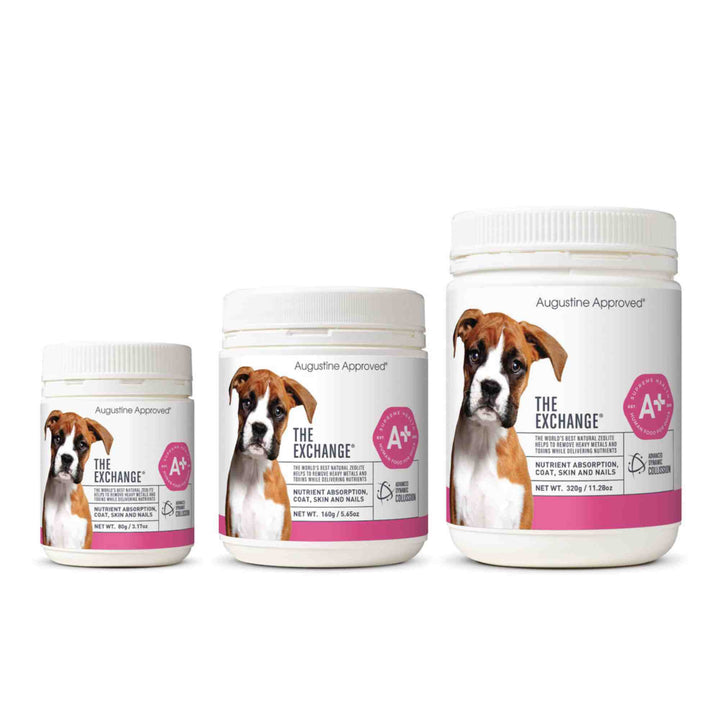
For the load you cannot shop your way out of
The Exchange, Zeolite
A single-ingredient New Zealand clinoptilolite zeolite, micronised using the Dynacol process to increase the reactive surface area. One ingredient, nothing else in the jar. It is intended for pets eating fish, seafood or processed food, and it sits alongside liver support rather than replacing it.
Not recommended for pregnant or lactating animals. Follow the label, and check with your vet before starting anything new alongside prescribed medication.
Choose your jar sizeDaily amounts for adult dogs and puppies, from the product label:
Scroll sideways to see the full table.
| Dog size | Adult daily amount | Puppy daily amount |
|---|---|---|
| Miniature | 1/4 tsp | 1/8 tsp |
| Small | 1/2 tsp | 1/4 tsp |
| Medium | 1 tsp | 1/2 tsp |
| Large | 1.5 tsp | 1 tsp |
| Giant | 2 tsp | 1.5 tsp |
One teaspoon is roughly 1.7g. Mixing the powder with a little water or MCT oil before it goes into the food makes it far easier with a fussy eater.
What this comes down to
Salmon is worth feeding your dog. Wild caught, off the bone, unseasoned, capped at a tenth of the day's calories, rotated with other proteins rather than served daily, and paired with something that helps clear what the ocean sent along with it.
And it is worth noticing what actually did the work in that sentence. Not the fish. The sourcing question. The same question, asked of every other thing that goes in the bowl, is most of what separates a dog who ages well from one who does not. You are already the person who reads labels. This is the same instinct, pointed at the fish counter.
Milka is a senior now, with a snout going white, and she still gets fish a few times a week. Not every day. Wild caught, every time.
Much love, Larry
Please keep in mind that I'm not a veterinarian, and this isn't medical advice. Every pet is unique, so I always recommend working alongside your vet, ideally a holistic or integrative vet, especially for anything ongoing or serious.
Sources
- Hites RA, Foran JA, Carpenter DO, et al. Global Assessment of Organic Contaminants in Farmed Salmon. Science, 2004 — https://www.science.org/doi/10.1126/science.1091447
- Nutrients and contaminants in farmed Atlantic salmon fillet and fish feed from 2006 to 2021. Norwegian Institute of Marine Research, 2025 — https://www.sciencedirect.com/science/article/pii/S2666154325003047
- Roush JK, Cross AR, Renberg WC, et al. Evaluation of the effects of dietary supplementation with fish oil omega-3 fatty acids on weight bearing in dogs with osteoarthritis. JAVMA, 2010 — https://pubmed.ncbi.nlm.nih.gov/20043801/
- Merck Veterinary Manual. Salmon Poisoning Disease and Elokomin Fluke Fever in Dogs. — https://www.merckvetmanual.com/dog-owners/disorders-affecting-multiple-body-systems-of-dogs/salmon-poisoning-disease-and-elokomin-fluke-fever-in-dogs
- Washington State University Veterinary Teaching Hospital. Salmon Poisoning. — https://hospital.vetmed.wsu.edu/2021/10/29/salmon-poisoning/
- LA County Dept. of Public Health, Veterinary Public Health. Animal Health Advisory: Salmon Poisoning Disease in four dogs. 2024 — http://publichealth.lacounty.gov/vet/docs/AHAN/AHAN_SalmonPoisoningDiseaseDogs_04022024.pdf
- FDA. Fish and Fishery Products Hazards and Controls Guidance, Chapter 5 (parasite destruction freezing standards) — https://www.fda.gov/files/food/published/Fish-and-Fishery-Products-Hazards-and-Controls-Guidance-Chapter-5-Download.pdf
- FDA/EPA. Advice About Eating Fish (Best Choices mercury chart) — https://www.fda.gov/food/consumers/advice-about-eating-fish
- Beltcheva M, Metcheva R, Popov N, et al. Modified natural clinoptilolite detoxifies small mammal's organism loaded with lead. Biological Trace Element Research, 2012 — https://pubmed.ncbi.nlm.nih.gov/22147334/
- Kraljević Pavelić S, et al. The Impact of Long-Term Clinoptilolite Administration on the Concentration Profile of Metals in Rodent Organisms. 2023 — https://pubmed.ncbi.nlm.nih.gov/36829471/