Colloidal silver is a liquid suspension of tiny silver particles, and pet parents reach for it for hot spots, cuts, itchy paws, gunky eyes and smelly ears. Here is the honest version. On the skin, silver has a long and genuinely well documented history as an antimicrobial, and veterinary wound references still list it as a topical agent during the inflammatory and repair phases of healing. Given by mouth, it is a different story: there is no established nutritional role for silver, no high-quality evidence of benefit, and real documented risks with long-term use.
In this article
- Topical and internal use are two different questions
- What does the research say about silver on skin and wounds?
- Is it safe to give colloidal silver by mouth?
- But the company that makes it says you can give it internally
- What about ears and eyes?
- What the evidence supports, use by use
- How to use colloidal silver sensibly
- Why does the same spot keep flaring up?
- Sources
If you have landed here, something is probably raw, weeping, smelly or red right now. You have been to the vet. Maybe more than once. There were antibiotics, and they worked, and then six weeks later the same paw was pink again. So you went looking for something gentler, and a dog group told you about silver.
I have been in that exact loop with my own dog, Milka. And what most pet parents are never told is that the internet answers the silver question with one word, safe or dangerous, when the real answer depends entirely on where you are putting it.
Topical and internal use are two different questions
This is the distinction that almost every article on this topic collapses, and it is the reason the advice out there feels so contradictory.
Silver applied to a surface is doing local work. It sits on the wound bed or the skin, it reduces the microbial load in that spot, and very little of it needs to go anywhere else. Silver swallowed is doing something entirely different. It enters the gut, and whatever is absorbed travels through the body and has to be cleared by organs that were not asking for it.
Same bottle. Completely different risk and evidence picture. So when someone tells you colloidal silver is perfectly safe, or that it is dangerous quackery, the first thing to ask is: which use are you talking about?
What does the research say about silver on skin and wounds?
This is the strongest ground silver stands on, and it is not fringe. The Merck Veterinary Manual lists silver among the topical agents used in small animal wound management, noting it is bactericidal, that it is indicated during the inflammatory and repair phases of healing, and that it shows no clinical evidence of resistance developing. That same entry is careful to add that silver can be toxic and that research into its best uses is ongoing.
Here is the thing that makes silver interesting, though. A consensus group of wound care specialists points out that topical antiseptics like silver work differently from antibiotics. An antibiotic usually attacks one mechanism, which is why bacteria learn their way around it. Silver hits multiple sites on the target cell at once, which makes resistance far harder to develop. Their recommendation is specific: use it where there is already an established infection or a heavy microbial load that is holding up healing, for short periods, then reassess.
On the animal side, a 2025 review of silver nanoparticles in veterinary medicine gathers a stack of wound healing studies across species, including faster wound closure in rodent models and better healing with less scarring in an equine limb wound model.
Let's be real for a second about the limits. A 2010 Cochrane review found insufficient evidence to say whether silver dressings actually speed wound healing in people, and a porcine burn study found the dressings did not reduce redness or swelling compared with plain gauze. So the antimicrobial activity is solid and well demonstrated. The claim that silver makes wounds heal dramatically faster is much shakier. What you are reasonably buying is a clean, low sting way to keep the microbial load down on a surface wound while the body does the healing.
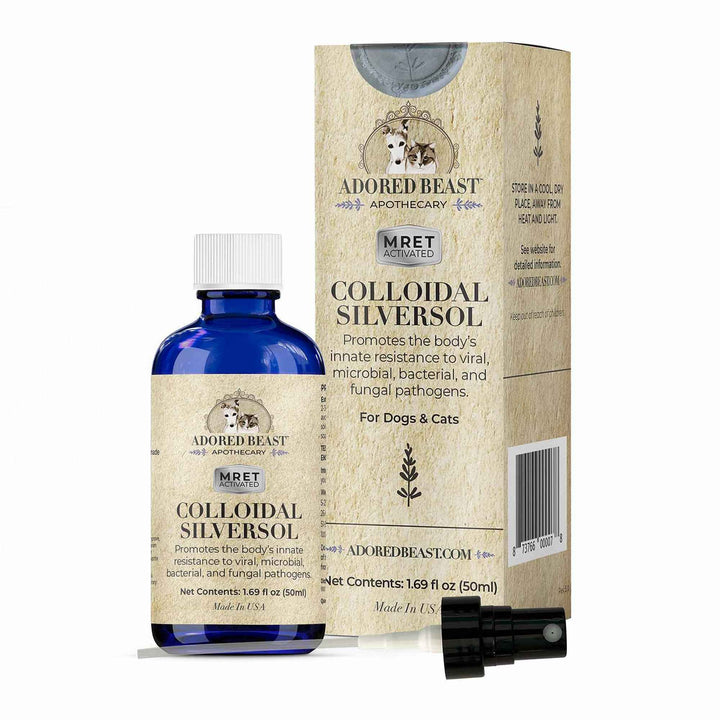
The bottle that lives in our first aid drawer
Colloidal SilverSol by Adored Beast
There are a lot of silver sprays out there and most of them tell you nothing about what is actually in the bottle. This one does. It is pure silver suspended in deionized water with nothing else added, at a stated 10 ppm, and it comes as a fine spray, which matters more than it sounds when you are trying to cover a sore paw on a wriggling dog.
- Silver and deionized water, no fillers, no fragrance, no synthetics
- Spray format for scrapes, grazes, hot spots and raw paw skin
- Stated concentration of 10 ppm printed on the label, so you know what you are applying
- Roughly 400 sprays per bottle, which is a long time for occasional first aid use
Is it safe to give colloidal silver by mouth?
This is where I part company with a lot of holistic content, and I would rather say it plainly than sell you something on a claim I cannot stand behind.
Silver is not a nutrient. It has no known biological role in the body, which means there is no deficiency to correct and no daily requirement to meet. A 2025 toxicology review of oral colloidal silver supplements notes that the US Food and Drug Administration, the European Chemicals Agency, the World Health Organization and Australia's Therapeutic Goods Administration have all discouraged swallowing it, citing the absence of demonstrated benefit and the potential for cumulative toxicity. The same review describes silver nanoparticles accumulating in the liver, spleen, kidneys and brain in animal studies.
The human literature adds two practical points that matter for dogs on medication. Silver taken internally is associated with argyria, a permanent grey blue discoloration of skin and tissue, and it can interfere with the absorption of some antibiotics and thyroid medication. If your dog is on either, that interaction is a real conversation to have with your vet before anything goes in the bowl.
You will notice that products with internal dosing charts, including ours, tell you not to use them for an extended period. That instruction is doing a lot of quiet work. Silver internally is a short, bounded, purposeful thing, if you use it that way at all. It is not a daily immune supplement, and I would not give it to a dog every day for months on the theory that it is keeping infections away.
My position, and it is a position rather than a research finding: I use silver topically without much hesitation, and I would only use it internally on a vet's say so, for a defined reason, for a defined number of days.
But the company that makes it says you can give it internally
They do, and I am not going to pretend otherwise, because you will find their article in about four seconds and I would rather you heard the full picture from me.
Adored Beast, who make the bottle we carry, publish guidance on giving colloidal silver internally for yeast overgrowth, urinary issues, oral health, recovery after surgery, and general immune support. Their reasoning rests on two pieces of proprietary technology. SilverSol, which they describe as silver missing an electron so that it seeks out pathogens and leaves beneficial bacteria alone. And MRET activated water, which they describe as water molecules flattened into a linear shape so they pass into cells more easily.
Here's what I would want you to know before you decide what to do with that.
Their article links one study, and it is a real one. Israeli researchers published work in Scientific Reports in 2015 describing what they called the zombies effect, where bacteria killed by silver nitrate go on to kill living bacteria of the same species. It is good science. It was also done in a culture dish, using silver nitrate rather than a colloidal silver product, on a single bacterial species, with no animal in the picture anywhere. It tells us something interesting about how silver behaves against bacteria on a surface. It tells us nothing about what happens when a dog swallows silver every day.
The two mechanism claims, the selective targeting and the flattened water molecules, do not have published data attached that I was able to find. They may well turn out to be right. For now there is no way for either of us to check them, which is worth knowing when you are weighing up a daily internal dose.
Adored Beast is one of the brands we trust most. Julie Anne Lee, DCH has spent decades in holistic animal health and her formulations sit right across our shelves, which is exactly why we carry this one. On this particular point, their guidance goes a little further than the independent research has gone so far, and I would rather say that to you plainly than have you come across it somewhere else later.
So here is where I land. If you are thinking about giving it internally, follow their label exactly, respect the duration limit printed on it, and have the conversation with your vet first. Ideally a holistic or integrative vet, someone who is comfortable with natural options and with conventional medicine, and who will actually engage with the question rather than wave it away. They can look at your real dog, what else is in the bowl, and what medication is in play. That is the part no article can do for you, including this one.
What about ears and eyes?
Ears and eyes come up constantly in the silver conversation, and they deserve more caution than a hot spot on a shoulder does.
For ears, the useful question is not what to put in the ear. It is why the ear keeps becoming a problem. Recurring ear trouble usually involves yeast, food reactions, environmental allergies, moisture, gut imbalance or ear anatomy, often several at once. Silver may help with the microbial part of one flare. It does nothing about the reason your dog has had four flares this year. And if an ear is painful, swollen, bleeding, heavily discharging, or your dog has a head tilt or has gone off balance, that is a vet visit today, not a home remedy.
Eyes are the one I get asked about most and the one I am most careful with. Eyes are unforgiving, corneal damage moves quickly, and a red or squinting eye can look identical whether the cause is a scratch, a foreign body, an infection or pressure building inside the eye. Those need completely different care, and getting it wrong costs vision. Whatever anyone tells you about silver being gentle enough for eyes, a new eye problem gets examined first.
What the evidence supports, use by use
Here is everything above in one place. This is the table I wish had existed when I first went looking.
| What pet parents use it for | What the evidence actually supports | Where I land |
|---|---|---|
| Minor cuts, grazes, scrapes | Good. Silver is listed as a topical agent in veterinary wound management and is bactericidal with no clinical evidence of resistance | Reasonable first aid use. Keeps the surface clean while the body heals |
| Hot spots, raw paw skin | Reasonable for the microbial load. Nothing in the literature addresses the allergy or yeast driver underneath | Use it on the surface, and go after the cause in parallel |
| Speeding up wound healing | Weak. A Cochrane review found insufficient evidence, and a porcine burn study found no reduction in redness or swelling versus plain gauze | Expect a cleaner wound, not a faster one |
| Recurring ear flare ups | Limited. May reduce microbes in one flare, addresses none of the underlying drivers | Fine alongside a real root cause plan. Not a plan on its own |
| Eye problems | Not established, and eye conditions with identical symptoms need opposite care | Vet first, every time. This is the one I will not hedge on |
| Daily internal immune support | None. Silver has no nutritional role, and major regulators discourage oral use on toxicity grounds | No. This is the use I would ask you to drop |
| Short internal course for a specific reason | Thin, and product labels themselves limit duration. Interacts with some antibiotics and thyroid medication | Only with your vet, for a defined reason and a defined number of days |
How to use colloidal silver sensibly
- Start with the label on your bottle. Concentration and instructions vary between brands, and the label is the only dosing guidance you should follow.
- Patch test a small area first. Silver sensitivity in dogs is uncommon but real. Watch for rash, lethargy or vomiting, and stop if any appear.
- Clean the area before you spray. Silver works on the surface it reaches, so debris in the way makes it less useful.
- Apply, then stop your dog licking it off for a few minutes while it soaks in. A distraction or a short walk is usually enough.
- Give it a defined window. Wound specialists recommend short courses followed by reassessment rather than open ended use. If a spot is not looking better in a few days, that is information, and it means a vet call rather than more spraying.
- Keep internal use out of the routine. No daily dosing, no months on end, and nothing internal at all if your dog is on antibiotics or thyroid medication without checking first.
- Go to the vet for anything deep, bleeding heavily, punctured, bitten, very painful, or involving an eye. Silver is for the minor end of the spectrum.
Why does the same spot keep flaring up?
Here is the pattern I see over and over in our inbox. The paw calms down. Two weeks pass. The licking starts again. The same ear, the same paw, the same patch of belly, on a loop, and every round someone reaches for something to put on it.
When a spot keeps coming back, the spot is a symptom, not the problem. Something is driving it, and in dogs that something is very often yeast overgrowth tied to gut imbalance, a food the dog is reacting to, or an immune system that is stretched. A topical silver spray is a good tool for the flare on the surface. It has no reach at all into the reason the flare exists.
If the paw licking, the smelly ears, the greasy coat and the rusty stains on the fur are showing up together, that is a recognizable pattern, and we wrote it up properly in Yeast in Dogs: Why It Keeps Coming Back, and How to Support the Gut at the Root. For dogs already in that loop, the Yeasty Beast Protocol works on the gut side over several weeks rather than on the surface. If you would rather start with the bigger picture of how digestion sits underneath skin, ears and immunity, start with Dog Gut Health: The Root of Whole-Body Wellness. And if you want a gentler topical option for irritated skin, calendula is worth knowing about.
None of this is fast. It took months with Milka, and there were weeks where I was certain it was not working. But the difference between managing flares forever and being done with them is whether anyone ever went after the cause.
The bottom line on colloidal silver for dogs
Keep a bottle in the first aid drawer. Use it on the outside of your dog, on the minor things, for short stretches. Do not put it in the water bowl every day, do not use it as an immune supplement, and do not let it become the reason a recurring problem never gets properly investigated.
You are not alone, so many pet parents go through this exact loop before anyone tells them the difference between calming a flare and addressing what causes it. If you are somewhere in it right now and would like a second pair of eyes, our team reads every message and we are happy to help you think it through. None of us are veterinarians, and nothing here replaces your vet knowing your dog.
Sources
- Merck Veterinary Manual. Topical Agents in Wound Management in Small Animals. merckvetmanual.com
- Appropriate Use of Silver Dressings in Wounds: an expert working group consensus. Wounds International. woundsinternational.com
- Silver Nanoparticles as Antimicrobial Agents in Veterinary Medicine: Current Applications and Future Perspectives, 2025. PMC11820087
- Potential Toxicological Risk Associated with the Oral Use of Colloidal Silver Dietary Supplements. Toxics, 2025. mdpi.com
- Comparative Evaluation of Silver-Containing Antimicrobial Dressings on In Vitro and In Vivo Processes of Wound Healing, citing the 2010 Cochrane review. PMC3471607
- Comparison of the efficacy of silver-based antimicrobial burn dressings in a porcine model of burn wounds. Burns. sciencedirect.com
- Ben-Knaz Wakshlak R, Pedahzur R, Avnir D. Antibacterial activity of silver-killed bacteria: the "zombies" effect. Scientific Reports, 2015. pubmed.ncbi.nlm.nih.gov
- Adored Beast Apothecary. Benefits of Colloidal Silver for Pets, and How to Find the Right One, 2022. Manufacturer guidance, cited as the manufacturer's stated position rather than as independent evidence. blog.adoredbeast.com
- Children's Hospital of Philadelphia. Colloidal silver: many risks, no health benefits, 2026. chop.edu
- National Capital Poison Center. What is colloidal silver? Is it safe? poison.org