If your dog has diarrhea and is otherwise bright, drinking and alert, the first 24 hours come down to four things: check the red flags that mean a vet today, keep water available at all times, feed small and highly digestible meals rather than starving them, and write down everything they ate, did and came into contact with in the last two days. Most dog diarrhea in a healthy adult settles on its own. In one placebo-controlled trial, close to nine in ten dogs with sudden diarrhea were back to normal stools within a week with no medication at all.
So the job in the first day is not to force the gut to stop. It is to rule out the causes that need help today, keep your dog hydrated, support the gut lining while it recovers, and gather the information that tells you why this keeps happening.
In this article
Let's be real for a second. Nobody is calm at 6am standing over a mess on the kitchen floor wondering whether this is nothing or something. I have been there with Milka more times than I can count. She is a French Bulldog who spent her first year with a gut that fell apart at the smallest thing, and even now, as a healthy senior, she still has the occasional loose day out of nowhere.
What changed for us was not finding one magic thing to give her. It was having a sequence. Check, hydrate, feed gently, support, and write it down. That last step is the one almost nobody talks about, and it is the one that eventually told us what was setting her off.
When is dog diarrhea an emergency, and when can you wait?
This is the only part of the first 24 hours that is not negotiable. Before anything else, run through this list. Veterinarians at Cornell's Riney Canine Health Center are clear that while many cases in dogs and cats are mild and settle themselves, some signs mean your dog needs to be seen.
Call your vet today if any of these are present:
- Black, tarry stool. This is partly digested blood, and it points higher up the digestive tract.
- Fresh blood in the stool, especially more than a streak, or with any other sign on this list.
- Vomiting alongside the diarrhea. Losing fluid from both ends speeds up dehydration sharply.
- Lethargy, or refusing food. A dog who will not get up or will not eat is telling you something beyond an upset gut.
- A puppy. Vomiting and diarrhea in a young or unvaccinated dog needs a parvovirus test. Cornell notes that parvo usually starts with low energy and a drop in appetite before the diarrhea shows up, so waiting for blood in the stool wastes time you do not have.
- A senior dog, or a dog with a known condition such as kidney, liver or heart disease.
- A dog who may have eaten something they should not have, including a toy, a bone, a plant, or anything from a bin.
- Diarrhea that is still going after 48 hours, or that is getting worse rather than better.
None of those on the list? Your dog is bright, drinking, wagging, and the only thing that is wrong is the stool? Then the rest of this article is for you.
Should you withhold food when your dog has diarrhea?
Here's what most pet parents are never told. The advice you will find on nearly every page you open, to withhold food for 12 to 24 hours, is one of the most repeated pieces of pet care guidance there is, and the evidence underneath it has been moving for years.
The original reasoning was that resting the gut gives it a chance to calm down. It sounds obvious. But the cells lining the intestine draw much of their fuel directly from what passes through the gut, and when nothing passes through, they start to suffer. Veterinary nutrition reviews now link fasting to shortened intestinal villi, the tiny finger-like structures that absorb nutrients, and to a greater risk of bacteria crossing the gut wall.
The clearest evidence comes from a study in puppies with severe parvovirus. One group was fed from twelve hours after admission. The other was held off food until the vomiting stopped, which took around fifty hours on average. The early-fed puppies improved faster on mood, appetite, vomiting and stool, gained weight, and showed a better gut lining, while the fasted group's lining got worse.
That is a severe illness, not a mild upset, so it does not translate one to one. Veterinary opinion has not fully converged either: some clinical guidance still supports a short rest from food for around 24 hours in an adult dog who is actively vomiting, while specifically warning against withholding food from puppies for longer than about twelve hours.
So here is the honest version. If your adult dog is vomiting and cannot keep anything down, a short pause from food is reasonable, and that is a moment to call your vet anyway. If your dog has diarrhea but no vomiting and is otherwise well, feeding small amounts of the right food is better supported than starving them. When in doubt, ask your own vet what applies to your dog rather than following a rule of thumb from a search result. Mine included.
What should you feed a dog with diarrhea?
The principle is highly digestible, low fat, small portions, offered often. Think three to four small meals across the day instead of one or two normal ones, so an inflamed gut is never handed more than it can process at once.
In practice that means a simple, plain, low-fat option your dog already tolerates. It also means everything else comes off the menu for a day or two. No chews. No dental sticks. No scraps from your plate. No new topper you were meaning to try. This is not about being strict for the sake of it. Every extra thing you add is one more variable, and if you want to work out what caused this, you need the picture clean.
One more thing worth knowing: if the diarrhea started right after a food change, going back to the previous food until stools firm up, then transitioning much more slowly, is often all that is needed. A rushed switch is one of the most common causes of the whole episode.
And if your dog is mid-transition to raw or fresh food, some looseness in the first days is expected as the digestive system adjusts. That is a different situation from a dog who was stable and suddenly is not.
What about water and dehydration?
Water is the part that is never restricted. Diarrhea moves everything through too fast for water to be absorbed properly, and it leaves the body with the waste instead. Over a day or two that adds up, and dehydration puts real strain on the kidneys.
Keep fresh water down at all times and encourage small, frequent drinks rather than one large bowlful at once. A dog who cannot keep water down, or who is clearly drinking far less than usual, is a dog who needs to be seen rather than watched.
Does a dog with diarrhea need antibiotics?
This one surprises a lot of pet parents, because so many of us have walked out of an appointment holding a box of metronidazole.
The 2022 antimicrobial stewardship guidelines from the American Animal Hospital Association and the American Association of Feline Practitioners state plainly that most acute diarrhea is either not caused by bacterial infection or resolves on its own, so antimicrobials are not indicated, do not speed up recovery, and can push the gut further into imbalance.
A randomised, double-blinded, placebo-controlled trial found the same thing from the other direction: dogs with sudden diarrhea reached acceptable stool consistency in around three and a half days on a probiotic, four and a half days on metronidazole, and a little under five days on placebo, with no statistically significant difference between the three groups. And the cost of the antibiotic route is not zero. One study tracking dogs given metronidazole found measurable disruption to the gut microbiome for at least four weeks afterwards.
None of that is a reason to argue with your vet, and there are real situations where antibiotics are the right call, including signs of sepsis or a dog who is not improving with supportive care. It is a reason to be able to ask a good question. "Do you think this needs an antibiotic, or would supportive care and a recheck in 48 hours be reasonable here?" is a question any vet will respect. If your dog does end up on a course, rebuilding the gut afterwards matters more than most people realize.
What can you give a dog with diarrhea at home?
Two things have reasonable support behind them, and I want to be straight with you about how strong that evidence actually is, because I would rather you trust me on the next thing I tell you.
Probiotics. The research is genuinely mixed. A large placebo-controlled trial across primary care practices in the UK and Ireland found dogs given a probiotic paste recovered in a median of 32 hours versus 47 hours on placebo, a meaningful difference when you are the one cleaning the floor. The trial I mentioned above found no significant difference. So the honest summary is that some probiotic strains shorten some episodes for some dogs, the effect is not dramatic, and the downside risk is very low. That is a reasonable thing to reach for, and it is not a promise.
Soluble fibre. This is the one that does the visible work. Soluble fibre absorbs excess water in the bowel and gives loose stool something to hold onto, which is why fibre keeps appearing in digestive support products across the board.
Which is exactly why the two things I keep in the cupboard are a soothing pre and probiotic blend, and a fibre topper. Not five products. Two, used together, at the first loose stool rather than on day three when everyone is exhausted.
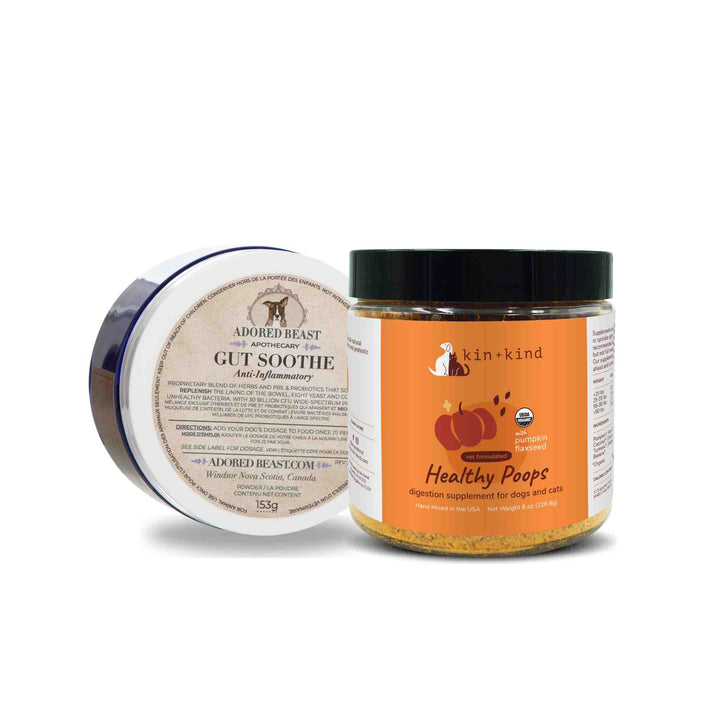
What I keep in the cupboard for Milka
Diarrhea Support Bundle for Dogs
Two products, not a shelf of them. Gut Soothe is a pre and probiotic blend with slippery elm, marshmallow root and L-glutamine, herbs chosen to calm an irritated gut lining rather than override it. Organic Healthy Poops adds the soluble and prebiotic fibre that helps bulk up loose, watery stool. One works on the lining, one works on the stool, and together they cover what a bad day actually needs.
- 14-strain probiotic blend with functional prebiotics
- Fibre from organic pumpkin, flax, coconut and chicory root
- No maltodextrin, cellulose, animal fat or fillers
- Choose your sizes for the gut blend and the fibre topper
- Many pet parents report a difference inside the first day, and some dogs need longer
I am not a veterinarian, and this is not medical advice. Every dog is different, so for anything ongoing or serious, work alongside your vet, ideally a holistic or integrative one.
The first 24 hours at a glance
Scroll sideways to see the full table.
| When | What to do | Why it matters |
|---|---|---|
| First hour | Run the red-flag list above | Some causes need a vet the same day |
| All day | Leave fresh water down at all times | Fluid loss is the main risk |
| Hours 1 to 2 | Offer a small, low-fat, digestible meal | The gut lining recovers better with fuel |
| Every 3 to 4 hours | Repeat small portions, not large ones | Big meals overwhelm an inflamed gut |
| All day | No chews, no scraps, no new extras | One variable at a time keeps it readable |
| First loose stool | Start gut support and fibre | Earlier support beats day-three support |
| All day | Log food, water, walks, stress, stool | Patterns show up only when written down |
| 48 hours | Still loose or worse, call your vet | Two days is the usual line for a check |
Why does my dog keep getting diarrhea?
Here is the part I wish someone had told me years earlier.
Every now and then Milka gets diarrhea and we have no idea why. She is a senior now, she eats well, and it still happens. For a long time we did what everyone does. We fixed the episode, felt relieved, and moved on. Then it happened again six weeks later and we had nothing to compare it to, because nobody had written anything down.
So we started keeping a pet journal. Not a beautiful one. A WhatsApp group between myself and Charly on the phone. We document what she ate, including the exact brand and batch. What she did. Where we walked. Who she met. Anything new in the house, from a cleaning product to a visitor. Her stool, every day, not only the bad ones.
Within a couple of months the pattern was obvious in a way it had never been in my memory. That is not a PAWDEGA theory, by the way. It is how veterinary dermatologists and nutritionists run food trials: an elimination period, then foods reintroduced one at a time, with the owner keeping a written log of what went back in and what happened after. The reason the log exists is that human memory is genuinely unreliable at exactly this task.
It also explains why these trials run long. In the largest review of its kind, more than eight in ten dogs with a food-related reaction had settled by five weeks on an elimination diet, and over nine in ten by eight weeks. A two-week experiment tells you almost nothing. That is not a reason to be discouraged. It is a reason to start writing today rather than starting over in three months.
What to write down, every single day:
- Food. Everything. Brand, protein, batch number, and the exact time.
- Extras. Chews, dental sticks, table scraps, the biscuit from the neighbour.
- Water. Roughly how much, and whether it changed.
- Stool. Consistency, colour, frequency. A photo takes two seconds and beats a description.
- Where you walked and what they picked up, licked, or rolled in.
- Stress and routine. Guests, travel, building work, a night alone, a new dog on the street.
- Products. Flea and tick applications, wormers, vaccines, medications, shampoos, floor cleaners.
- Anything else new. If you had to think about whether to write it down, write it down.
The thing nobody warns you about is that the trigger is often not food at all. For us, some of Milka's worst stretches lined up with stress and with things she had come into contact with, not with anything in her bowl. You will never see that connection without a record.
And if you have already been through the loop of an episode, a recovery, and a return, this next guide is the one I would hand you. It covers the digestive conditions that hide behind "my dog keeps getting diarrhea and nobody can tell me why", including pancreatitis, EPI and SIBO.
What if the diarrhea keeps coming back?
One bad day is a bad day. A pattern is information. If your dog has had loose stool more than a few times in a couple of months, the question changes from what do I give today to what is going on underneath.
Common threads worth looking at with your vet: a microbiome knocked off balance by a recent course of antibiotics or steroids, a diet the gut cannot cope with long-term, parasites, and stress, because the gut and the nervous system are far more connected than most of us were taught. There is a reason so much of a dog's whole-body health traces back to the gut.
If the picture includes a lot of gas and bloating with the loose stool, it is worth reading about SIBO in dogs and why it gets missed. If your vet has already used the words inflammatory bowel disease, start with what IBD in dogs really means and where to start.
You are not powerless here, and you are not overreacting for taking it seriously. A dog's gut is not supposed to fall apart every few weeks, and "sensitive stomach" is a description, not an explanation. Keep the journal, work with a vet who will look for the cause with you, and support the gut while you figure it out.
I am rooting for you, and your dog, every step of the way.
Much love, Larry
Sources
- Langlois DK, Koenigshof AM, Mani R. Metronidazole treatment of acute diarrhea in dogs: a randomized double blinded placebo-controlled clinical trial. Journal of Veterinary Internal Medicine, 2020. Link
- American Animal Hospital Association and American Association of Feline Practitioners. 2022 AAFP/AAHA Antimicrobial Stewardship Guidelines. Link
- Cornell University College of Veterinary Medicine, Richard P. Riney Canine Health Center. Diarrhea: worry or wait? Commentary from Dr. Meredith Miller. Link
- Cornell University College of Veterinary Medicine, Richard P. Riney Canine Health Center. Parvovirus: transmission to treatment. Link
- Woods-Lee G. Nutritional management of acute gastroenteritis. Today's Veterinary Nurse, 2023. Reports the Mohr et al. 2003 early enteral nutrition findings in canine parvoviral enteritis, and the guidance against prolonged withholding of food in puppies. Link
- Purina Institute. Nutritional management of acute gastroenteritis. Summarises evidence linking fasting to reduced villus height and increased bacterial translocation. Link
- Nixon SL, Rose L, Muller AT. Efficacy of an orally administered anti-diarrheal probiotic paste in dogs with acute diarrhea: a randomized, placebo-controlled, double-blinded clinical study. Journal of Veterinary Internal Medicine, 2019. Link
- Shmalberg J, Montalbano C, Morelli G, Buckley GJ. A randomized double blinded placebo-controlled clinical trial of a probiotic or metronidazole for acute canine diarrhea. Frontiers in Veterinary Science, 2019. Link
- Olivry T, Mueller RS, Prélaud P. Critically appraised topic on adverse food reactions of companion animals (1): duration of elimination diets. BMC Veterinary Research, 2015. Link
- Elimination diet trials: steps for success and common mistakes. Today's Veterinary Practice, 2023. Source for the owner logbook used during dietary rechallenge. Link