Tear stains in dogs are a surface sign of something happening underneath. The rust-colored marks under the eyes come from porphyrins, iron-rich pigments carried in tears that darken when they meet the air, and from yeast and bacteria multiplying in fur that never gets a chance to dry. That means the real question is not how to lift the color out of the coat. It is why the eyes are producing or holding more moisture than they drain, and why the damp skin underneath has become such a comfortable place for yeast to settle in.
Put plainly: tear staining is a moisture problem and a microbiome problem, and the fur is only where you happen to see it.
On this page
- What causes tear stains in dogs?
- Are my dog's tear stains a yeast sign?
- When do tear stains need a vet, not a supplement?
- How do you support the eyes while the gut work happens?
- What is the step-by-step plan?
- What if this is part of a bigger yeast picture?
- Do tear stain powders and wipes work?
- How long does it take for tear stains to fade?
- Sources
If you have been wiping that same patch of fur every morning for months, you already know how this goes. You buy the wipes. You buy the powder. You trim the hair. It looks better for a week. Then it creeps back, a little darker than before, and you are standing at the bathroom sink at 7am wondering what you are missing.
You are not missing anything obvious. You have been handed a cosmetic answer to a question that was never cosmetic.
What causes tear stains in dogs?
Two separate things have to happen before you see a stain.
First, the eye has to stay wet. Veterinary Partner describes excessive tearing, called epiphora, as coming from either irritation to the eye or a failure of tears to drain away properly. Tears are supposed to run down a duct at the inner corner and out through the nose. When something irritates the eye, or when that duct is narrow, kinked or blocked, the overflow spills onto the face instead.
Second, that permanently damp fur becomes habitat. Veterinary Partner is direct about this: the reddish brown color comes from tear pigments called porphyrins, or from secondary yeast infections in the skin. Not one or the other as a rule. Often both at once, layered.
This is the part almost nobody explains. Warmth, trapped moisture and poor airflow are the exact conditions Malassezia yeast likes best. The World Association for Veterinary Dermatology consensus guidelines list skin folds as a common risk factor for localized yeast disease, and name the facial folds, the lip folds and the chin among the sites most often affected. Those same guidelines note that yeast at the nail folds produces a red brown staining of the claws. Same organism, same damp crevice, same rusty color, a different part of the dog.
Face shape stacks the odds. A Royal Veterinary College study using VetCompass primary care records found English Bulldogs carried roughly 49 times the odds of skin fold dermatitis compared with crossbred dogs, French Bulldogs roughly 26 times, and Pugs roughly 16 times. Shallow orbits, a shortened muzzle and heavy folds, the brachycephalic build, mean more tear overflow and less ventilation on the skin it lands on.
So a flat-faced dog is not staining because the breed is doomed to it. It is staining because its face holds moisture longer, and what grows in that moisture is the same thing that grows between the toes of a dog who licks his paws all day.
Are my dog's tear stains a yeast sign?
Sometimes yes, often no. The honest way to find out is to stop looking at the face and look at the whole dog.
Holistic veterinarian Julie Anne Lee, DCH, who formulated the protocols we carry, counts tear staining as one signal on a longer list. Here is that list. Count only what your dog shows right now, not something that cleared up two years ago.
- A musty, cheesy, or corn chip smell, which is the single most telling one
- Rust or brown staining on the paws, plus staining at the corners of the mouth
- Smelly, waxy or thickened ears, or ears that keep flaring up
- Damp, weepy itchy patches rather than dry flaky ones
- Darkening skin, particularly in the armpits, groin and between the toes
- Scooting, or licking around the back end and genitals
- Repeat bladder infections
If tear staining is the only box ticked, this is very unlikely to be a yeast story, and a yeast protocol is the wrong first move. If you are ticking two, three or four boxes, the staining under the eyes is one visible corner of something systemic, and you now have a much better explanation than "he is a stainy breed."
Worth knowing: darkening skin also shows up with hypothyroidism, and low thyroid makes yeast worse. It is a reasonable thing to ask your vet to check. A vet can also confirm yeast quickly with a simple tape or slide impression of the skin, which is a fair thing to request instead of accepting a combined steroid and antifungal drop by default.
Scroll sideways to see the full table.
| What you are seeing | Most likely driver | Where to start |
|---|---|---|
| Staining only, no other signs, since puppyhood | Face shape and tear drainage | Vet eye exam, then a daily drying routine |
| Staining plus odor, brown paws, gunky ears | Yeast overgrowth with a gut driver | Yeast protocol first, then gut repair |
| Staining plus loose stool or itchy skin | Gut inflammation, no yeast picture yet | Gut repair protocol and a diet review |
| Sudden staining, squinting, pawing at the face | Pain, injury, or a blocked tear duct | Same-week vet visit, no supplements yet |
When do tear stains need a vet, not a supplement?
Before you change anything in the bowl, rule out the mechanical causes. Eyelashes growing inward, eyelids rolling in or out, a duct that never opened properly, a scratch on the surface of the eye, glaucoma. None of those respond to diet, and all of them are uncomfortable for your dog while you experiment.
Two questions worth asking at that appointment, which move the conversation past "it is cosmetic" without putting anyone on the defensive:
- Can we check whether the tear ducts are draining, and whether the eyelids and lashes are sitting correctly?
- Can we take a skin impression from the stained area so we know whether yeast is part of this?
If you want a second opinion from someone who works this way routinely, our list of holistic vets offering online consultations is a good place to start. None of what follows replaces that conversation. I am a pet parent who went deep on this, not a veterinarian.
How do you support the eyes while the gut work happens?
Here is the gap most pet parents fall into. You commit to the internal work, which is right, and then you spend eight weeks watching a face that still looks damp and irritated, because the gut takes time and the eye is uncomfortable now.
Two things help in the meantime, and neither one is a stain remover.
The first is mechanical and free. Moisture is what sets the stain, so the goal is a face that spends less of the day wet. Wipe the inner corners with a fresh damp cotton pad, one per eye, sweeping away from the corner rather than back toward it. Then dry the area properly. A tidy trim of the hair at the inner corners makes a real difference, because shorter hair wicks less.
The second is herbal support for the eye itself, which is where I point pet parents while the deeper work is underway.
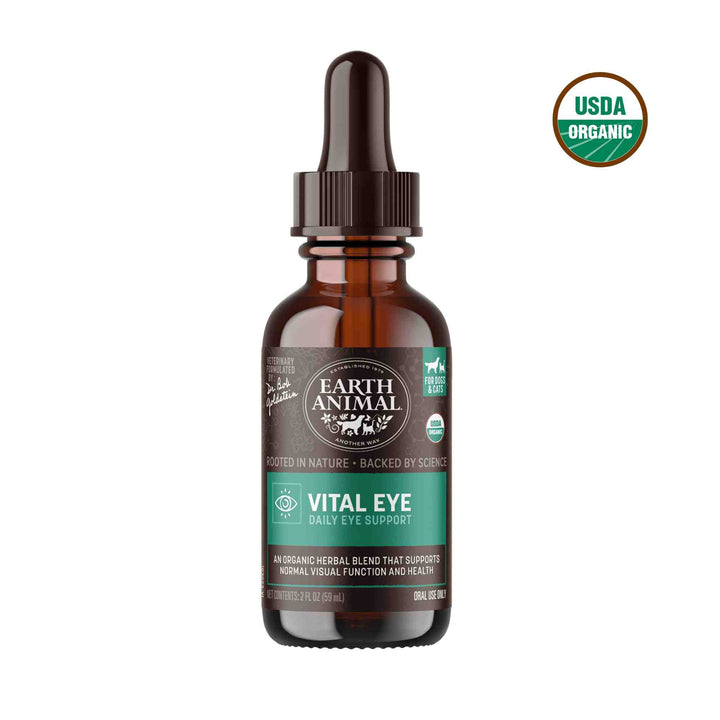
What I recommend for the eyes themselves
Vital Eye by Earth Animal
Most eye products for staining target the fur. This one targets the eye. It is an organic herbal blend formulated to support healthy eye function and comfort, which is what you actually want while the gut side of the work is still catching up. It is support, not a stain remover, and I would rather tell you that than sell you a promise.
- Organic and wildcrafted eyebright, chamomile, ginkgo, lycium and bayberry
- Formulated by Dr. Bob Goldstein, VMD, and made in Vermont
- Liquid drops dosed by weight, into the mouth, food or water
- Zero synthetics, zero fillers, zero additives
- Suitable for dogs and cats
What is the step-by-step plan?
Order matters more than the number of products. This is the sequence I would give a friend.
- Get the eye examined. Rule out lashes, lids, ducts and pain before you change anything else.
- Count the yeast signals. Use the list above and write down what your dog shows today. This one step decides everything that follows.
- Take the sugar load down. Less processed food, fewer starchy chews, no root vegetables or fruit in the bowl while you are working on this. Julie Anne Lee's protocol instructions ask for two weeks of this before any herbs go in, and skipping it is the most common reason things go badly.
- Run the right protocol for what you counted. Multiple yeast signals go to a yeast protocol first, then gut repair. Tear staining with digestive or skin signs but no yeast picture goes straight to gut lining repair.
- Keep the face dry daily while you wait. The internal work and the drying routine are not alternatives. They are two halves of the same job.
Why the gut at all, when the problem is on the face? Because of the gut-skin axis, and that link is now reasonably well documented in dogs. A 2023 study in Microbiome found dogs with atopic dermatitis carried a measurably different gut and skin microbial makeup compared with healthy dogs of the same breed. A 2025 trial in BMC Microbiology followed 23 dogs with atopic skin disease and 11 healthy ones, and found daily probiotics over 16 weeks significantly lowered clinical severity, with the dogs who improved most being the ones whose gut diversity rose.
Diet matters too, though I want to be straight with you about how much. A large Finnish study in Royal Society Open Science found diet was the single lifestyle factor most strongly linked to a dog's gut bacteria. The same study found the diet-driven changes and the allergy-driven changes were not the same changes. Food moves the microbiome. It is not a lever that reaches every symptom directly, and anyone telling you one bag of food fixes this is overselling it.
Fats are the better documented piece. In a randomized, double-blind, placebo-controlled trial published in BMC Veterinary Research, 40 dogs with atopic dermatitis ate either a diet enriched with omega-3s, antioxidants and polyphenols or a control diet for 60 days. The enriched group's skin lesion scores fell by 49 percent by day 60. The control group did not change. If you want the detail on sourcing, where the omega-3 comes from matters more than the label claim.
What if this is part of a bigger yeast picture?
If you counted several signals, the face is not the project. The whole dog is.
This is where I will tell you what we see rather than what a study says, and label it clearly as that. Tear staining fading is one of the changes pet parents report back to us most often after working through the Yeasty Beast Protocol, usually alongside the smell going and the paws lightening. It comes up frequently enough that PAWDEGA lists chronic tearing on the protocol page as one of the signs it is built for. That is observation across a customer base, not a controlled trial, and I would rather you hear the difference from me than find out later.
Two things to understand before you start anything. Yeast gets harder to shift the harder you hit it, which is why the gentle, sequenced approach exists at all. And dogs quite often look worse before better as yeast dies off and releases its toxins, a pattern worth reading about in advance so it does not frighten you into quitting in week two. We wrote about yeast die-off and why dogs get worse before they get better for exactly that reason, and the wider picture lives in our guide to why yeast in dogs keeps coming back.
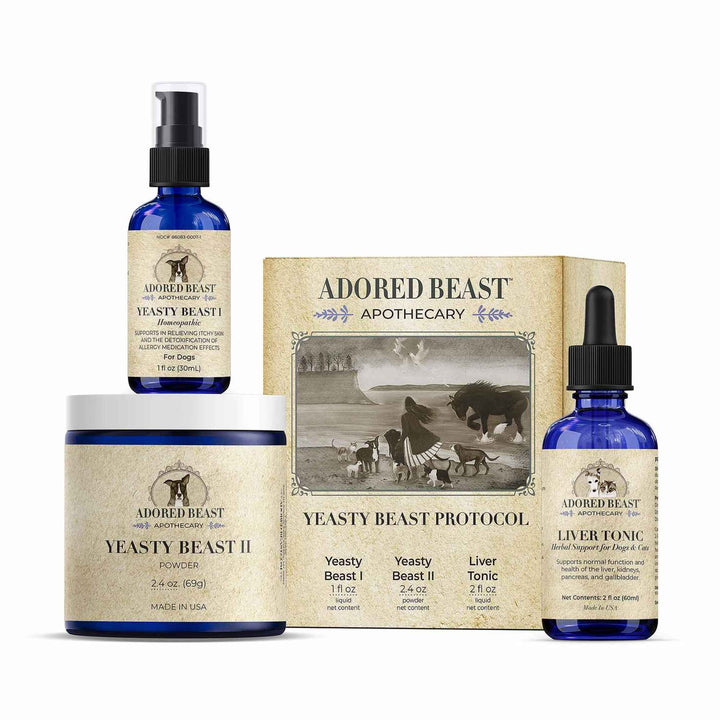
If you counted more than one signal
Yeasty Beast Protocol
A sequenced three-part kit from Julie Anne Lee, for the dog whose staining sits alongside the smell, the ears and the paws. It is not an eye product and it is not a faster version of one. It is the whole-dog route, done in an order designed to avoid a harsh die-off.
- Liver Tonic, Yeasty Beast I and Yeasty Beast II, used in sequence
- Starts with a two-week diet change before any herbs
- Deliberately carries no conventional probiotics, by design
- Followed by the Leaky Gut Protocol, which is not optional for lasting results
Do tear stain powders and wipes work?
Search dog tear stains and nearly everything that comes back is aimed at the fur. Some of it earns its place. Some of it does not.
Wipes and a careful drying routine genuinely help, because they remove the moisture the whole problem depends on. Keep doing that.
The oral stain powders are a different matter, and there is publicly available regulatory information worth knowing. In August 2014, the FDA issued warning letters to the makers of several well-known tear stain products because they contained tylosin tartrate, an antibiotic that is not approved for use in dogs or cats, and not approved for anything to do with tear staining. The agency warned that continued marketing could lead to seizure of the products or an injunction against the companies. A further FDA warning letter went out in 2017 to another company selling a tylosin-containing tear stain powder.
Think about what that product is asking of you. A low dose of an antibiotic, in the food, every day, for the life of the dog, for a cosmetic outcome. Set aside antibiotic resistance for a second and think about the gut you are dosing. Repeated antibiotics are one of the reliable ways to flatten a dog's microbial diversity, which is the same diversity the research above links to calmer skin. You can end up feeding the root cause in order to hide the symptom.
Optical brighteners, heavy fragrance and bleaching agents around the eye belong in the same bin. If the skin under the stain is already irritated, you are adding to it. A gentle certified organic shampoo and plain water do more good than anything with a whitening claim on the front.
How long does it take for tear stains to fade?
Longer than you want, and I am not going to compress it to sound better.
Two separate clocks are running. The stained hair you can see today is already colored and stays colored until it grows out or is trimmed off, which takes months on a small breed's face. What you are actually watching for is the new hair coming in at the inner corner. If that growth is coming through clean, it is working, even while the old stain sits there looking unchanged.
The second clock is the internal one. The probiotic trial above ran 16 weeks. The diet trial ran 60 days. Neither is a quick fix, and yeast that took two years to build does not clear in a fortnight.
So do what the pet parents who succeed at this do: write it down before you start. Photograph the face in the same light once a week. Note the smell, the ear flare-ups, the paw licking, the stool. Small wins arrive in those places long before the face looks different, and pet parents who are not tracking them quit right at the point it is starting to work.
If your dog has been ticking these boxes for a long time, or has been through rounds of medication for skin flare-ups, please write to us before you order anything. Our Pet Wellness Care Advisors will help you pick the right starting point at no cost. I would rather you spent nothing and got the sequence right than spent money on the correct product in the wrong order.
You are not failing your dog. You were handed a cosmetic answer to a question nobody sat down and explained. Now you have the explanation, and you have somewhere sensible to start.
Much love,
Larry
I am not a veterinarian and this is not medical advice. Every pet is unique, so I always recommend working alongside your vet, ideally a holistic or integrative vet, especially for anything ongoing or serious.
Sources
- Veterinary Partner, VIN. Runny Eyes (Epiphora) in Dogs.
- Bond R and colleagues. Biology, diagnosis and treatment of Malassezia dermatitis in dogs and cats. Clinical Consensus Guidelines of the World Association for Veterinary Dermatology. Veterinary Dermatology, 2020. Link.
- Bond R and colleagues. Malassezia Yeasts in Veterinary Dermatology: An Updated Overview. Frontiers in Cellular and Infection Microbiology, 2020. Link.
- O'Neill DG, Rowe D, Brodbelt DC, Pegram C, Hendricks A. Ironing out the wrinkles and folds in the epidemiology of skin fold dermatitis in dog breeds in the UK. Scientific Reports, 2022. Link.
- Thomsen M and colleagues. A comprehensive analysis of gut and skin microbiota in canine atopic dermatitis in Shiba Inu dogs. Microbiome, 2023. Link.
- Song H, Mun SH and colleagues. Probiotics ameliorate atopic dermatitis by modulating the dysbiosis of the gut microbiota in dogs. BMC Microbiology, 2025. Link.
- Sinkko H, Lehtimaki J, Lohi H, Ruokolainen L, Hielm-Bjorkman A. Distinct healthy and atopic canine gut microbiota is influenced by diet and antibiotics. Royal Society Open Science, 2023. Link.
- de Santiago MS and colleagues. Randomized, double-blind, placebo-controlled clinical trial measuring the effect of a dietetic food on dermatologic scoring and pruritus in dogs with atopic dermatitis. BMC Veterinary Research, 2021. Link.
- U.S. Food and Drug Administration. Warning letters issued to manufacturers of unapproved tear stain removers containing tylosin tartrate, August 2014, and a further warning letter issued in 2017. 2017 warning letter.
- Julie Anne Lee, DCH RCSHom, on the Next Level Pet Parent Podcast: yeast signals, protocol sequencing and die-off.