EPI in dogs, or exocrine pancreatic insufficiency, is what happens when the pancreas stops making enough digestive enzymes to break food down. The food passes through without being absorbed, so the dog eats well and loses weight anyway. Enzyme replacement, given with every meal for life, is the foundation of managing it. But it is not always the whole answer.
Here is the part that most pages leave out: roughly two thirds of dogs respond well to enzyme replacement alone, while about one in five responds poorly, usually because bacterial overgrowth in the small intestine and a low vitamin B12 level are sitting underneath the enzyme shortage. If your dog is on enzymes and still having loose stools, that second layer is the first place I would look.
In this article
A while ago I sat down with Julie Anne Lee, DCH, RCSHom, the founder of Adored Beast Apothecary, for an episode of the Next Level Pet Parent Podcast on pancreatitis, EPI and SIBO. She spent decades in holistic veterinary clinics before she started formulating, and I wanted to ask her the question we get more than almost any other.
Why do these digestive cases keep coming back?
Her answer reframed the whole thing for me. In her experience, a dog stuck in a loop of loose stools and weight loss is often carrying more than one problem at once. Pancreatitis, EPI and small intestinal bacterial overgrowth can each create the conditions for the next one. And when only one of them is being addressed, the dog never quite gets clear. That idea turned out to have a surprising amount of published research behind it, which is what this article is really about.
What is EPI in dogs?
The pancreas has two jobs. One is hormonal, regulating blood sugar. The other is digestive, making the enzymes that break down fat, protein and starch so the body can absorb them. EPI is a failure of the second job.
According to the Merck Veterinary Manual, EPI is less common in dogs than pancreatitis, but it is still the second most common disorder of the exocrine pancreas.
Here is the detail that explains why so many pet parents feel blindsided. Signs do not appear until more than 90% of that enzyme-producing capacity is already gone. Veterinary education material from the Royal Canin Academy describes EPI as underdiagnosed for exactly this reason. Your dog can be losing pancreatic function for a long stretch while looking completely normal on the outside.
So if you are sitting with a new result and wondering how you missed it, you did not miss it. There was very little to see.
Is EPI the same as pancreatitis?
No, and the difference matters because it changes what you are dealing with long term.
Research published in Veterinary Sciences describes two separate routes into EPI. The common one is pancreatic acinar atrophy, where the immune system infiltrates and destroys the enzyme-producing tissue. The rarer route is acquired, arriving through chronic pancreatitis or a pancreatic tumour. In dogs, the atrophy route is by far the more frequent of the two, which is the reverse of the pattern seen in people and in cats.
The atrophy form runs in families. Work published in the Journal of Veterinary Internal Medicine points to autosomal recessive inheritance in German Shepherds, and an earlier study of two multigenerational American pedigrees found EPI in 19 of 135 dogs, or 14.1%. Rough Collies show a similar picture.
This table is the one I wish someone had handed us six years ago, because these three conditions overlap constantly and the differences are subtle.
| What you notice | EPI | Bacterial overgrowth (SIBO) | Chronic pancreatitis |
|---|---|---|---|
| Appetite | Ravenous, often frantic | Increased, but less extreme | Often goes off food |
| Energy | Usually normal until malnourished | Variable, uncomfortable in waves | Lethargic or restless |
| Stool | Large volume, pale, greasy, frequent | Loose, less voluminous | Mucusy, comes and goes |
| Gas and gurgling | Common | Very prominent, plus reflux | Less typical |
| Pain signs | Not a feature | Discomfort, bloating | Hunching, stretching, tender belly |
| The blood test | cTLI, very low | Folate high, B12 low | cPL, plus abdominal ultrasound |
If you want the fuller picture on the other two, we have written separately about SIBO in dogs and why it gets missed and about why pancreatitis keeps coming back.
What does EPI actually look like at home?
The signature is a hungry dog getting thinner. Not a sick-looking dog. A hungry one.
The Veterinary Sciences research reports that more than 90% of affected dogs show increased appetite, a larger volume of stool passed more often, weight loss, flatulence and poor digestion, with loose or pulpy stools. Coat and skin quality drop off too. And in about a third of dogs, the researchers noted nervousness or aggression, which is the detail I find most worth repeating, because a dog whose body is quietly starving is not being difficult on purpose.
Serum metabolomics work published in 2023 backs the starvation picture up at a biochemical level. Of 759 metabolites measured, 114 differed between dogs with EPI and healthy dogs, with fatty acid and amino acid patterns consistent with malnourishment and lowered vitamin B and C metabolites pointing to micronutrient shortfalls. The authors are careful to say cause cannot be drawn from an exploratory study like this one, and neither will I.
Which tests confirm EPI in dogs?
One blood test does most of the work. It is called cTLI, canine trypsin-like immunoreactivity, and it needs a fasted sample.
The reference range in healthy dogs sits at roughly 5.0 to 35 micrograms per litre. A value under 2.5, alongside the signs above, is considered highly indicative of severe EPI. That is unusually clean for a chronic digestive condition, where so much else is a process of elimination.
The mistake I see is stopping there. Ask for serum cobalamin, which is vitamin B12, and serum folate at the same time, from the same draw. VCA's veterinary guidance makes the case plainly: the pancreas is central to cobalamin absorption, and because gut bacteria consume cobalamin, measuring folate and cobalamin together gives you far more than either alone.
One draw. Three values. It costs nothing extra in stress for your dog, and it answers the question the cTLI on its own cannot. If your vet has not run these, it is worth understanding what routine bloodwork does and does not cover.
Why is my dog still sick on enzymes?
This is the question that brought most of you here, and it deserves a straight answer.
Work on the faecal microbiome in dogs with EPI reports that around 60 to 65% respond well to enzyme replacement alone, and about 17 to 20% respond poorly. Persistent loose stools, even on enzymes, is common rather than unusual. You are not doing it wrong, and your dog is not the exception.
The mechanism is where it clicks. When food is not being broken down, it sits in the small intestine as fuel. A review in dvm360 lists what then tips the balance: an abundance of undigested material for bacteria to feed on, altered gut motility and immune function, and the loss of pancreatic juice that would normally hold bacterial numbers in check. Bacteria multiply where they should not, and you get a second condition growing on top of the first.
This was Julie's central point in the episode, arrived at from clinical experience rather than from a study. EPI can create overgrowth. Overgrowth keeps the gut inflamed. And a dog carrying both, while only one is being addressed, stays stuck.
The numbers on how often the two travel together are striking. In an observational cohort of 299 dogs with EPI, 67% had low serum cobalamin and 55% had raised serum folate. An earlier study found the combined pattern in 47% of dogs with EPI, with raised folate in 60% and low cobalamin in 82%.
High folate with low B12 is the fingerprint. Bacteria produce folate and consume B12, so that pairing on a blood panel is your signal that something is growing in the small intestine that should not be there.
There is encouraging news buried in the same literature: the small intestinal imbalance seen in dogs with EPI improves as enzyme replacement takes hold. Enzymes are doing more than digesting dinner. They are removing the fuel supply. Which is exactly why the enzymes your vet prescribed are the foundation, and nothing here replaces them. What we can do is support the gut and the organs working overtime alongside them.
What we send pet parents in this exact spot
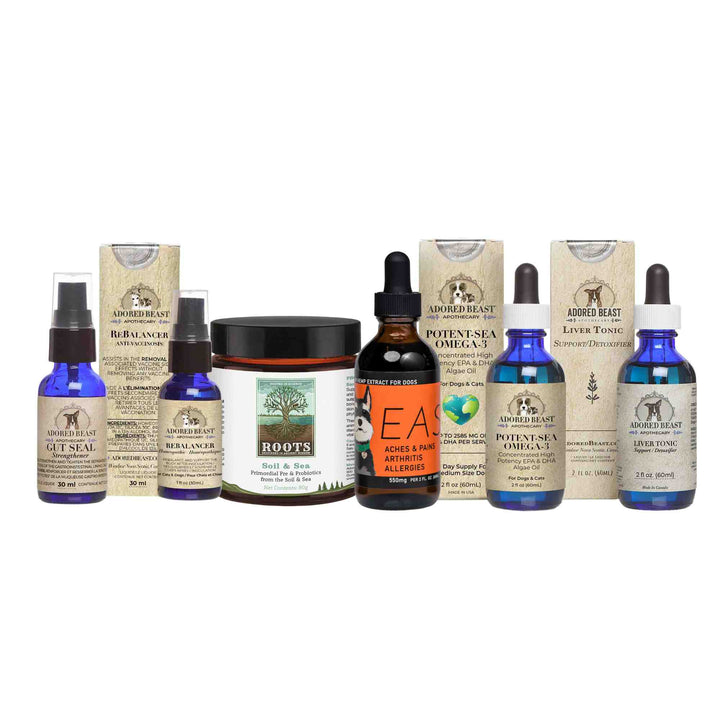
SIBO Support Bundle for Dogs
A standard probiotic is the wrong tool here. Most contain Lactobacillus and Bifidobacterium, which are genuinely good strains that you do not want multiplying further up in a small intestine that already has too much growing in it. This bundle was built around that problem instead of ignoring it, which is why we reach for it rather than a general gut blend.
- Soil-based and spore-forming strains, plus prebiotic chlorella, chosen to stay intact through the small intestine
- Liver Tonic, herbal support for the liver, kidneys, gallbladder and pancreas working as one system
- Potent-Sea algae oil for omega 3 without the heavy metal question that comes with fish oil
- Rebalancer and Gut Seal for the inflamed gut lining underneath everything else
One note on that bundle, because it matters for a dog on a veterinary plan. It contains a full-spectrum hemp extract and a rosemary extract, and rosemary can be contraindicated where there is a seizure history. Take the ingredient list to your vet before you start, and ask about interactions with anything your dog is already on. That conversation is short, and it is the right way round.
Why B12 matters more than almost anything else
If you take one thing from this article, make it this one.
In a study of dogs with EPI cited by the MSD Veterinary Manual, cobalamin deficiency was the only independent risk factor for a poor outcome. The only one. Other vitamin shortfalls turn up as well, including a vitamin K deficiency severe enough to cause clotting problems.
The reason is structural rather than dietary. A healthy pancreas produces intrinsic factor, the carrier B12 needs in order to be absorbed in the ileum. Lose exocrine pancreatic function and you lose intrinsic factor, and the bacterial overgrowth sitting on top consumes what little B12 does make it through. Clinical resources from the Purina Institute put low cobalamin in 75% to 82% of dogs with EPI, and note that leaving it uncorrected can cause the whole plan to fail.
The good part is that this is fixable, and it is your vet's call how. A randomised trial published in the Journal of Veterinary Internal Medicine in 2022 compared oral against injectable supplementation in dogs with low cobalamin from EPI or chronic enteropathy, following earlier work suggesting oral dosing holds up comparably. So if monthly injections feel like a lot for a nervous dog, there is a published conversation to have rather than an assumption to accept.
And there is a hopeful finding to sit with. The same body of work reports that where clinical remission is reached, long survival is likely. That is not a promise about your dog. It is a reason to keep going.
What should I feed a dog with EPI?
There is no single EPI diet, and anyone who tells you otherwise is selling something.
VCA's guidance is explicit that no diet is specific to EPI, and suggests a starting point of low fibre with moderate protein and moderate fat, adjusted to the individual dog as the vet watches the response. The Purina Institute adds a finding worth knowing about, which is that how an individual dog responds to a diet change may not track the fat level of that diet at all. Some dogs do well long term on ordinary food plus their enzymes.
In other words: low fat is a common starting point, not a rule, and it is not automatically the answer for your dog.
The conventional guidance land in the same place is quality and gentleness. Julie's preference, from clinical experience, is a gently cooked fresh diet first, with plenty of hydration and bone broth, moving toward raw slowly and only once the digestive system is holding steady. A week at each step, not a day. Her phrase for it was that the turtle wins the race, and if you change five things at once you will never know which one helped.
Keep a written record. Food, stool quality, energy, weight, and anything unusual going on at home. It sounds like homework, and it is the single most useful thing you can bring to your next appointment.
On the supplement side, gut support has real but modest evidence behind it in dogs. A 2024 review in Veterinary Record gathers the controlled canine trials of probiotics, prebiotics and synbiotics in digestive disease, and a randomised trial in Gut Microbes makes the underlying case that conventional approaches do not address altered microbial composition at all. That is support with a plausible mechanism. It is not a fix, and I will not dress it up as one. If you want the background, we have written about what digestive enzymes do and do not do for dogs.
What to ask your vet at the next appointment
Take this list with you. Every item on it comes from the research above, and none of it asks your vet to do anything unusual.
- Can we run cTLI, serum cobalamin and serum folate from one fasted draw? Three values, one blood sample, one visit.
- What is my dog's B12 number, and what would you like it to be? Ask for the figure, not a reassurance.
- If B12 is low, would oral supplementation work for us, or do you want injections? There is published evidence on both.
- Does the folate result suggest bacterial overgrowth as well? High folate with low B12 is the pattern to ask about by name.
- How long before we retest, and what would tell us it is working? Agree the horizon up front so you are not guessing at week three.
- Are the fat-soluble vitamins worth checking? Vitamin K in particular, given the clotting risk reported in the literature.
- Here is the ingredient list for what I want to add. Any interactions with what she is already on? This is the question that keeps everything else safe.
We put everything we know about this cluster of conditions into one free guide, including the diagnostics to ask for, how to think about diet, and where pancreatitis, EPI and bacterial overgrowth overlap. It goes into far more depth than an article can.
One last thing, and I mean this. A result like this one arrives and it feels like a door closing. From everything we have seen across six years of pet parents writing to us, it is closer to a door opening, because a named condition with a specific blood test and a specific set of follow-up questions is a far better position than months of loose stools and nobody knowing why.
You now know what to ask for. That is not a small thing.
Hear the full conversation
Julie Anne Lee, DCH, goes much deeper on all three conditions in the episode, including how she approached the diet differently for each one and why she watched pain so closely in her clinics.
Watch the episode on YouTube →If you want a professional who will work through the specifics with you alongside your own vet, we keep a list of holistic and integrative vets we trust for online consultations. And if you want to work out where your dog sits in all of this, bark at us. A real person reads every message.
Much love, Larry
Please keep in mind that I'm not a veterinarian, and this isn't medical advice. Every pet is unique, so I always recommend working alongside your vet, ideally a holistic or integrative vet, especially for anything ongoing or serious.
Sources
- Steiner JM. Exocrine Pancreatic Insufficiency in Dogs and Cats. Merck Veterinary Manual. Link
- Tabar Rodríguez MD. Exocrine pancreatic insufficiency in dogs. Royal Canin Academy. Link
- Ultrasonographic Findings of Exocrine Pancreatic Insufficiency in Dogs. Veterinary Sciences, 2022. Link
- Westermarck E, Saari SAM, Wiberg ME. Heritability of Exocrine Pancreatic Insufficiency in German Shepherd Dogs. Journal of Veterinary Internal Medicine, 2010. Link
- Moeller EM, Steiner JM, Clark LA, et al. Inheritance of pancreatic acinar atrophy in German Shepherd Dogs. American Journal of Veterinary Research, 2002, volume 63, issue 10.
- Isaiah A, Parambeth JC, Steiner JM, et al. The fecal microbiome of dogs with exocrine pancreatic insufficiency. Anaerobe, 2017. Link
- Morgan JA, Moore LE. Canine EPI: concurrent and secondary diseases. dvm360. Link
- Soetart N, Rochel D, Drut A, Jaillardon L. Serum cobalamin and folate as prognostic factors in canine exocrine pancreatic insufficiency: an observational cohort study of 299 dogs. The Veterinary Journal, 2019. Link
- Untargeted Analysis of Serum Metabolomes in Dogs with Exocrine Pancreatic Insufficiency. Metabolites, 2023. Link
- Chang H, Steiner JM, et al. Effect of oral or injectable supplementation with cobalamin in dogs with hypocobalaminemia caused by chronic enteropathy or exocrine pancreatic insufficiency. Journal of Veterinary Internal Medicine, 2022. Link
- Barko PC, Williams DA. Serum concentrations of lipid-soluble vitamins in dogs with exocrine pancreatic insufficiency treated with pancreatic enzymes. Journal of Veterinary Internal Medicine, 2018. Link
- Exocrine Pancreatic Insufficiency in Dogs. Purina Institute. Link
- Nutrition and Pancreatic Disease in Dogs. VCA Animal Hospitals. Link
- Schmitz SS. Evidence-based use of biotics in the management of gastrointestinal disorders in dogs and cats. Veterinary Record, 2024. Link
- White R, Atherly T, Guard B, et al. Randomized, controlled trial evaluating the effect of multi-strain probiotic on the mucosal microbiota in canine idiopathic inflammatory bowel disease. Gut Microbes, 2017. Link
- Lee JA, interviewed by Larry Pruden. Pancreatitis, EPI and SIBO in dogs. Next Level Pet Parent Podcast. Watch the episode