Most excessive shedding in dogs is a nutrition problem before it is a skin problem. Hair is roughly 95% protein, and normal coat growth can take 25 to 30% of a dog's daily protein requirement, so when the food is ultra-processed, low in usable protein, or short on omega-3, the coat is one of the first places a dog's body economizes. Seasonal coat changes are normal and expected. A dog who sheds heavily all year round, with a dull, dry, or thinning coat, is usually telling you something about what is in the bowl.
You vacuum. You brush. You buy the de-shedding tool everyone swears by. And there is still a drift of hair along the baseboards by Thursday.
Here is what most pet parents are never told: the coat is not a cosmetic feature. It is one of the most expensive things a dog's body builds, and it gets built out of whatever is left over after the essential work is done. When Milka was a puppy, her coat was the thing I noticed last. I was busy with the gut issues and the itchy skin. But when we changed her food, her coat changed too, and looking back, it was the clearest signal I had that something in her diet had never been working.
In this article
How much shedding is actually normal?
The question I am asked more than almost any other is some version of why is my dog shedding so much, and my first question back is always about the bowl. But before we get there, the baseline matters.
Every dog sheds. Hair grows in a cycle, a growing phase, a transition phase, and a resting phase, and the hair is released at the end of the resting phase as a new hair pushes through. Double-coated breeds drop their undercoat heavily during the two big shedding seasons, spring and autumn. Dogs who live mostly indoors under artificial light often shed at a low level year round instead of in two clear waves.
So the question is not whether your dog sheds. It is whether anything else has changed alongside it. The pattern worth paying attention to looks like this:
- Hair that comes away in your hand with almost no pull
- A coat that has gone dull, dry, brittle, or coarse to the touch
- Flakes and dandruff through the coat
- Visible thinning, especially along the flanks, trunk, or tail
- Slow regrowth after a clip or a shave
- Shedding that arrived at the same time as a diet change, a course of medication, or a stressful few months
That combination of easily shed hair, slow regrowth, and scaling is the classic picture of a coat that is not being fed well enough, and it is described exactly that way in the veterinary nutrition literature.
How does food cause excessive shedding in dogs?
Three things have to be true for a dog to hold a good coat. Enough usable protein. Enough of the right fats. A gut that can actually absorb both. Ultra-processed food can fall short on all three at once.
Protein first. Hair is about 95% protein, rich in the sulphur-containing amino acids methionine and cystine. Building hair and keratinizing skin can account for 25 to 30% of a dog's entire daily protein requirement. When that demand is not met, the result is brittle, poorly pigmented hair that sheds easily and grows back slowly, along with excess scale. Veterinary nutrition guidance puts an adult dog's protein at roughly 25 to 30% on a dry matter basis for healthy skin and coat, and names low nutrient digestibility as a risk factor in its own right.
And here is the part that gets missed. The protein percentage printed on the bag is not the protein your dog receives. High heat during extrusion drives the Maillard reaction, which binds lysine into a form the body cannot use. In a survey of 67 commercial pet foods, reactive lysine averaged 87% of total lysine in extruded dog foods, and fell as low as 77% in one extruded diet for growing dogs. Sixty of the 67 foods tested contained less reactive lysine than total lysine, whatever the processing method.
Then there is what actually crosses the gut wall. In a 2023 University of Illinois study comparing formats, freeze-dried raw had the highest amino acid digestibility and extruded kibble the lowest, with lysine digestibility measurably higher in freeze-dried raw and frozen raw than in the extruded diet. A separate feeding trial found kibble protein digestibility around 85%, against 92 to 94% for four fresh-cooked recipes.
Stack those numbers. A lower protein level, a portion of it heat-damaged, and less of the remainder absorbed. The muscles, organs, and immune system are served first. The coat is served last.
What should I feed a dog who sheds too much?
A complete and balanced fresh diet, in whichever format fits your life. Freeze-dried raw, frozen raw, or a gently cooked fresh recipe. The two words that matter most are complete and balanced, because a coat rebuilt on an unbalanced homemade diet runs into the same shortfall from a different direction.
Here is how the formats compare on the one thing this article is about, the protein that builds hair.
| Format | Heat applied | What the research shows about protein | Who it suits |
|---|---|---|---|
| Freeze-dried raw | None. Moisture is removed under vacuum | Highest amino acid digestibility of the formats tested in 2023, including lysine | Most households. Shelf stable, no freezer space needed |
| Frozen raw | None | Lysine digestibility higher than extruded in the same 2023 comparison | Freezer space and a routine that handles thawing |
| Gently cooked fresh | Low, brief | Protein digestibility of 92 to 94% against about 85% for kibble in a 2021 trial | Dogs who will not eat raw, and nervous first-time switchers |
| Canned | High, inside the sealed can | Reactive lysine averaged 97% of total, better than extruded, but carries the highest levels of Maillard reaction products | A step up from kibble on protein, not the end point |
| Extruded kibble | High heat and high pressure | Lowest amino acid digestibility of the formats tested. Reactive lysine averaged 87% of total, as low as 77% in one diet | Convenience, at a measurable cost to the protein reaching the coat |
You do not have to go all the way on day one. Swapping a quarter of the bowl to a complete and balanced fresh recipe changes the quality of what your dog absorbs at every meal, and you can build from there at whatever pace your budget and your dog's stomach allow. If you want the longer version of what changes when a dog moves onto this kind of diet, we wrote about freeze-dried raw and what it does for coat, digestion, and energy.
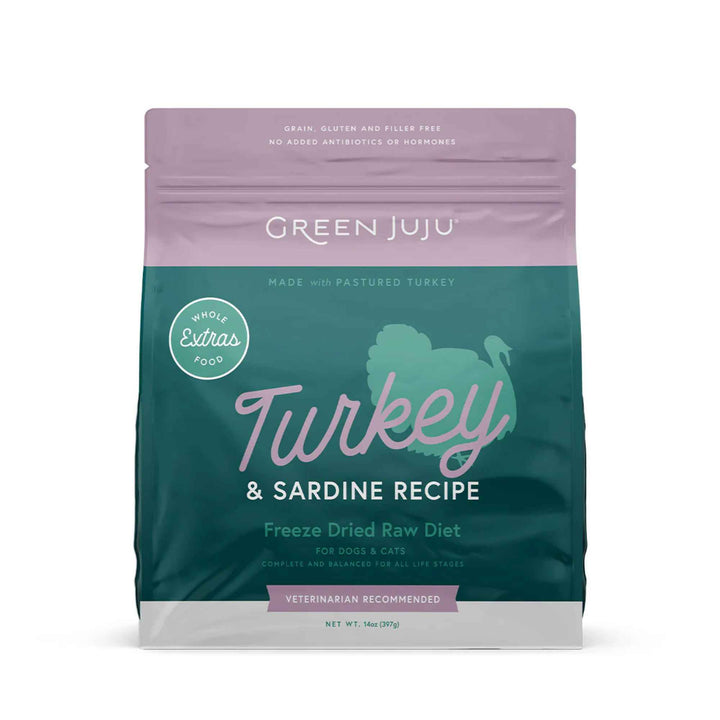
Where I would start for a shedding coat
Extras Turkey & Sardine Recipe, Freeze-Dried Raw
Of everything on our shelves, this is the recipe I reach for when the concern is the coat, because it does two jobs in one bowl. It is complete and balanced, so it can be fed as the whole meal rather than as a topper, and the omega-3 comes from whole wild-caught sardines rather than from a synthetic added at the end.
- Pasture-raised turkey with turkey liver, heart, and bone
- Whole sardines for naturally occurring EPA and DHA
- No synthetic vitamins or minerals, no fillers, low carbohydrate
- Meets AAFCO profiles for all life stages, dogs and cats
- Shelf stable, so no freezer space and no thawing
What if I cannot change the food right now?
Then you work on absorption and on fats, and you are honest with yourself that these are support, not a substitute. I would rather you add three things to a kibble bowl consistently for three months than change everything for two weeks and give up.
In order of what I would add first:
- Digestive enzymes. If the protein is less available to begin with, helping your dog break down and absorb more of what is there is the logical first move. Smaller, firmer stools are the everyday sign that more of the meal is being used rather than passed. We have written a full explainer on whether digestive enzymes for dogs actually help.
- Pre and probiotics. The gut and the skin are connected, and the research is getting better. In a randomized controlled study of 40 dogs with mild to moderate atopic dermatitis, a daily probiotic alongside their existing veterinary care produced a significant reduction in skin lesion scores against placebo over 90 days, with itch scores improving only in the probiotic group. That study was about itch rather than shedding, so read it as evidence for the gut and skin link, not as a coat study.
- Omega-3, from a source you trust. EPA and DHA support the skin barrier, and the barrier is what holds a coat. Source matters more than the label does, which is why we wrote a whole piece on choosing the right omega-3 for dogs.
If your dog eats kibble and you want the fuller list of what is worth adding and what is not, start with our guide to the best supplements for dogs on kibble.
How long before the shedding slows down?
Longer than anyone selling you something wants to say. You are not changing the hair that is already on your dog. You are changing the hair that has not grown yet, and that takes a full turn of the hair cycle.
The most useful number I know comes from a placebo-controlled trial in 24 dogs with poor quality coats. They received a daily omega-3 supplement for 90 days. The clinical coat and skin score improved significantly from day 60, not day 14. And when supplementation stopped, scores drifted back to where they started by day 180.
So two honest expectations. Give any change eight to twelve weeks before you judge it. And whatever works, keep doing it, because a coat is rebuilt continuously rather than fixed once.
What tends to shift first, in my experience with our own dogs and with customers: stool quality within a week or two, then the smell of the coat, then the feel of it, then the volume of hair on the floor. Take a photo of your dog in the same light on the day you start. In week ten you will not trust your memory, and the photo will settle it.
When is shedding not about the food?
Sometimes it is not the bowl, and I would rather say that plainly than sell you a bag.
Veterinary dermatology splits hair loss into two broad groups. Hair falling out because the skin is inflamed, from parasites, bacteria, fungal infection, or allergic skin disease. Or hair not coming back because the hair cycle itself has stalled, which is where hormonal conditions live. Hypothyroidism tends to show up in young to middle-aged dogs. Hyperadrenocorticism, often called Cushing's, tends to show up in older ones. Both commonly produce symmetrical thinning over the flanks and trunk. Physical or emotional stress can also push a large number of follicles into the resting phase at once, so hair loss can follow weeks after an illness, a surgery, or a move.
Book the vet visit, and go with specifics rather than worry. Useful things to bring up:
- Is the thinning symmetrical, and could we check thyroid and adrenal function?
- Can we rule out mites and fungal infection with a skin scrape and a slide impression?
- Is the skin itself itchy, red, damp, or darkly pigmented, rather than the hair loss being quiet?
- Did this start within a few weeks of a medication, a vaccination, or a stressful event?
I am not a veterinarian and none of this is medical advice. Your vet is the one who can test for what I have listed above, and a diet change and a workup can run alongside each other perfectly well. If you would like a practitioner who will engage with the food side of this too, we keep a list of holistic vets offering online consultations.
One pattern deserves its own mention. If the heavy shedding comes with paw licking, head shaking, a musty or corn-chip smell, brown staining between the toes, or recurring ear infections, you are probably not looking at a shedding problem at all. That is the yeast and allergy picture, it runs back to the gut, and it needs a different order of operations. We have written the anchor piece on why yeast in dogs keeps coming back, and the guide below walks through the whole thing step by step.
You are not failing your dog because there is hair on the sofa. But if the coat has gone dull and the shedding never lets up, that is information, and it is information you can act on. Start with the bowl. Give it a full hair cycle. Then look at the photo you took on day one.
Much love, Larry
Sources
- Watson TDG. Diet and Skin Disease in Dogs and Cats. The Journal of Nutrition, 1998. Link
- Geary EL, Parsons CM, Utterback PL, Templeman JR, Swanson KS. Standardized amino acid digestibility and nitrogen-corrected true metabolizable energy of frozen raw, freeze-dried raw, fresh, and extruded dog foods using precision-fed cecectomized and conventional rooster assays. Journal of Animal Science, 2023. Link
- van Rooijen C, Bosch G, van der Poel AFB, Wierenga PA, Alexander L, Hendriks WH. Reactive lysine content in commercially available pet foods. Journal of Nutritional Science, 2014. Link
- Tanprasertsuk J, Perry LM, Tate DE, Honaker RW, Shmalberg J. Apparent total tract nutrient digestibility and metabolizable energy estimation in commercial fresh and extruded dry kibble dog foods. Translational Animal Science, 2021. Authors were affiliated with a fresh pet food company, which is worth knowing when reading the result. Link
- Prospective, randomised, double blind, placebo-controlled evaluation of an n-3 essential fatty acid supplement in dogs with poor quality coats. Prostaglandins, Leukotrienes and Essential Fatty Acids, 2020. Link
- Efficacy of Lacticaseibacillus rhamnosus GG in canine atopic dermatitis: a randomised controlled study. Brazilian Journal of Microbiology, 2025. Link
- VCA Animal Hospitals. Nutrition and Your Dog's Skin and Haircoat. Link
- Siak M. Non-pruritic Alopecia in the Dog: Is It Always Hormonal? WSAVA Congress Proceedings, 2018. Link