PEA (palmitoylethanolamide) is a fatty acid your dog's own body produces on demand to calm overactive immune cells. PEA for dogs is sold as a supplement for joint discomfort and itchy skin, and the strongest canine evidence behind it is a 2026 randomized, placebo-controlled trial in 50 dogs, where 76% of dogs given PEA were classified as responders on a validated pain scale, compared with 40% of dogs given a placebo, over six weeks. But here is what most pet parents are never told: there is no head-to-head trial telling you which form of PEA works best in dogs, and every company in that argument is selling a form.
Here is the one-line version, in case that is all you came for: PEA is not a painkiller, it is a signal molecule that tells overactive immune cells to settle down, which is why the research runs on four to eight week timelines and why giving it alongside a fat source matters more than the form printed on the label.
Jump to a section
- What is PEA for dogs, and how does it work?
- Does the form of PEA matter?
- What actually helps PEA get absorbed?
- Does PEA actually work for dog joint pain?
- Does PEA help itchy dogs and skin allergies?
- How much PEA do dogs take in studies?
- Is PEA safe for dogs?
- PEA versus CBD for dogs: which one?
- What is PEA not supported for in dogs?
- How would I approach a PEA trial with my own dog?
- When should you talk to your vet?
- The one thing to remember
Now let me talk to you like a friend for a minute.
If you have landed here, something has probably been going on for a while. A dog who takes the stairs one at a time now. A dog who has been licking the same paw for months. Maybe you have already been through a round of medication, and it helped, and then it stopped helping, or the side effects were not worth it. And now you are reading about a compound with a name you cannot pronounce, wondering if this is the real thing or the next thing.
I have been exactly there. Milka is a senior now, snout going white, and I have learned the hard way that adding more supplements is not the same as adding the right one. When her ALT came back elevated a few years ago, my instinct was to pile on support. It got worse before it got better. What actually helped was backing off and being far more specific about what each thing was genuinely supported to do.
So that is how I am going to walk you through PEA. Not what it might do. What the canine research actually shows, and where it runs out.
What is PEA for dogs, and how does it work?
PEA stands for palmitoylethanolamide. It belongs to a family of fatty acid amides that your dog's cells make locally, on demand, when tissue comes under stress. A 2022 review in Biomolecules by researchers at the Universities of Perugia and Turin describes their job as holding back immune and inflammatory cell activity before inflammation becomes chronic and self-sustaining.
Read that again, because it is the whole point. PEA is not blocking a pain signal on its way to the brain the way an anti-inflammatory drug does. It is telling the cells that generate the inflammation in the first place to stand down. In the 2026 trial, the researchers describe it acting partly by dampening mast cell activation and partly through a receptor called PPAR-alpha, reaching cannabinoid receptors only indirectly.
That mechanism explains two things you need to know before you buy any of it. First, nothing happens in three days. Second, PEA has to actually get absorbed to do any of this, and absorption is where the entire industry argument lives.
Does the form of PEA matter?
This is the most confidently argued question in the PEA world, and the honest answer is that nobody knows yet.
Here is the chemistry everyone agrees on. PEA is highly lipophilic and barely dissolves in water, which makes absorption the central practical problem. From there, three camps have each solved it differently, and each says theirs is the answer.
Camp one mills the crystals smaller. Micronized PEA sits at a particle size between 0.5 and 10 micrometres, ultra-micronized finer still. A 2014 study in Journal of Neuroinflammation compared them head to head in rats with inflammatory pain and found the milled forms worked better by mouth than unmilled PEA. Notably, when the same formulations were injected rather than swallowed, the difference vanished, which points squarely at absorption as the reason.
Camp two pairs standard PEA with a dispersion technology instead of milling it. That is the form used in the 2026 canine trial.
Camp three argues the milling premise was never properly tested in people or animals at the clinical level, and that unmilled PEA has its own positive trials. That position has support. A 2023 review in Psychiatry and Clinical Neurosciences concluded that head-to-head formulation comparisons are still lacking and the formulation of choice remains open to debate. A 2016 meta-analysis said much the same, that micronized forms are theoretically more absorbable, with no head-to-head work to confirm it.
So who do you believe? Here is the part I want you to hold onto. The research group behind most of the micronization literature is tied to the ultra-micronized brand. The 2026 canine trial was funded by the company that sells the dispersion technology. The suppliers of unmilled PEA are the ones telling you milling does not matter. Every party in this argument sells a form. Including us, and I am telling you that on our own blog.
What the canine research actually used
| Form | How it's processed | Where it shows up in canine research | Canine evidence status |
|---|---|---|---|
| Ultra-micronized PEA | Milled finer than micronized (below 0.5 micrometres) | 2015 atopic dermatitis study, 160 dogs; VCA clinical guidance | Encouraging skin data, but open-label with no placebo group |
| Micronized PEA | Milled to a 0.5 to 10 micrometre particle size | 2014 rat model comparing oral versus injected forms | Better oral absorption than unmilled PEA in rats; no dedicated canine RCT |
| Dispersion-technology PEA | Standard PEA formulated with a dispersion technology instead of milling | 2026 randomized, placebo-controlled canine joint pain trial (50 dogs) | Strongest current canine evidence: peer-reviewed RCT, 76% responders vs. 40% on placebo |
| Standard (unmilled) PEA | Conventional PEA powder, no micronization or dispersion step | Dr. Judy's PEA (OptiPEA) | No dedicated canine RCT for this specific grade; supplier's position is that milling has not been shown to matter head to head |
Read that table as a map, not a ranking. Every form in it has evidence behind it somewhere, and no study has ever put two of them side by side in a dog.
What actually helps PEA get absorbed?
Since the form debate is unresolved, here is the thing all three camps agree on, and it is the most useful sentence in this post.
PEA is lipophilic. It moves with fat, not water. So give it with a fat source rather than on an empty stomach or sprinkled over dry food. A spoon of the fattier part of your dog's meal, some plain fish oil, a little ghee, or an oil they already take.
The supplier of the PEA we carry says this directly, and it follows from the chemistry rather than from anyone's marketing. I would put more weight on that one habit than on chasing a particular milling process. It costs nothing and no one disputes it.
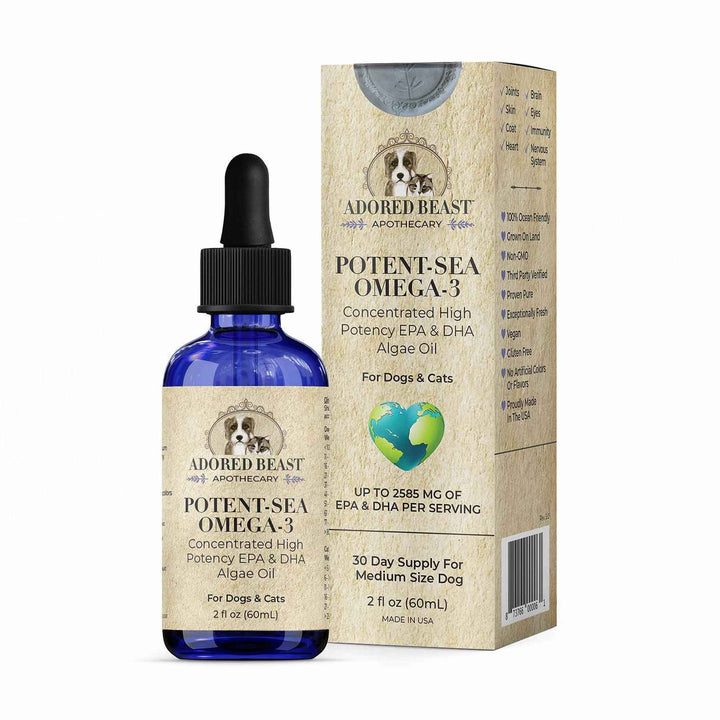
The fat source that also earns its own keep
Potent-Sea Omega-3 Algae Oil
If you are looking for the fat source to pump onto your dog's food alongside PEA, Potent-Sea is worth having on hand for a different reason too: it is an EPA and DHA algae oil that also sits in the joint and skin support foundation, without the heavy-metal exposure that comes with fish oil.
- Concentrated EPA and DHA from algae, not fish
- Free from solvents, pesticides and heavy metals
- One daily addition to food, alongside the PEA dose
Does PEA actually work for dog joint pain?
This is where the evidence is strongest, and it got meaningfully stronger this year.
In February 2026, a trial published in Frontiers in Veterinary Science reported on 50 dogs and 50 cats with joint pain lasting at least two months, randomized to either a dispersion-enhanced PEA or a placebo for six weeks. Owners scored their animals using the Canine Brief Pain Inventory, a validated instrument, at baseline and at weeks two, four and six. The dogs averaged around ten years old.
The headline number: 76% of the PEA dogs met the trial's threshold for a successful response, versus 40% on placebo. Ability to walk separated from placebo as early as week two. Pain at its worst separated by week four. No adverse events were reported in the dog PEA group at all.
Now the honest caveats, because they matter and almost nobody lists them:
- Overall quality of life showed no significant difference between the groups. Pain and function improved. The global life-quality score did not separate.
- Ability to climb stairs did not reach statistical significance. Neither did enjoyment of life at week six.
- In the cats, the total pain index did not separate from placebo at all. Only specific tasks did, namely jumping up and jumping down.
- Dogs already on prescribed pain medication were excluded, as were dogs with a known joint deformity such as hip dysplasia. So this trial tells you nothing about swapping PEA in for a medication your dog is already taking.
- The study was funded by the company that makes the ingredient. That does not invalidate it. It was randomized, blinded, placebo-controlled and published in a peer-reviewed journal, which puts it well ahead of most supplement evidence. But you deserve to know who paid.
You will also see a widely quoted figure that 54.5% of dogs with osteoarthritis responded to co-micronized PEA with quercetin at 24 mg/kg within two weeks. That one is real, but it comes from a 2018 veterinary orthopaedic conference abstract covering 13 dogs with no control group. Thirteen dogs, no placebo, not peer-reviewed. I have seen that number presented as though it were a landmark trial. It is a promising early signal. That is all.
Does PEA help itchy dogs and skin allergies?
Here the evidence looks impressive at first glance and gets thinner the closer you look.
The most cited study is from 2015 in Veterinary Dermatology. Clinicians at 39 clinics enrolled 160 dogs with non-seasonal atopic dermatitis and moderate itching, and gave them ultra-micronized PEA for eight weeks. Owner-scored itch dropped from 5.7 to 3.63 on a visual analogue scale. Skin lesion scores and quality of life improved too.
Sounds strong. But that study was open-label. No placebo group, and nobody was blinded.
Here is why that matters, and I want to give you a real yardstick rather than a vague warning. In the 2026 joint trial, the dogs who got nothing but a placebo capsule improved from 4.4 to 2.9 on their pain scale. That is a substantial improvement from an inert powder, driven by the fact that a hopeful person watching their own dog is not a neutral instrument. Owner-scored itch in an unblinded study is exactly the setting where that effect is largest.
So I would put it this way: the skin evidence for ultra-micronized PEA is genuinely encouraging, mechanistically sensible, and not yet confirmed by a placebo-controlled canine trial. In cats, there is better-quality evidence, including a blinded, placebo-controlled study showing longer time to relapse in cats with non-flea hypersensitivity dermatitis. If itching is your dog's main issue, PEA is a reasonable layer, but it is not the foundation. For most itchy dogs I talk to, the real progress comes from working on the gut and the food first. If your dog has the musty smell, the rusty paw staining, or the ears that keep coming back, start with the root-cause approach we mapped out in our guide to why yeast in dogs keeps coming back before you start layering compounds on top.
How much PEA do dogs take in studies?
Published canine dosing sits roughly between 10 and 40 mg per kilogram of body weight per day, depending entirely on the formulation. Which is another way of saying there is no single right number.
The 2026 trial did something worth noticing: it did not dose by strict mg/kg at all. It used weight bands.
| Dog's body weight | Capsules per day | Total PEA per day |
|---|---|---|
| 3.00 to 6.99 kg (about 6.6 to 15.4 lb) | 1 | 150 mg |
| 7.00 to 12.99 kg (about 15.4 to 28.6 lb) | 2 | 300 mg |
| 13.00 to 19.99 kg (about 28.7 to 44.1 lb) | 3 | 450 mg |
| 20.00 to 34.99 kg (about 44.1 to 77.1 lb) | 4 | 600 mg |
| Over 35.00 kg (about 77.2 lb and up) | 5 | 750 mg |
Weight bands and dosing from Briskey et al., Frontiers in Veterinary Science, 2026 (Table 1). This was the dispersion-technology product used in the trial, not a universal dose for every PEA product on the shelf.
The 2015 skin study used a comparable range, from 50 mg up to 450 mg by body weight.
Two rules I would hold to. Do not carry a dose across from one product to another, because concentration and form are not the same between them. And follow the label on the product in your hand, with your vet's input. This is a case where more is not better, and I say that as someone who learned it the expensive way.
One more thing worth knowing: you cannot get there through food. PEA does occur naturally in egg yolk, peanuts and soybeans, but soybean, one of the richest sources, carries around 7 micrograms per gram. Dechra's own literature on the veterinary form states outright that dietary intake cannot reach the levels used for skin support. Food is the foundation of everything else, and I will always say so, but it is not a route to a meaningful PEA dose.
Is PEA safe for dogs?
The safety picture is one of the more reassuring parts of this compound, with real caveats.
In toxicity work summarized in a 2020 review in Veterinary Sciences, micronized PEA showed an acute oral LD50 above 2000 mg/kg and a no-observed-effect level above 1000 mg/kg in longer-term testing. Those numbers sit far above any supplement dose. That same review notes something genuinely unusual: long-term use has not been associated with tolerance building, so the response does not appear to fade with repeated dosing the way it can with some drugs.
VCA's veterinary guidance on the ultra-micronized form lists possible side effects as vomiting, diarrhoea and stomach pain, with allergic reactions rare. It advises caution in pregnant or nursing dogs and reports no known drug interactions.
And one honest note from that same VCA page that applies to this entire category: the FDA does not review supplements for safety or effectiveness before they are sold. Which brings us right back to why the form on the label, and the company behind it, is doing more work than you might think.
PEA versus CBD for dogs: which one?
They get compared constantly because they touch the same system, and they are not the same thing.
PEA reaches cannabinoid receptors indirectly and works substantially through PPAR-alpha and mast cell regulation, with no psychoactive component. CBD binds and acts differently. A 2023 review of canine CBD research found its pharmacokinetics in dogs still incompletely mapped, most trials focused on osteoarthritis, and methodological bias present in nearly all of them.
The practical difference that matters most: the American Kennel Club's veterinary guidance notes that CBD's documented effects in dogs include loose stools and shifts in liver enzyme values after several weeks, and that CBD inhibits cytochrome P450, an enzyme system involved in clearing many medications. If your dog is on other medication, that interaction question is a real conversation to have with your vet. PEA does not carry the same reported interaction concern. Neither one is the obvious winner. For a dog on multiple medications, PEA's interaction profile is easier to work with. For a dog where anxiety sits alongside discomfort, a hemp oil like EASE Hemp Oil may fit the whole picture better. They are also not mutually exclusive.
What is PEA not supported for in dogs?
I would rather lose your click than tell you something the research does not say.
Nerve pain, IVDD, and spinal conditions. You will find PEA recommended for these all over the internet. The canine evidence is one small 2011 pilot in twelve Cavalier King Charles Spaniels, owner-scored, no control group. That is not enough to build a recommendation on. When Milka went through her own spinal recovery, what actually moved the needle was hands-on care, not a powder. We share what we learned in The Benefits of Red Light Therapy for Dogs, and that is where I would point you first.
Anxiety and reactivity. I could not find a single canine study. Skip it.
Replacing an anti-inflammatory medication. No study has tested that swap. The 2026 trial specifically excluded dogs on prescribed pain medication. Never change a prescribed medication without your vet.
How would I approach a PEA trial with my own dog?
If you decide it is worth trying, here is the sequence I would follow:
- Score where you are starting. Write down three specific, countable things. Minutes of paw licking. Whether the jump into the car happens on the first try. How the first ten steps look after a nap. Vague memory is a terrible measuring instrument, and you will need something to compare against.
- Ask what form it is, then stop worrying about the answer. Worth knowing, so ask. But do not pay a large premium for a milling process that has never been compared head to head in a dog. Put that attention into giving it with fat instead.
- Follow the product's own dosing, with your vet's input. Do not translate a number from a study or from another brand.
- Give it four weeks minimum, eight to be fair. In the 2026 trial, function started separating at week two and pain at week four. The skin study ran eight weeks. Deciding at day ten tells you nothing.
- Change one thing at a time. If you start PEA, a new food, and a joint chew in the same week, you will learn nothing about any of them.
- Re-score at four and eight weeks against your original notes. If nothing has moved by week eight on an appropriate form and dose, stop paying for it. That is a real answer too.
If PEA is the piece you want to add, the PEA supplement we carry from Dr. Judy Morgan uses OptiPEA, a GMP-grade European PEA, and the supplier confirmed in July 2026 that it is the standard powder rather than the micronized or water-dispersible grade. Their position is that milling has not been shown to matter, and I have laid out above where I think that position is solid and where it reaches. Give it with a fat source.
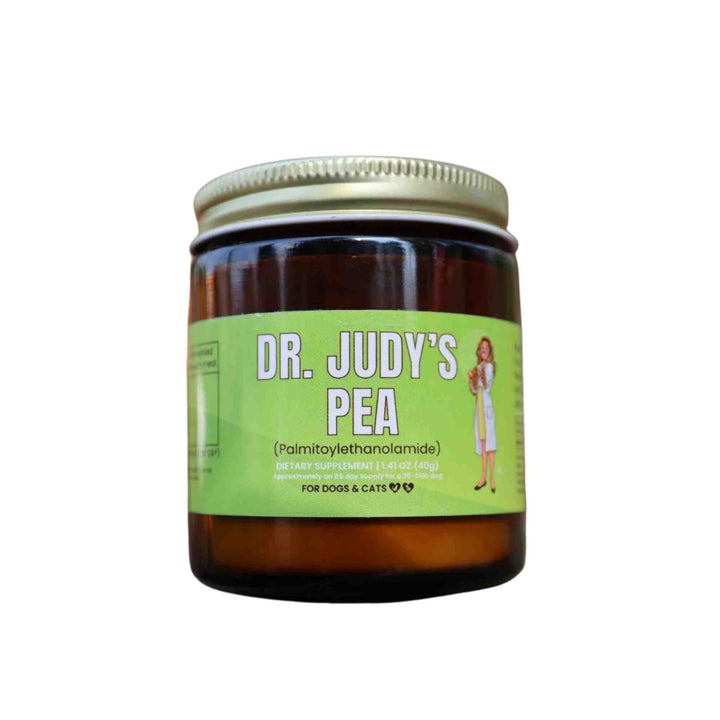
Why we carry this one
Dr. Judy's PEA (Palmitoylethanolamide)
We asked the supplier which grade this actually is instead of assuming, and told you the answer above: standard OptiPEA, not micronized or water-dispersible. You are not guessing which camp you are buying into.
- 100% Palmitoylethanolamide via OptiPEA, EU GMP-certified manufacturing
- Weight-based label dosing for cats and dogs
- Give with a fat source, per the supplier's own guidance
And if joint comfort is the real goal, PEA is a layer, not a plan. The foundation is a lean body, food that lowers the inflammatory load, and omega-3s, which is the order we laid out in our guide to natural joint support for dogs. Jump for JOYnts and Potent-Sea sit in that foundation layer.
When should you talk to your vet?
Before you start, if your dog is on any medication, is pregnant or nursing, or has liver or kidney involvement. And promptly, rather than eventually, if your dog is limping, suddenly unwilling to move, swollen, or clearly in pain. A supplement is not the right first response to a dog in acute distress, and ongoing discomfort deserves a proper look so you know what you are actually working with.
Please keep in mind that I'm not a veterinarian, and this isn't medical advice. Every pet is unique, so I always recommend working alongside your vet, ideally a holistic or integrative vet, especially for anything ongoing or serious.
The one thing to remember
PEA is one of the more legitimate compounds in the holistic space right now. A real randomized controlled trial in dogs, a plausible mechanism, and a wide safety margin put it ahead of most of what gets marketed to us.
And it is not a miracle, and the version on the shelf may not be the version in the study.
The gap between what a study tested and what a label sells you is where a lot of our money and hope goes to die. But closing that gap honestly sometimes means admitting the answer is not known yet, rather than picking whichever version we happen to stock. You are allowed to ask a company which form they use. You are allowed to hear "there is no head-to-head data" and find that a fair answer. You are allowed to give something eight weeks and then stop.
Your dog's body is already doing this work. Your job is to give it fewer things to fight and better tools to work with.
Much love, Larry
PEA or CBD hemp oil: which one for your dog?
| Dr. Judy's PEA | EASE Hemp Oil | |
|---|---|---|
| Best for | A dog on other medications, where an easier interaction profile matters | A dog where situational anxiety sits alongside the discomfort |
| Key differentiator | Works through PPAR-alpha and mast cell regulation; no reported drug interactions | Full-spectrum hemp extract; inhibits cytochrome P450, which clears many medications |
| Evidence status | Randomized, placebo-controlled canine joint pain trial (2026) | Canine CBD pharmacokinetics still incompletely mapped per a 2023 review; most trials focus on osteoarthritis with methodological limitations |
| Shop Dr. Judy's PEA | Shop EASE Hemp Oil |
Sources
- Briskey, D., Craddock, E., Rao, A., Mills, P.C. "Levagen+ (palmitoylethanolamide) alleviates joint pain and reduces the impact of joint pain in canines and felines: a double-blind, placebo-controlled, randomized clinical trial." Frontiers in Veterinary Science, 2026. Link
- Della Rocca, G., Re, G. "Palmitoylethanolamide and Related ALIAmides for Small Animal Health: State of the Art." Biomolecules, 2022. Link
- Gugliandolo, E., Peritore, A.F., Piras, C., et al. "Palmitoylethanolamide and Related ALIAmides: Prohomeostatic Lipid Compounds for Animal Health and Wellbeing." Veterinary Sciences, 2020. Link
- Noli, C., Della Valle, M.F., Miolo, A., Medori, C., Schievano, C., Skinalia Clinical Research Group. "Efficacy of ultra-micronized palmitoylethanolamide in canine atopic dermatitis: an open-label multi-centre study." Veterinary Dermatology, 2015. Link
- Noli, C., Della Valle, M.F., Miolo, A., et al. "Effect of dietary supplementation with ultramicronized palmitoylethanolamide in maintaining remission in cats with nonflea hypersensitivity dermatitis." Veterinary Dermatology, 2019. Link
- Hyland, K., DVM. "Ultra-Micronized Palmitoylethanolamide (PEA-um)." VCA Animal Hospitals, 2024. Link
- Vezzoni, A., Crupi, F., Boiocchi, S., Boano, S. "Effect of palmitoylethanolamide co-ultra micronized with quercetin in dogs with osteoarthritis." Proceedings of the 5th World Veterinary Orthopaedic Congress ESVOT-VOS, 2018.
- Della Rocca, G., et al. "Pharmacokinetics, efficacy, and safety of cannabidiol in dogs: an update of current knowledge." 2023. Link
- Klein, J., DVM. "Does CBD For Dogs Work?" American Kennel Club. Link
- Dechra Veterinary Products. "Redonyl Ultra: An ultra-small ingredient that offers ultra-big support for skin health." Link
- Impellizzeri, D., Bruschetta, G., Cordaro, M., et al. "Micronized/ultramicronized palmitoylethanolamide displays superior oral efficacy compared to nonmicronized palmitoylethanolamide in a rat model of inflammatory pain." Journal of Neuroinflammation, 2014.
- Chiappedi, M., et al. "Palmitoylethanolamide: One molecule, different formulations." Psychiatry and Clinical Neurosciences, 2023. Link
- Innexus Functional Ingredients. OptiPEA product and company information. Link
- Formulation confirmed by Gwen Campbell (Dr. Judy Morgan), email correspondence, 29 July 2026.
Disclaimer: This blog may contain affiliate links, and PAWDEGA may earn a small commission at no extra cost to you if you purchase through them. It may also link to products on our website, and this content is for educational purposes, not a replacement for veterinary advice.