Red light therapy for dogs with hip dysplasia may help with pain and mobility, and it will not change the shape of the joint. In a randomized, double blinded trial in dogs with bilateral hip osteoarthritis, the dogs receiving photobiomodulation sessions scored better on owner reported pain and function measures through the first month, and their joint range of motion stayed better from day 15 out to day 90. The evidence is real, small, and mixed. It belongs alongside your vet's plan, not in place of it.
Here is the honest version in one sentence: red light therapy does not change a dysplastic hip, but it may change how much that hip hurts.
Before we go further: the red light device linked later in this article is an affiliate link. If you buy through it, PAWDEGA earns a commission at no extra cost to you. It changes nothing about what I would tell you, and you will notice most of this article is spent on what red light cannot do.
In this article
If your vet said the words hip dysplasia in the last few weeks, you are probably reading this at an hour you would rather be asleep. You are following the veterinary plan exactly. You have the anti inflammatory, the weight target, the instruction to keep the walks short and flat. And still there is the question nobody at the appointment had time for.
What else can I do?
You are allowed to ask that. It is not disloyal to your vet and it is not wishful thinking. It is the question that separates the pet parents who feel like passengers from the ones who feel like participants. Red light therapy comes up fast when you start looking, usually on a page selling a panel, usually with the good studies quoted and the disappointing ones left out. So let's do this properly.
Is red light therapy safe alongside your vet's plan?
This is the gate question, so it goes first. Photobiomodulation is non invasive, it involves no drug and no needle, and in the canine trials it has been run alongside conventional pain medication rather than instead of it. In the elbow osteoarthritis trial, both groups stayed on their anti inflammatory and the researchers looked at whether the dose could come down. That is the model to have in your head: an addition, not a swap.
What it is not is a reason to change anything your vet prescribed. Never reduce or stop a pain medication because a light panel arrived. That decision is your vet's, on your dog's specifics, and it is exactly the conversation the elbow trial was built around.
There are a few real cautions worth raising at your next appointment: light aimed at or near the eyes, use over a known or suspected tumour, and use in a pregnant animal. Bring the device and its stated wavelengths with you and let your vet see them. Written down, the whole thing takes ninety seconds of the appointment.
Please keep in mind that I'm not a veterinarian, and this isn't medical advice. Every pet is unique, so I always recommend working alongside your vet, ideally a holistic or integrative vet, especially for anything ongoing or serious.
What does the research say about red light therapy for dogs with hip dysplasia?
Almost no trial studies hip dysplasia by name. They study hip osteoarthritis, which is where a dysplastic hip ends up, so that is the literature that applies to your dog. Here is what exists, including the parts the device pages tend to skip.
| Study | What it looked at | What it found | How much weight to give it |
|---|---|---|---|
| Alves and colleagues, 2022 | 20 dogs, 40 joints, moderate to severe bilateral hip osteoarthritis. Sessions versus a control group | Better pain, function and gait scores through day 30. Joint range of motion better from day 15 to day 90 | The closest thing to your dog's situation. Small, and most measures are owner scored |
| Looney and colleagues, 2018 | 20 dogs with elbow osteoarthritis. Real light versus sham light, twice weekly for six weeks | Better lameness and pain scores, and lower anti inflammatory doses, than the sham group. Mood and vocalising did not differ | Well designed and properly blinded. RCVS Knowledge appraised the overall strength of evidence as weak on sample size alone |
| Alves and colleagues, 2023 | 30 dogs with bilateral hip osteoarthritis. Platelet rich plasma, light sessions, or both | All three produced clinically meaningful improvement. The combination lasted longest | Useful signal that light adds to something rather than competing with it |
| Three trials after knee surgery, 2017 to 2018 | Dogs recovering from a tibial plateau levelling osteotomy | No improvement in bone healing in any of the three. One found a single better force plate measure at eight weeks and nothing else | The counterweight. Same modality, different job, no benefit found |
Read the table as a whole and a pattern shows up. Where the target is pain and function in an arthritic joint, the results lean positive. Where the target is bone knitting back together, they do not. That is not a contradiction. It is a modality that appears to do one job and not another, which is far more believable than a light that does everything.
One thing in dogs' favor, and it is not a small point: a dog cannot talk himself into feeling better. The caregiver placebo effect is real, which is why the good canine trials are sham controlled and blinded, and why the sham controlled ones deserve more of your attention than any before and after video.
Why does the same light help one dog and do nothing for another?
Because it is not the same light. This is the part almost nobody selling a panel explains, and it is what most pet parents are never told.
The accepted mechanism is that light is absorbed by cytochrome c oxidase, an enzyme in the mitochondria, which nudges cellular energy production upward. That enzyme has absorption peaks in red light, roughly 620 to 680 nanometres, and in near infrared, roughly 760 to 825 nanometres. Wavelengths in between do very little. Blue and green do not do this job at all.
Then there is dose, and dose behaves in a way that is genuinely counterintuitive. The response is biphasic: too little does nothing, the right amount stimulates, and more than that stops working. In cell work at 660 and 810 nanometres, cellular energy rose by around 15 to 20 percent at a dose of 3 joules per square centimetre, then fell back toward baseline as the dose climbed to 30. Longer is not better. Brighter is not better. There is a window, and you can overshoot it.
Which explains the messy literature better than anything else. The canine trials used clinician operated devices at stated wavelengths and stated energy densities, and the ones reporting doses were working in the low single digits of joules per square centimetre. A consumer panel that does not publish its wavelengths or its output is not a smaller version of that. It is an unknown.
What can red light therapy not do for a dysplastic hip?
Hip dysplasia is a structural problem. The ball and the socket do not fit each other properly, the joint is loose, and that laxity grinds cartilage away over years until you are looking at osteoarthritis in a joint that was built at a disadvantage. It is largely inherited, and it is shaped by how fast the puppy grew and what he has carried since.
No amount of light reshapes that socket. Anything promising otherwise is selling you something. What the evidence supports is more modest and still worth having: less pain reported, better measured range of motion, and in one trial a lower anti inflammatory dose. For a nine year old Labrador who is stiff getting off the floor in the morning, modest is not nothing.
And breeding selection genuinely moves this. In a Swiss study of five large breeds screened over two decades, hip dysplasia prevalence fell from 46 to 18 percent in German Shepherds and from 25 to 9 percent in Golden Retrievers between the late nineties and the early twenty tens. That is the long game, and it is the answer for the next dog rather than this one.
What matters more than red light for a dysplastic hip?
If you only have the energy for a short list, this is the order I would put it in. Red light sits below all three, and I say that as someone who owns a device and uses it.
- Body condition, first and by a distance. In a lifetime study of 48 Labrador Retrievers, littermate pairs were split so one group ate a quarter less food for life. The first radiographic signs of hip arthritis showed up at a median of 12 years in the restricted group against 6 years in the free fed group. Across the whole group, radiographic hip arthritis rose from 15 percent at two years old to 67 percent by fourteen. Nothing else on this page moves a number like that. You should be able to feel your dog's ribs easily.
- Omega 3, specifically EPA and DHA. In a randomized, double blinded trial in 38 dogs with osteoarthritis, dogs on a food supplemented with fish oil omega 3s improved on force plate measured weight bearing. Force plates do not have opinions, which is what makes that finding sturdier than most. Worth knowing that the work was funded by a pet food company. Worth knowing too that our own preference is algae as the source rather than fish, because it skips the heavy metal question entirely, and if you want that reasoning in full we wrote about why the omega 3 source matters more than the supplement.
- Controlled, consistent movement. The 2022 AAHA pain management guidelines place photobiomodulation and laser therapy in the rehabilitation toolbox next to therapeutic exercise and hydrotherapy, and note in the same passage that controlled prospective trials in the veterinary literature are thin across that whole toolbox. Muscle around a bad hip is doing work the joint cannot. Two short flat walks beat one long one, every time.
Underneath all three sits inflammation, and inflammation is not only a joint story. It is fed by what goes in the bowl. This is where the supplement layer earns its place, not as a replacement for anything above, but as the part of the picture you control three times a day. There is a box further down that gathers that layer into one order, and our guide to natural joint support for dogs walks through the individual options if you would rather build it yourself piece by piece.
What should you ask before buying a device?
I am not going to hand you a session protocol, because the honest answer is that the right dose for your dog's hip depth and coat is a clinical decision and the trials do not agree closely enough for me to turn into a recipe. What I can give you is the short list that separates a real device from an expensive night light.
- What wavelengths does it emit, in nanometres? You want red in the 620 to 680 range, near infrared in the 760 to 825 range, or both bands together. Plenty of reputable devices, including the one I link below, publish the light counts and the bands on the product page but not the exact nanometres, so ask their support team and get the figures in writing before you order. A company that cannot answer that question is telling you something.
- What is the output, and at what distance? Without irradiance you cannot know your dose, and dose is the whole ballgame. Ask for this in the same email.
- Does near infrared reach a hip joint? A hip sits far deeper than a wrist. Red light alone lands mostly on skin, which is why the deeper work is asked of near infrared.
- What did your vet's rehab service say when you showed them the specification? Many practices run laser sessions themselves and will tell you plainly whether your device is in the same conversation.
- What are you measuring? Pick two things before you start: time to rise from lying down, and willingness on the second walk of the day. Write them down weekly. Otherwise six weeks pass and all you have is a feeling.
We used red light at home during a hard recovery of our own, and I wrote about that honestly, including what I could not tell apart from ordinary healing, in our post on red light therapy through Milka's IVDD recovery.
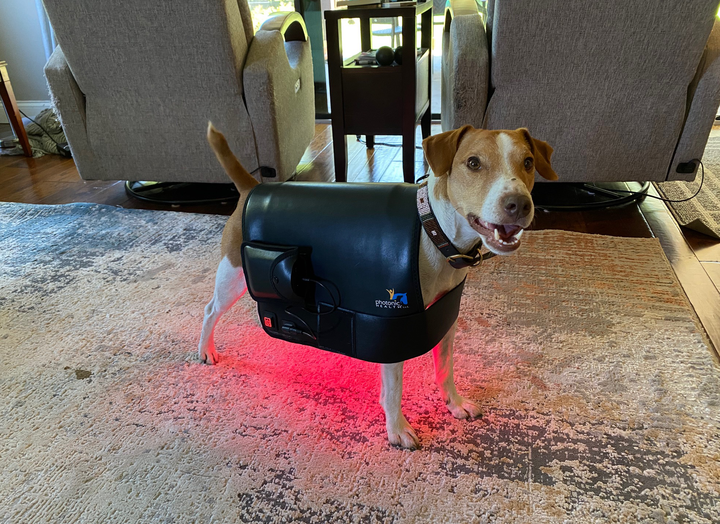
The one we point pet parents to
Photonic Health Essential Back Pad
Most panels sold for pets are human devices with a dog on the packaging. Photonic Health builds for animals, and the difference that matters for a hip is the form factor: this is a large flexible pad with straps, so it wraps the joint and stays there while your dog lies down, instead of you holding a wand over a moving target for twenty minutes.
- 270 lights, 150 red and 120 near infrared, with both bands running at once rather than one at a time
- Three timer settings, 10, 20 and 30 minutes, so a session is a button rather than a stopwatch
- Two stretch straps, roughly 2 ft and 4 ft, for wrapping a hip on a small dog or a large one
- Cord free battery pack, which matters more than it sounds for a sore dog who will not settle beside a wall socket
- Their line also includes a pad configured for IVDD if the spine is the concern rather than the hip
Affiliate link. PAWDEGA earns a commission if you buy through it, at no extra cost to you.
Whichever device you land on, it works on inflammation from the outside. The other half of the job is done from the inside, three times a day, in the bowl.

The layer that runs underneath
Hip Dysplasia Support Bundle for Dogs
Potent-Sea for algae sourced EPA and DHA, which is the piece of this box with the strongest trial support behind it. Coco-Gold pairs turmeric with coconut oil and black pepper, which is how curcumin is made usable. HerbAprin and Inflapotion for soreness and inflammation response, and Gut Soothe, because the inflammation story starts further upstream than the hip.
Choose your sizesAt home device or in clinic laser: which one for your dog?
This is the decision most pet parents are actually stuck on, so here it is side by side.
| At home LED panel or pad | In clinic laser session | |
|---|---|---|
| Best for | A dog who needs frequent, low stress sessions and hates the car. Long term daily routines | A dog whose pain is escalating now, or one already going in for rehabilitation |
| The real difference | You control frequency. You rarely know your delivered dose | Known wavelengths and energy density, applied by someone who can feel the joint first |
| Evidence status | Indirect. No canine hip trial has tested a consumer panel | This is what the hip and elbow trials used, at small sample sizes |
| Main risk | Overshooting the dose window, or a device with no published specification | Sessions stop when the visits stop, and repeat car trips cost a sore dog something |
| Best next step | Send the specification sheet to your vet's rehab service before you order | Ask for a trial block of sessions with one measured outcome agreed up front |
If your budget stretches to one of the two, my honest read is that a short supervised block in the clinic tells you more than a year of guessing at home, because at the end of it you know whether your dog is a responder. Then take that answer home.
And if you take one thing away, let it be this. Doing everything your vet said is not the same as doing everything. Red light may be a real, modest part of your dog's comfort. The weight, the omega 3s and the walking are the part that changes the years. You are not powerless here. You are the one paying attention.
Much love, Larry
Sources
- Alves JC, Santos A, Jorge P, Carreira LM. A randomized double-blinded controlled trial on the effects of photobiomodulation therapy in dogs with osteoarthritis. American Journal of Veterinary Research, volume 83, issue 8, 2022. Full record and PDF
- Looney AL, Huntingford JL, Blaeser LL, Mann S. A randomized blind placebo-controlled trial investigating the effects of photobiomodulation therapy (PBMT) on canine elbow osteoarthritis. The Canadian Veterinary Journal, 2018. PMC6091142
- RCVS Knowledge, Veterinary Evidence. In dogs, is concurrent laser treatment more effective at treating osteoarthritis compared to NSAIDs alone? veterinaryevidence.org
- RCVS Knowledge, Veterinary Evidence. Does LLLT improve radiographic healing for dogs with cranial cruciate ligament rupture undergoing TPLO surgery? veterinaryevidence.org
- Alves JC et al. A Preliminary Report on the Combined Effect of Intra-Articular Platelet-Rich Plasma Injections and Photobiomodulation in Canine Osteoarthritis. Animals, 2023. doi.org/10.3390/ani13203247
- Wang Y, Huang YY, Wang Y, Lyu P, Hamblin MR. Red (660 nm) or near-infrared (810 nm) photobiomodulation stimulates, while blue (415 nm), green (540 nm) light inhibits proliferation in human adipose-derived stem cells. Scientific Reports, 2017. nature.com
- Zein R, Selting W, Hamblin MR. Review of light parameters and photobiomodulation efficacy: dive into complexity. Journal of Biomedical Optics, 2018. PMC8355782
- Kealy RD, Lawler DF, Ballam JM et al. Lifelong diet restriction and radiographic evidence of osteoarthritis of the hip joint in dogs. Journal of the American Veterinary Medical Association, 2006. PubMed 16948575
- Roush JK, Cross AR, Renberg WC et al. Evaluation of the effects of dietary supplementation with fish oil omega-3 fatty acids on weight bearing in dogs with osteoarthritis. Journal of the American Veterinary Medical Association, 2010. PubMed 20043801
- Gruen ME, Lascelles BDX, Colleran E et al. 2022 AAHA Pain Management Guidelines for Dogs and Cats. Journal of the American Animal Hospital Association, 2022. aaha.org
- Ohlerth S, Geiser B, Fluckiger M, Geissbuhler U. Prevalence of Canine Hip Dysplasia in Switzerland Between 1995 and 2016, A Retrospective Study in 5 Common Large Breeds. Frontiers in Veterinary Science, 2019. PMC6821640