If your dog tested positive for Ehrlichia on an in-clinic SNAP 4Dx test, here is what that result actually tells you: your dog was exposed to the organism and produced antibodies against it. It does not confirm an active infection. Confirming active infection takes a second step, usually a complete blood count and serum protein measurement, followed by a PCR test that looks for the organism's DNA rather than for antibodies. A positive antibody test in a dog with no symptoms and normal bloodwork does not automatically call for a three week course of doxycycline.
Here is the one line to hold onto: a positive tick-borne test is a record of exposure, not proof of active disease.
I know how that sentence would have landed for me a year ago, standing in a veterinary clinic in Thailand holding a prescription I had not asked for.
Milka was bitten by ticks. A lot of them. We were traveling, doing the nomad thing, and the islands were covered in them. One day we stopped counting. We gave her Ledum, a homeopathic remedy, right away, and we ramped up everything we already had her on. And she still ended up with a tick-borne disease.
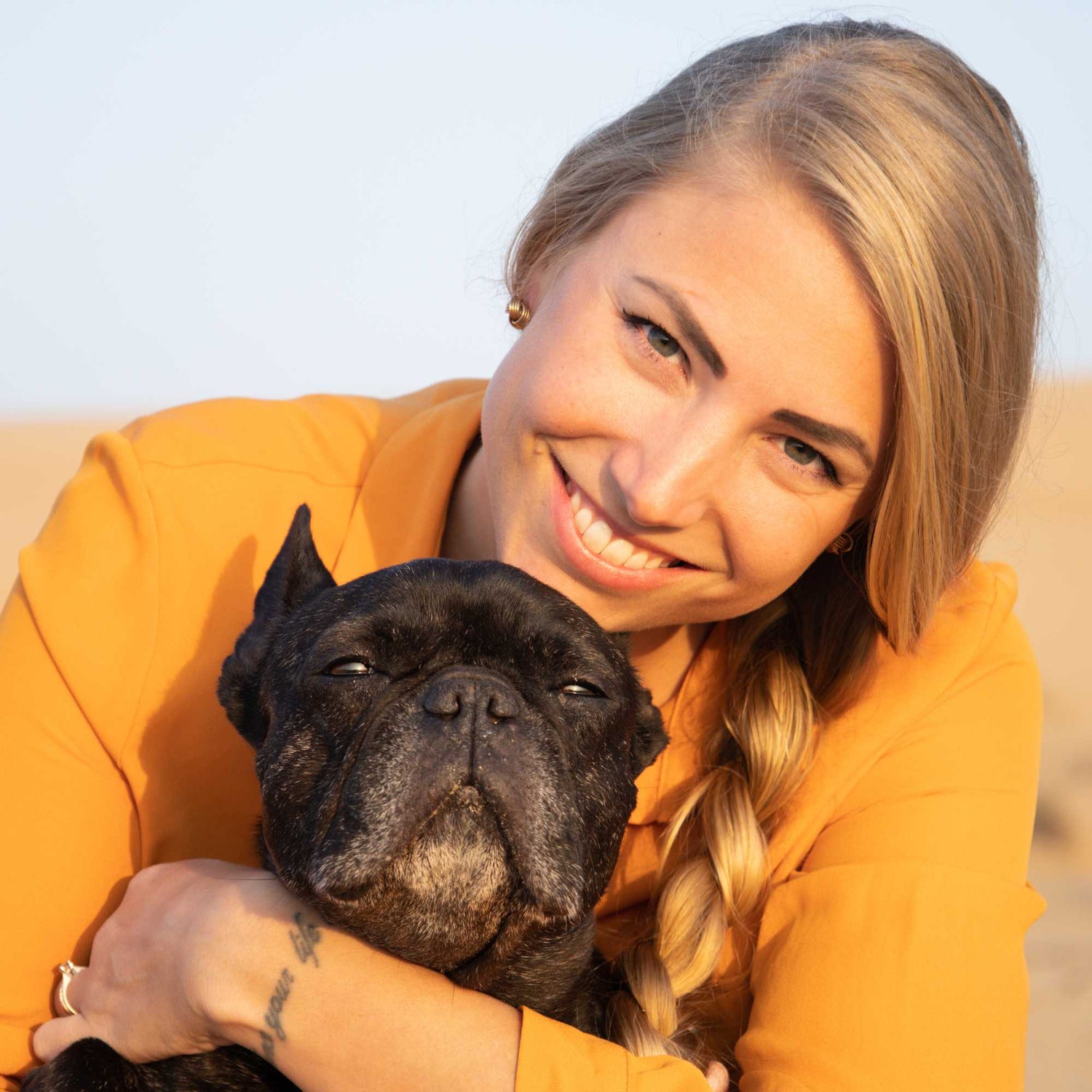
The way it showed up was not what I expected. She stopped eating. Milka has never turned down food in her life, not once, so that was the alarm. She was also shaking. We assumed it was her teeth, because she is a senior French Bulldog and her teeth are not perfect. That is what took us to the vet.
The vet ran a SNAP 4Dx. It came back positive for Ehrlichia that day, and a prescription for doxycycline was in my hand within minutes.
We took the antibiotics home. We did not give them.
What happened over the next few weeks changed how I think about tick-borne disease entirely, and most of what I learned is not hidden or fringe. It is sitting in veterinary literature that almost no pet parent ever sees.
What's in this article
- What does a positive SNAP 4Dx test actually tell you?
- Exposure or active infection: what is the difference?
- What tests should you ask for after a positive result of ehrlichia in dogs?
- Can a dog test positive for Ehrlichia and have no symptoms?
- What are the signs of Ehrlichia in dogs?
- Does a positive result of Ehrlichia mean my dog needs doxycycline?
- What should you do first if your dog tested positive for Ehrlichia?
- How did we support Milka through Ehrlichia naturally?
- How do you support your dog's gut if antibiotics are the right call?
- Will my dog keep testing positive for Ehrlichia?
- Can flea and tick products fully protect your dog?
- What should you take away from a positive result of Ehrlichia in dogs?
- Two paths after a positive Ehrlichia result
- Sources
What does a positive SNAP 4Dx test actually tell you?
The SNAP 4Dx Plus is an in-clinic screening test. It looks for heartworm antigen, and antibodies to Lyme, anaplasmosis, and ehrlichiosis. Most clinics run it once a year alongside heartworm screening.
Here is the part that matters. For the three tick-borne diseases on that test, what is being detected is antibodies. Your dog's immune system made those antibodies because it met the organism. That is a real and useful piece of information. It is not the same as your dog being sick from it right now.
This is not a holistic reading of the test. It is the mainstream veterinary position. Writing for dvm360, Dr. Adam Birkenheuer, a board certified internal medicine specialist, is explicit that the presence of antibodies indicates exposure and does not always indicate disease, and that these tests should be used to screen for exposure rather than to confirm an active infection.
Cornell University's Riney Canine Health Center puts the practical consequence even more plainly: a patient with a positive antibody test but no clinical signs and no changes on bloodwork does not require antibiotics. Many dogs that test positive never become ill at all.
And in regions where these organisms are common, positives are everywhere. Veterinary guidance on interpreting SNAP results notes that in some Lyme endemic areas, 70 to 90 percent of perfectly normal dogs test positive, and that medicating all of them is not warranted.
So when a pet parent is told "your dog tested positive, here are the antibiotics," an important step has been skipped. Not out of negligence. Usually out of a 15 minute appointment slot.
Exposure or active infection: what is the difference?
This is the distinction the whole decision rests on, so here it is side by side.
| Antibody test (SNAP 4Dx Plus) | PCR test | |
|---|---|---|
| What it detects | Antibodies your dog's immune system produced | The organism's own DNA |
| What a positive means | Your dog met the organism and responded to it | Organism material is present in the sample |
| Where it runs | In clinic, result the same day | External lab. Milka's took about two weeks |
| Main blind spot | Can miss the earliest window, because antibodies take time to appear | Can stay positive for weeks after an infection has cleared, because it cannot tell a living organism from a dead one |
| What it is for | Screening for exposure, not confirming active infection (Birkenheuer, dvm360) | A positive makes a convincing case for active infection and can reasonably support medicating (Cohn, Today's Veterinary Practice) |
| After recovery | Unreliable for judging recovery. Antibodies persist after the organism is eliminated, and titres often take six to nine months to begin falling | A negative does not prove a dog is uninfected |
Both tests have real blind spots, and this is where honesty matters more than a clean story. Antibody testing can miss the earliest window, because it takes time for antibodies to appear. PCR can stay positive for weeks after an infection has cleared, because it cannot tell a living organism from a dead one. Dr. Leah Cohn, writing in Today's Veterinary Practice, notes that a positive PCR makes a convincing case for active infection and can reasonably support medicating, while a negative PCR does not prove a dog is uninfected.
Used together, they tell you far more than either one alone. That is the actual point.
What tests should you ask for after a positive result of Ehrlichia in dogs?
This is the part I wish someone had handed me on a piece of paper. If your dog has tested positive on an in-clinic screen, these are the reasonable next steps to ask your vet about.
- A complete blood count. Guidance published through dvm360 recommends a CBC plus a serum protein measurement as the immediate follow-up to a positive Ehrlichia SNAP. You are looking for low platelets, anaemia, or low white cells.
- A serum protein measurement, specifically globulin. Long term immune stimulation pushes globulin up, sometimes dramatically. It is one of the quieter signals that something is genuinely active.
- Urinalysis. VCA's veterinary guidance includes checking whether the kidneys are losing protein.
- PCR, if the bloodwork shows abnormalities. This is what moves you from "exposed" to "actively infected." It is the test we ran on Milka, and it took about two weeks to come back.
- A repeat antibody test roughly three weeks later. Documenting a rise between an early sample and a later one is how seroconversion is established, which tells you the exposure is recent rather than historic.
You are allowed to ask for these. You are allowed to ask what each one would change about the plan. That is not being difficult. That is being the person who knows your dog best.
Can a dog test positive for Ehrlichia and have no symptoms?
Yes, and it is common enough that it is almost a running joke in veterinary internal medicine. The most frequent reason an Ehrlichia positive dog is sitting in front of a vet is a routine wellness exam, not illness.
That is worth sitting with for a second. A large share of positive results come from dogs who feel completely fine.
What are the signs of Ehrlichia in dogs?
Veterinary guidance on when to run a tick-borne panel lists fever, inappetence, lethargy, unexplained lameness in more than one limb, vasculitis, certain kidney problems, and clotting abnormalities.
Look at that list again. Inappetence is on it. A dog who will not eat.
That is exactly what Milka showed, and we did not connect it to ticks at all. We thought it was her teeth. If your dog goes off food and something feels off to you, and there is any tick exposure in the picture, say that out loud at the appointment.
Does a positive result of Ehrlichia mean my dog needs doxycycline?
Not automatically, and this is where I want to be careful, because the internet version of this conversation is usually far too confident in both directions.
The standard veterinary approach comes from the ACVIM consensus statement on ehrlichial disease, which sets the doxycycline recommendation at 5 mg/kg twice daily for at least 28 days. That recommendation exists for good reasons and it has helped a very large number of dogs.
But here is what is rarely explained to the person holding the prescription: whether doxycycline reliably clears the organism is genuinely unsettled in the research.
A 2007 study in the Journal of Veterinary Internal Medicine found that a four week course did clear E. canis from the blood and tissues of experimentally infected dogs. A 1998 study in the Journal of Clinical Microbiology found the opposite in one of four subclinically infected dogs, concluding that even six weeks may not be enough for every dog. A 2020 JVIM paper describes the findings on clearance as discrepant. And one survey of canine blood samples, most from dogs medicated with doxycycline for anywhere from one to 24 months, still detected E. canis in 44 percent of them.
I am not sharing that to argue against the drug. I am sharing it because "take this for three weeks and it will be gone" is a cleaner promise than the evidence actually supports, and you deserve the real version.
The other half of the picture is the gut. A 2023 review in The Veterinary Journal on the effects of antimicrobials in dogs and cats found that antibiotics reduce microbial richness and diversity, wipe out beneficial groups, and let opportunistic organisms bloom. The finding that stayed with me is that a drug's spectrum, dose, and duration cannot reliably predict how severe or how long that disruption will be. Recovery is described as extremely individualised, and repeat courses of the same drug can affect the same dog differently each time.
So the honest framing is this. Doxycycline is a real tool with real value and genuine uncertainty attached, and the cost of using it is not zero. Which means the decision deserves more than 15 minutes.
What should you do first if your dog tested positive for Ehrlichia?
Here is the piece of advice I now give every pet parent in this position, and it came from Julie Anne Lee, DCH, founder of Adored Beast, who supported us through Milka's recovery and who has navigated Lyme disease in her own body.
Fill the prescription. Take the antibiotics home. Do not necessarily give them.
That sounds contradictory until you have lived the 2am version of it. If your dog deteriorates at midnight, you do not want to be driving to an emergency clinic to obtain a medication you could already have in a drawer. Having it in the house is what buys you the time to make a considered decision instead of a panicked one.
You might pay for a course you never open. That is a small price for not being cornered.
And you need to know how to gauge which way things are going. Learning to take your dog's temperature, check gum colour and capillary refill, and notice changes in circulation or tremors is the difference between watching and guessing.
How did we support Milka through Ehrlichia naturally?
This section is our personal experience, not a clinical protocol, and I want to label it clearly. Milka's PCR did come back positive, so we were dealing with an active infection, and we worked with veterinary and expert support throughout rather than on our own.
If you want the full conversation, Julie and I recorded a podcast episode about all of this, including her own experience with Lyme disease and how she thinks about testing. You can watch the full episode here.
We ran a daily symptom diary. Honestly, this was the single most valuable thing we did. Every symptom, every day, written down. Whether she ate. Whether there were tremors and how long they lasted. Energy. Stool. Temperature.
That diary did two things. It kept us sane, because improvement in a sick dog is not linear and memory is a terrible instrument. And it gave the people advising us something real to work from. When Julie told us to change a remedy or increase frequency, it was because we could tell her precisely what had shifted since yesterday.
The tremors became our signal. When they appeared, we knew to step things up. When they faded, we knew we were moving in the right direction.
Alongside that, we ramped up the support Milka was already on:
- Antioxidant and cellular support. We doubled her Vital Defense, a chaga, phytoplankton and spirulina blend, and added Phyto Synergy so she was covered from more than one angle.
- Functional mushrooms. Turkey Tail and Chaga liquid triple extracts, both of which we travel with anyway.
- Rotating probiotics. We alternated what we had on hand rather than staying on one, including Fido’s Flora.
- Homeopathic remedies, including Your Go 2. I want to be straight with you here: controlled evidence for veterinary homeopathy is weak. Systematic reviews of randomised trials have not found reliable evidence of effect. I am telling you what we used and what we observed, and nothing more than that.
- Red light therapy, which is already part of Milka's routine. This is the device we use.
The one we doubled
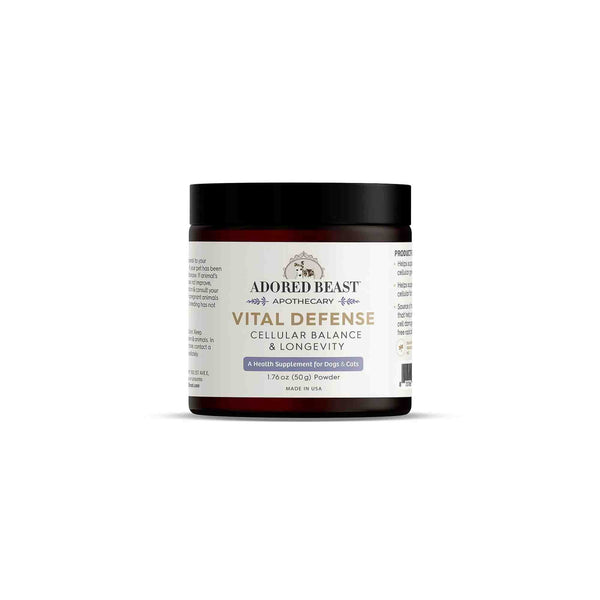
Vital Defense
A chaga, phytoplankton and spirulina blend from Adored Beast, formulated to support cellular health and the body's antioxidant defences. This is the one we doubled while Milka's body was working hard, and it is what she still gets as a senior.
One note worth knowing: chaga is naturally high in oxalates, so if your dog has kidney disease or a history of oxalate stones, talk to your vet before starting it.
See Vital DefenseFor Milka's exact recovery routine, you can download the free Complete Flea and Tick Protection Guide.
It took about three to three and a half weeks for her symptoms to resolve completely. No more tremors. Eating normally.
Was it cheaper than the antibiotics? No. It would have been far cheaper to give her the three week course. For us it was worth it, and I would make the same call again. That is our decision for our dog, made with support around us. It is not a prescription for yours.
How do you support your dog's gut if antibiotics are the right call?
Sometimes they are. A dog with a high fever and a confirmed active infection needs medical care, and choosing that is not a failure of anything.
What you can do is support the gut alongside it, and there is real canine data here rather than wellness folklore.
A 2021 randomised, double blinded, placebo controlled trial published in Frontiers in Veterinary Science gave 22 healthy dogs a 21 day antibiotic course, followed one hour later by either a synbiotic or a placebo. The dysbiosis index and beta diversity differed significantly between the groups, and the placebo group still had not fully recovered by days 82 to 84.
Two practical things fall out of that study. Support the gut during the course, not only after it. And spacing matters, since the trial used a one hour gap between the antibiotic and the supplement.
Practically, that means a species-appropriate probiotic such as Fido’s Flora or Gut Soothe if the gut is already irritated, kept an hour apart from the medication and continued well past the last dose.
What we reach for alongside a course
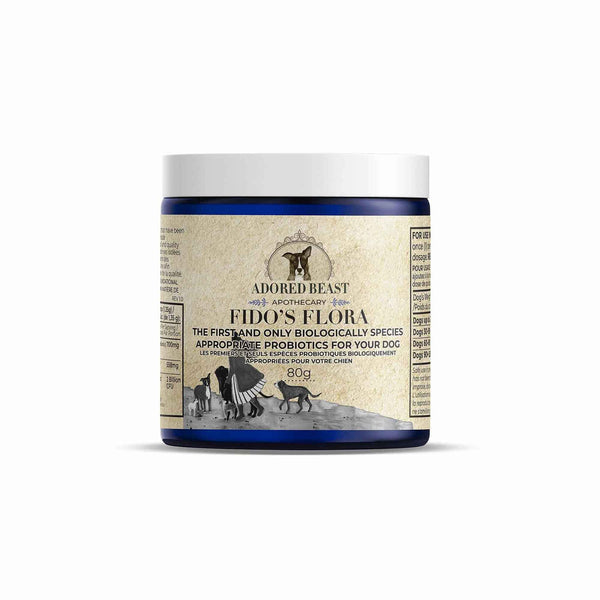
Fido’s Flora
Adored Beast's canine specific pre and probiotic, built around 16 strains including two strains isolated from dogs, plus larch prebiotic and fulvic and humic acids. It is the one I keep in the house for exactly this situation: a dog on a course of antibiotics whose microbiome is taking the hit described in the research above.
- Give it an hour apart from the antibiotic dose, as the 2021 trial did
- Keep going well past the final dose, since recovery in that trial ran past 12 weeks
- Two sizes, so you can match it to your dog's weight and how long you plan to run it
Also available on subscription, which is worth setting up if you are running it for the full recovery window.
Our full breakdown of what antibiotics do in a dog's body is in our guide to antibiotics for dogs and their side effects, and if you want the bigger picture on why the microbiome matters this much, start with dog gut health.
One more thing that gets overlooked when a dog goes off food: hydration matters more than appetite in the short term. A dog who is not drinking will feel worse fast. Bone broth or goat milk, syringed if you have to, keeps fluids and electrolytes going while appetite catches up.
Will my dog keep testing positive for Ehrlichia?
Possibly for a long time, yes, and this one has a story attached.
Recently Milka had a routine SNAP 4Dx as part of heartworm screening. It came back positive for Ehrlichia, and the vet told me Milka needed medication.
I explained that Milka had already had Ehrlichia and recovered. The vet then clarified that antibodies can remain even when the organism is gone.
That is exactly what the research shows. The 1998 study I mentioned earlier found that antibody testing was unreliable for judging recovery, because anti-E. canis antibodies persisted after the organism itself was eliminated. Veterinary references note titres often take six to nine months to even begin falling.
So if your dog has a history of exposure, keep the records. Print the bloodwork. Keep a file on your phone. When a new clinic sees a positive with no context, they are looking at a red flag. When they see it next to your dog's history, they are looking at a footnote.
Can flea and tick products fully protect your dog?
No, and this is the part that surprises people most.
The Companion Animal Parasite Council states plainly that no product can completely stop all tick-transmitted diseases, and that a tick missed for a day or two is enough time for transmission to occur. Cornell adds that oral isoxazoline products do not stop ticks attaching at all. They kill after attachment, which is why speed of kill is the metric that matters.
Then there is the number that reframed this for me entirely. Transmission timing varies enormously by organism. Babesia needs 36 to 48 hours of attachment. E. canis can transmit within about three hours.
Three hours. That is a far narrower window than most protection products are designed around, and it explains something Julie said that stuck with me: she has seen plenty of dogs develop tick-borne illness while on flea and tick medication. People let their guard down because they believe the product has it handled.
Use protection if you choose to. Also check your dog. Both.
What should you take away from a positive result of Ehrlichia in dogs?
A positive tick-borne test is information. It is not an instruction.
You are allowed to ask what the test actually measured. You are allowed to ask for a CBC before starting a 28 day course. You are allowed to want a PCR result before making a decision that affects your dog's gut for months. And you are allowed to have two vets, a conventional one you can physically reach and an integrative one online, working the problem together.
None of that is difficult behaviour. It is what being informed looks like.
If you want somewhere structured to start, I put together The Complete Flea and Tick Protection Guide, which walks through natural protection, how to think through these decisions before you are standing in a clinic, and what to have ready.
Milka is a healthy senior now. Snout going white, still bossing us around at dinner time.
And if you are the person sitting in a parking lot right now with a prescription and a knot in your stomach, breathe. You have more time than the moment feels like it is giving you.
With gratitude, Charly
Two paths after a positive Ehrlichia result
Most pet parents reading this are standing at one of two doors, and the right door depends on what the follow-up testing shows rather than on the SNAP result alone. Here is how the two paths differ.
| Positive antibody test, no clinical signs, normal bloodwork | Confirmed active infection | |
|---|---|---|
| What the guidance says | A patient with a positive antibody test, no clinical signs and no bloodwork changes does not require antibiotics (Cornell Riney Canine Health Center) | The ACVIM consensus statement sets doxycycline at 5 mg/kg twice daily for at least 28 days |
| Reasonable next step | CBC, serum globulin, urinalysis, and a repeat antibody test about three weeks later | Work the plan with your vet, ideally alongside an integrative vet |
| What to have in the house | The filled prescription, unopened, so a 2am decision is never made in a car park | The medication, plus gut support ready to start on day one of the course |
| What to track daily | Appetite, energy, temperature, gum colour, stool, tremors | The same diary, plus how your dog responds to each week of medication |
| The gut question | No antibiotic disruption to manage yet, which is the whole argument for confirming before medicating | Antibiotics reduce microbial richness and diversity. A synbiotic given an hour after the dose measurably changed recovery in the 2021 trial |
| What we used | Vital Defense and functional mushrooms, alongside a daily symptom diary | Fido’s Flora, kept an hour apart from the dose and continued well past the last one |
Neither column is a prescription. The point of the table is that the two situations are genuinely different, and a SNAP result on its own does not tell you which one you are in.
Sources
- Birkenheuer, A. "Canine tick-borne diseases: When to treat a positive patient-side test result." dvm360. Link
- "Anaplasmosis." Cornell University College of Veterinary Medicine, Riney Canine Health Center. Link
- "SNAP 4Dx: What do all those blue dots mean?" Wisconsin Federated Humane Societies. Link
- Cohn, L. "What to Do With the Ehrlichia-Positive Healthy Dog." Today's Veterinary Practice, 2022. Link
- Brooks, W. "Ehrlichia Infection in Dogs." Veterinary Partner, VIN. Link
- "Ehrlichia ewingii Q&A." dvm360. Link
- "Ehrlichiosis in Dogs." VCA Animal Hospitals. Link
- Neer, T.M. et al. "Consensus Statement on Ehrlichial Disease of Small Animals from the Infectious Disease Study Group of the ACVIM." Journal of Veterinary Internal Medicine, 2002;16(3):309-315.
- Eddlestone, S. et al. "Doxycycline Clearance of Experimentally Induced Chronic Ehrlichia canis Infection in Dogs." Journal of Veterinary Internal Medicine, 2007;21(6):1237-1242. Link
- Harrus, S. et al. "Therapeutic Effect of Doxycycline in Experimental Subclinical Canine Monocytic Ehrlichiosis: Evaluation of a 6-Week Course." Journal of Clinical Microbiology, 1998;36(7):2140-2142. Link
- Sato, M. et al. "Ehrlichia canis in dogs experimentally infected, treated, and then immune suppressed during the acute or subclinical phases." Journal of Veterinary Internal Medicine, 2020. Link
- Stavroulaki, E.M. et al. "Effects of antimicrobials on the gastrointestinal microbiota of dogs and cats." The Veterinary Journal, 2023. Link
- Whittemore, J.C. et al. "Effects of Synbiotics on the Fecal Microbiome and Metabolomic Profiles of Healthy Research Dogs Administered Antibiotics: A Randomized, Controlled Trial." Frontiers in Veterinary Science, 2021;8:665713. Link
- "The Case for Year-Round Flea and Tick Control." Companion Animal Parasite Council. Link
- "Flea and tick prevention." Cornell University College of Veterinary Medicine, Riney Canine Health Center. Link
- Fourie, J.J. et al. "Transmission of Anaplasma phagocytophilum by Ixodes ricinus ticks feeding on dogs and artificial membranes." Parasites & Vectors, 2019. Link
- Mathie, R.T. and Clausen, J. "Veterinary homeopathy: systematic review of medical conditions studied by randomised trials controlled by other than placebo." BMC Veterinary Research, 2015. Link
DISCLAIMER: This content is for informational purposes only and is not intended to be a substitute for professional veterinary advice, diagnosis, or treatment. Every animal's health situation is unique, so always work alongside your vet, ideally a holistic or integrative vet, for anything ongoing or serious. Our content may include affiliate and/or sponsored links, which means your support helps move our mission forward. As content creators, we earn from qualifying purchases.