MCT oil for dogs with seizures has real published evidence behind it, and it is smaller than the internet makes it sound. Across three controlled canine trials, adding medium chain triglyceride oil at roughly 9% of a dog's daily calories lowered average seizure frequency alongside anti-seizure medication. But in the most rigorous oil trial, only 5 of 28 dogs reached a 50% or greater reduction, and 11 dogs saw no change or got worse. MCT oil is a support tool used with veterinary care, never a replacement for medication.
Here is the line I want you to hold onto: MCT oil is one of the very few dietary additions for canine epilepsy with randomised controlled trial evidence behind it, and roughly one dog in five reaches a clinically meaningful response.
That is a real result. It is also not the result you will read anywhere else, because almost every page ranking for this topic is quoting the wrong numbers from the wrong study.
Let me show you what I mean.
Why does MCT oil get talked about for seizures at all?
Medium chain triglycerides are fats with shorter carbon chains than the fats in most of your dog's food. Because they are short, they skip the usual digestive route. They travel straight to the liver and get converted into ketones, which the brain can burn as fuel instead of glucose.
That matters because the epileptic brain has an energy problem. Researchers studying canine epilepsy have pointed to insufficient energy metabolism in the brain as part of the picture, and ketones offer a second fuel line into it.
This is the same principle behind the ketogenic diet used in children with epilepsy for the better part of a century. The canine research took that idea and asked a simpler question: can you get some of the benefit without putting a dog on a full ketogenic diet?
Does MCT oil actually stop seizures in dogs?
No. And I want to be blunt about that before anything else, because it is the most dangerous misunderstanding out there.
MCT oil does not stop a seizure that is happening. Nothing you keep in your kitchen does. If your dog is having a seizure that lasts more than five minutes, or has several in a row, that is an emergency and you call your vet.
What the research looked at is something different: whether feeding MCT daily, over months, reduces how often seizures happen. Here is what three trials found.
| Trial | What was fed | Dogs | Result |
|---|---|---|---|
| Law et al., 2015 British Journal of Nutrition |
MCT-enriched kibble, 10% of calories from C8, C10 and C12 | 21 | 3 dogs became seizure-free, 7 more had a 50%+ reduction |
| Berk et al., 2020 J. Veterinary Internal Medicine |
MCT oil supplement at 9% of metabolic energy, C8 and C10 only | 28 | 2 seizure-free, 3 with a 50%+ reduction, 12 under 50%, 11 no change or worse |
| Molina et al., 2020 The Veterinary Record |
Diet with 6.5% MCT oil plus omega-3s and other nutrients | 21 | 32% average drop in monthly seizures, 9 dogs with a 50%+ reduction, 4 dogs worse |
Now look at what happens when you put those side by side.
The statistics you see everywhere, 71% of dogs improved, 48% had a 50% or greater reduction, 14% became seizure-free, come from the 2015 Law kibble trial with 21 dogs. I have watched those exact figures get attached to the 2020 Berk oil trial with 28 dogs on multiple supplement websites, including ones selling MCT oil.
They are not the same study. They did not use the same product. And the oil trial, which was the double-blinded placebo-controlled one, produced a noticeably more modest outcome.
Here is what most pet parents are never told: in that oil trial, 39% of the dogs either saw no change or had more seizures while taking MCT.
I am telling you that because you deserve to make this decision with the real odds in front of you, not the marketing version. It is the same standard we hold everything at PAWDEGA to, and it is the reason how we read the evidence on functional supplements sometimes means telling you a product is less impressive than its label suggests.
Is the improvement real, or is it wishful thinking?
Fair question, and it has actually been studied.
Researchers pooled the placebo periods from three multicentre canine epilepsy trials covering 60 dogs, looking specifically for a placebo response. They did not find one. Monthly seizure frequency did not drop during placebo periods. If anything it edged up, averaging 2.95 seizures per month against 2.30 before the dogs enrolled.
So the modest effect that shows up on MCT is more likely to be real, not a hopeful pet parent counting differently. That cuts both ways though. It also means the dogs who did not respond genuinely did not respond.
How much MCT oil should I give my dog for seizures?
The trials used 9% of the dog's daily metabolic energy. Almost nobody translates that into something you can measure in your kitchen, so we did the arithmetic.
Assuming a maintenance energy requirement of 110 x (body weight in kg to the power of 0.75), MCT oil at 8.3 calories per gram and a density of 0.93 grams per millilitre:
| Dog's weight | 9% of daily calories | MCT oil per day |
|---|---|---|
| 10 lb / 4.5 kg | ~31 kcal | ~4 mL (about 0.8 tsp) |
| 20 lb / 9 kg | ~52 kcal | ~6.7 mL (about 1.4 tsp) |
| 30 lb / 13.6 kg | ~70 kcal | ~9 mL (about 1.8 tsp) |
| 40 lb / 18 kg | ~87 kcal | ~11 mL (about 2.3 tsp) |
| 50 lb / 22.7 kg | ~103 kcal | ~13 mL (about 2.7 tsp) |
| 60 lb / 27 kg | ~118 kcal | ~15 mL (about 3.1 tsp) |
| 80 lb / 36 kg | ~146 kcal | ~19 mL (about 3.8 tsp) |
These are estimates from published trial parameters, not veterinary dosing instructions. Your vet should confirm the number for your dog.
But notice something. The rule of thumb repeated across the internet is one teaspoon per 10 pounds of body weight. For a 10 pound dog that lands close to the study dose. For an 80 pound dog it would mean 8 teaspoons a day, which is more than double what the researchers used.
That is not a rounding error. That is a lot of extra fat and a lot of extra calories going into a dog whose vet has not signed off on it.
Two more things about the dose.
First, those calories are not free. At 9% of daily energy, you need to reduce food elsewhere or your dog gains weight. In the trials this was accounted for. In your kitchen it has to be done on purpose.
Second, work up slowly. Start at a fraction of the target, something like 1% to 2% of daily calories, and build over three to four weeks. Going straight to the full amount is the fastest way to end up with a dog with diarrhea and a bottle of oil you never use again.
Is coconut oil the same as MCT oil for dog seizures?
No, and this is the swap I see most often.
Coconut oil does contain medium chain fats, but the dominant one is lauric acid (C12). The canine seizure research used caprylic acid (C8) and capric acid (C10). A veterinary nutritionist at the University of Tennessee has made this point directly: the medium chain fats in coconut oil are not the ones the seizure studies were built on, and there is no published research evaluating coconut oil itself in dogs or cats.
So if you are reaching for the jar of coconut oil in your pantry hoping to replicate a study, you are not replicating that study.
Which fatty acid is doing the work?
This is the part that almost never gets discussed, and it is the most interesting piece of the whole picture.
Capric acid (C10) appears to be the one with the direct mechanism. Laboratory work has shown it acts as a non-competitive AMPA receptor antagonist, which in plain language means it damps down excitatory signalling in the brain. Caprylic acid (C8) on its own showed no antiseizure effect in laboratory studies, though it improved outcomes in mice when given together with C10.
Lauric acid (C12) has no comparable evidence behind it for seizures. What it does have is a marketing story, and you will find claims that C12 produces longer-lasting brain ketones. I could not find credible research supporting that, so I am not going to repeat it.
There is also a caution attached to C12. Some veterinarians, including Dr. Julie Buzby, recommend MCT oils without lauric acid on the grounds that it can overstimulate the pancreas, where C8 and C10 largely bypass it.
Here is where honesty gets a little uncomfortable for us, so I will say it plainly. The MCT oil we stock contains lauric acid. Its composition matches the 2015 Law formula, which used C8, C10 and C12 together and produced the strongest published results of any of the three trials. It does not match the 2020 Berk oil, which was C8 and C10 only. If your dog has a history of pancreatitis, this is a conversation to have with your vet before you start, not after.
I would rather you know that than find it out somewhere else.
The MCT oil we stock
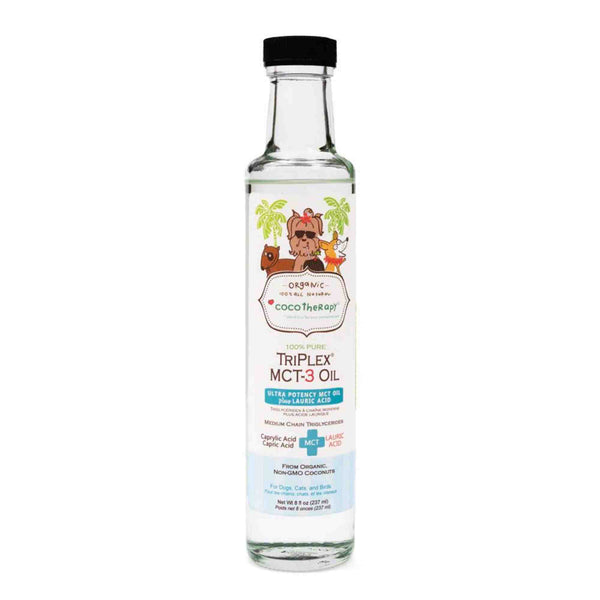
CocoTherapy TriPlex™ MCT-3 (Coconut) Oil
$27.99 | 8 oz | 6 reviews, all five star
This is the oil referenced above, so here is exactly what is in it rather than a benefit list. Per the label: medium chain triglycerides 93%, caprylic acid (C8) 7,000 mg, capric acid (C10) 4,700 mg, lauric acid (C12) 1,500 mg. Capric acid, the fraction with the direct mechanism described in this article, is the second largest component. Lauric acid is the smallest of the three.
One thing worth knowing: the label directs half a teaspoon per 10 pounds of body weight, starting at a quarter of that and building slowly. That sits close to the 9% figure the trials used, and well below the one-teaspoon-per-10-pounds rule floating around online.
Cold-pressed, unbleached, unhydrogenated, human grade, from USDA Certified Organic coconut oil. Talk to your vet first if your dog has a pancreatitis history.
Shop TriPlex MCT-3 OilCan MCT oil be given alongside seizure medication?
The evidence here is reassuring, and it is important, because this is the question that actually keeps people up at night.
In the 2015 trial, serum concentrations of phenobarbital and potassium bromide showed no significant differences between the MCT and placebo diet periods. Blood glucose and body weight did not shift either. What did move was blood beta-hydroxybutyrate, the ketone marker, confirming the oil was doing metabolically what it was supposed to.
A separate 2023 study in dogs on zonisamide found the MCT diet safe to use alongside that medication, though in that small group of seven dogs the diet did not significantly reduce seizure frequency at all. Another honest data point for the pile.
None of that is permission to change medication. Anti-seizure drugs are not something you taper, skip or stop on your own. Withdrawal can provoke seizures. Every supplement you add should be logged and reported to your vet, because a change in seizure frequency in either direction after starting something new is clinically useful information for them.
What are the side effects of MCT oil in dogs?
The common ones are digestive: loose stool, greasy stool, vomiting, or a dog who suddenly turns their nose up at dinner. Almost all of it comes from too much, too fast.
The bigger question is the pancreas, and the evidence is genuinely mixed.
A 2023 study at the University of Tennessee fed twelve healthy dogs meals with different fat compositions and found that swapping long chain fats for MCT had little effect on markers of pancreatic enzyme release. MCT also produced lower post-meal triglycerides than either long chain fat, which is a point in its favour.
But read the authors' own caveats. Those were healthy dogs. Butter had to be blended into the MCT meal because dogs would not eat pure MCT oil. And they state directly that dogs with chronic pancreatitis may respond differently.
So "MCT does not stress the pancreas" is not an established fact for dogs who already have pancreatic disease. It is an untested assumption. Dogs with a pancreatitis history, and breeds predisposed to it, need a vet in the loop.
How long before you know if it is working?
Give it months, not days.
The trials ran 84 to 90 days per phase. That is your realistic window. Keep a seizure diary from the day you start, with dates, times, duration and anything you noticed beforehand. Without that record you will be guessing, and epilepsy is a condition where seizure frequency naturally clusters and scatters enough to fool anyone relying on memory.
Where MCT oil fits in a whole-body plan
There is a lesson I learned the hard way with Milka, and it applies directly here.
When her ALT came back elevated at eight years old, after years of clean bloodwork, our instinct was to do more. More supplements. More support. We stacked them. And when we retested a few weeks later... her liver values were higher, not lower.
We backed off to one thing, and her ALT normalised. I wrote about that whole experience in detail in why more supplements is not better support, because it changed how we think about everything we add to a bowl.
More is not always better. It is one of the hardest lessons in holistic pet wellness, and it is the reason I am wary of the "throw everything at it" approach I see in seizure support groups. If you add MCT oil, CBD, three mushroom tinctures, detox supplements, and a diet change in the same week, and something shifts, you will never know what did it. Worse, if something goes wrong, you will not know what caused that either.
Change one thing. Give it time. Write it down.
If MCT oil is the one thing you and your vet decide to try, we stock CocoTherapy TriPlex MCT-3 Oil, which is the composition discussed above. For pet parents building broader neurological support with their vet's guidance, the Brain and Seizure Support Bundle brings several of these tools together, and CLARITY is a mushroom and adaptogen blend formulated for cognitive and nervous system support.
If you want the wider picture on what MCT does beyond seizure frequency, including the cognition research in senior dogs, I covered that separately in MCT oil for dogs: benefits, dosage and the brain research.
These are support tools. They work with the body and alongside your vet. They are not a substitute for anti-seizure medication, and I would never suggest otherwise.
Coconut oil vs MCT oil at a glance
If you are deciding between the jar in your pantry and a dedicated MCT oil, this is the whole comparison in one place.
| Coconut oil | MCT oil | |
|---|---|---|
| Dominant medium chain fat | Lauric acid (C12) | Caprylic (C8) and capric (C10) acid |
| Used in the canine seizure trials | No | Yes, all three trials |
| Published research in dogs or cats | None found | Three controlled trials, 2015 to 2020 |
| Carries the C10 anticonvulsant mechanism | Only in small amounts | Yes, C10 is a major fraction |
| Best use for a dog with epilepsy | Not a substitute for the studied oil | The option with actual trial evidence, used alongside medication |
The one thing I want you to take from this
If your dog has epilepsy that medication has not fully controlled, MCT oil is one of the few options with actual randomised controlled trial evidence behind it. That puts it ahead of almost everything else marketed for seizures.
And the honest odds are roughly one in five for a meaningful response, with a real chance of nothing changing at all.
Both of those things are true at once. You are allowed to try something with a one in five chance. What you are not owed is a website pretending it is a sure thing.
You know your dog. You have watched more of these episodes than any researcher has. Bring the real numbers to your vet, ask whether MCT fits your dog's specific picture, start low, go slow, and write everything down.
You are not powerless in this. You are your dog's biggest advocate.
Much Love, Larry
This blog is for educational purposes and is not a replacement for veterinary advice. I am not a veterinarian. Please work alongside your vet, ideally a holistic or integrative vet, for anything ongoing or serious, and never stop or change anti-seizure medication without veterinary guidance.
Sources
- Law TH, Davies ES, Pan Y, Zanghi B, Want E, Volk HA. "A randomised trial of a medium-chain TAG diet as treatment for dogs with idiopathic epilepsy." British Journal of Nutrition, 2015; 114(9):1438-1447. https://doi.org/10.1017/S000711451500313X
- Berk BA, Law TH, Packer RMA, et al. "A multicenter randomized controlled trial of medium-chain triglyceride dietary supplementation on epilepsy in dogs." Journal of Veterinary Internal Medicine, 2020; 34(3):1248-1259. https://doi.org/10.1111/jvim.15756
- Molina J, Jean-Philippe C, Conboy L, et al. "Efficacy of medium chain triglyceride oil dietary supplementation in reducing seizure frequency in dogs with idiopathic epilepsy without cluster seizures." The Veterinary Record, 2020; 187(9):356. https://doi.org/10.1136/vr.105410
- Berk BA, Packer RMA, Law TH, et al. "A double-blinded randomised dietary supplement crossover trial design... study protocol." BMC Veterinary Research, 2019; 15:181. https://doi.org/10.1186/s12917-019-1915-8
- Zhang Y, Kirk CA, Tolbert MK, et al. "Impact of fatty acid composition on markers of exocrine pancreatic stimulation in dogs." PLOS ONE, 2023; 18(8):e0290555. https://doi.org/10.1371/journal.pone.0290555
- Hasegawa D, et al. "Efficacy evaluation of a commercially available MCT enriched therapeutic diet on dogs with idiopathic epilepsy treated with zonisamide." BMC Veterinary Research, 2023; 19:167. https://doi.org/10.1186/s12917-023-03710-4
- Witzel Rollins A, DVM, PhD, DACVIM (Nutrition), University of Tennessee, in "Can I use coconut oil as Fifi's fat source?" dvm360. https://www.dvm360.com/view/can-i-use-coconut-oil-fifi-s-fat-source
- Buzby J, DVM, CVA. "MCT Oil for Dogs Can Help Dogs with Dementia or Epilepsy." Dr. Buzby's ToeGrips, 2025. https://toegrips.com/mct-oil-for-dogs/
- American Kennel Club Canine Health Foundation. "A Clinical Trial of Medium-Chain Triglyceride Oil for the Treatment of Canine Epilepsy," 2025. https://www.akcchf.org/breakthrough/a-clinical-trial-of/
- International Food Information Council. "The Basics of MCT Oil," 2025. https://ific.org/resources/articles/the-basics-of-mct-oil/