Cordyceps for dogs is a functional mushroom used to support energy and stamina, breathing, kidney function and immune balance. The research behind those uses is real, but almost all of it was done in people and rodents rather than dogs, and the species, the part of the mushroom used and the extraction method decide whether your dog receives anything active at all.
Here is the sentence I would want someone to tell me first: cordyceps has credible human research behind its effects on oxygen use, kidney function and immune signalling, yet there are still no published canine trials on it, and in one 2026 analysis of 65 cordyceps products sold online, more than half had a cheaper species substituted for the one printed on the label.
What you will find here
Most pet parents who search this are not in a crisis. Nothing is wrong. That is exactly the point. You noticed the half second of hesitation at the bottom of the stairs. You noticed he takes longer to settle after a walk he used to trot through. He is fine, and you would like him to stay that way for as long as physically possible.
I know that feeling well. Milka's snout has been going white for a while now, and every year I get a little more deliberate about what earns a place in her bowl and what does not. Cordyceps is one of the more interesting mushrooms in that conversation, and also one of the easiest to buy badly.
What does cordyceps do for dogs?
Cordyceps is an unusual fungus. In the wild, Ophiocordyceps sinensis grows out of caterpillar larvae on the Tibetan plateau, which is why real wild-harvested material is rare and expensive. Nearly every supplement you can actually buy is cultivated Cordyceps militaris instead. Its best studied compound is cordycepin, a close structural relative of adenosine, and reviews of the pharmacology describe antioxidant, anti-inflammatory and anti-tumour activity across laboratory models.
Energy and oxygen use. This is the claim cordyceps is famous for, and it is the one with the most direct human trial data. In a placebo-controlled trial in 37 healthy older adults, six weeks of a fermented cordyceps preparation raised maximum oxygen uptake and anaerobic threshold while the placebo group did not change. A separate randomised trial of a C. militaris blend in 28 adults found no meaningful change after one week, then a rise in maximum oxygen uptake of 4.8 mL/kg/min and 69.8 extra seconds to exhaustion after three weeks. The interesting part for a dog is the timing, not the size. Nothing happened in week one.
Breathing. A systematic review of 15 trials in 1,238 people with stable moderate chronic obstructive pulmonary disease found signals of improvement in lung function, exercise endurance and quality of life, with no serious adverse events reported. The authors also noted that none of the included trials were placebo-controlled or methodologically strong, which is the honest half of that finding.
Kidneys. A 2014 Cochrane review pooled 22 trials covering 1,746 people with chronic kidney disease and found some indication that cordyceps added to conventional care improved kidney function, but rated the evidence quality poor and drew no definitive conclusion. Older pharmacology reviews list renoprotective effects alongside immunomodulatory and antioxidant ones. So: plausible, traditionally used for exactly this, not proven.
Immune balance. This one has a wrinkle worth knowing. A 2020 review found that different C. militaris extracts push immunity in different directions, with water extracts and polysaccharides tending toward one arm of the immune response and strong alcohol extracts and isolated cordycepin tending toward another. An immune-active supplement is not automatically the right idea for every dog, which matters a great deal in the safety section below.
How strong is the evidence in dogs specifically?
Thin. I would rather say that plainly than dress it up.
Among medicinal mushrooms, turkey tail carries the one genuinely strong canine result. In a double-blind randomised pilot study at the University of Pennsylvania, published in 2012, high-dose polysaccharopeptide delayed the progression of metastases and produced the longest survival times reported in canine hemangiosarcoma. That is a real canine trial with a control arm. Cordyceps has nothing equivalent.
The closest thing is a 2025 study of MycoDog's CLARITY, a blend that contains cordyceps alongside lion's mane and reishi. Thirty senior dogs were followed for 12 weeks under veterinary supervision using the DISHAA cognitive framework plus collar tracking and bloodwork. Eighty-one percent improved or held steady on cognitive scoring, average cognitive dysfunction scores fell by 39 percent, and no supplement-related adverse events were reported.
Read that with your eyes open. It was funded by the maker, it had no placebo group, it ran on 30 dogs, and it was testing a five-ingredient formula rather than cordyceps on its own. It is encouraging, and it is not proof of what cordyceps does by itself. A 2026 review of the human performance trials reached a similar verdict from the other direction: the effect signal is consistent, the studies are small and mixed, and better trials are needed.
The short version: cordyceps is a reasonable addition to an aging dog's rotation. It is a weak reason to choose a product on its own, and anyone selling it to you as settled science is ahead of the evidence.
What happened when we ran cordyceps with Milka for a year
This next part is one dog's story rather than data, and I want to be clear about that before I tell it.
Milka has had a high red blood cell count her entire life. It shows up in bloodwork going back to when she was a puppy. Every time it came up, the answer was the same: she is dehydrated. Nobody looked past it, and for years, neither did we.
About a year ago a vet finally stopped at that number instead of explaining it away. The working picture we ended up with is that Milka's blood carries less oxygen than it should, and her body compensates by producing more red blood cells to move what oxygen there is. Two reasonable contributors: she is a French Bulldog, and brachycephalic dogs do not move air the way other dogs do, and she has lived most of her life in genuinely hot climates.
Here is the part that unsettled me. She has never had a symptom. Not one. The only outward sign anybody ever noticed was a comment during a blood draw that her blood looked thick, which matters because thicker blood carries a clotting risk.
So we got serious about consistency with the cordyceps blend we keep in the house, which is BREATHE, and I come back to why that one further down. Daily, not most days, for more than a year. Her most recent bloodwork, done in Germany a couple of months ago, came back with a lower red blood cell count than before.
I am not going to tell you cordyceps did that. It is one dog, there was no control group and no placebo, and other things in her life changed across the same year. What I will say is this: cordyceps has the most direct human research behind it of anything in that bottle for oxygen use, the mechanism lines up with the exact thing we were watching, the number moved in the direction we wanted, and we are carrying on.
That is the honest shape of most holistic pet care. You rarely get a clean experiment. You get a number you are tracking, a change you can defend a reason for, and a decision about whether to keep going. Which is also the argument for running bloodwork on a healthy dog. Without those old results going back to puppyhood, nobody would have had anything to compare against, and Milka's count would still be filed under dehydrated.
How to choose a cordyceps supplement for dogs
This is the part almost nobody writes about, and it matters more than the benefit list. Two bottles both labelled cordyceps can differ by an order of magnitude in what they actually contain.
Three things create that gap. Species: C. militaris is the richer natural source of cordycepin, and the American Herbal Products Association's position is that when militaris or Paecilomyces hepiali are used, the species should be named on the label rather than hidden behind the word cordyceps. The part used: a 2024 adulteration bulletin from the American Botanical Council's botanical monitoring programme flags cultivated cordyceps ingredients that carry undeclared amounts of the grain substrate the fungus was grown on, often brown rice, which dilutes everything you are paying for. Extraction: raw dried mushroom is largely locked inside chitin cell walls, so an extract is what makes the compounds available.
And then there is what is not supposed to be in there at all. That 2026 analysis of 65 online products found four containing undeclared corticosteroids, and a veterinary review of cordyceps notes that herbal products in general have been found contaminated with arsenic, lead, cadmium and mercury. Third-party testing stops being a marketing bullet and starts being the whole point.
Scroll sideways to see the full table.
| What the label says | What it usually means | What to do |
|---|---|---|
| "Cordyceps", no species | Species unverified, could be either | Ask the brand which species |
| Cordyceps militaris | Cultivated, richest cordycepin source | Good sign, keep reading |
| C. sinensis or CS-4 | Fermented mycelium, less cordycepin | Usable, expect a milder profile |
| "Mycelial biomass" | Grain substrate included in the powder | Put it back on the shelf |
| "Fruiting body" | The mushroom itself, no grain filler | What you want to see |
| "Polysaccharides" only | No beta-glucan number disclosed | Ask for the beta-glucan figure |
| "Dual" or "triple extract" | Cell walls opened, compounds available | What you want to see |
| "Dried mushroom powder" | Compounds locked inside chitin | Low value per gram |
| No third-party testing named | Identity and metals risk unchecked | Choose a tested brand instead |
Run a cordyceps label through those nine rows and most of the market disqualifies itself in about 20 seconds. Which leaves the practical question: so what do you actually buy.
We do not carry a standalone cordyceps bottle, and that is deliberate. Cordyceps does its most interesting work in company. In our lineup it sits inside two blends, and the one I would start with for a dog whose breathing or stamina is the thing you have noticed is BREATHE.
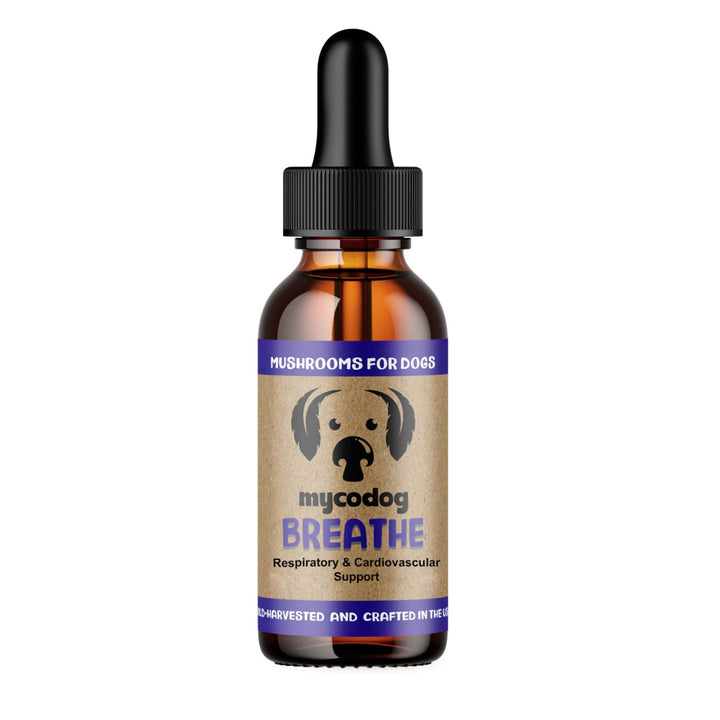
The cordyceps bottle I would start with
BREATHE by MycoDog
Cordyceps is the lead mushroom here, not a name on the back of a long list. It is paired with reishi, artist conk and chaga plus ashwagandha, which is the combination I would want behind respiratory and cardiovascular support rather than cordyceps standing alone.
- Fruiting body only, with no grain, no mycelium and no fillers
- Triple-extracted spagyric tincture, so the compounds are available rather than locked in chitin
- At least 350mg of mushroom extract per 1mL
- Grown outdoors in the forests of the Pacific Northwest, third-party lab tested
- Liquid dropper, which is far easier than hiding a capsule in a meal
Which dogs should skip cordyceps?
I would rather you not buy this than buy it for the wrong dog. Veterinary guidance on cordyceps is consistent about who should avoid it, and the reasons are mechanical rather than vague.
- Dogs on blood thinners or anti-platelet medication. Cordyceps may add to their effect, which raises bleeding risk.
- Dogs within two weeks of surgery. Same reason. Stop well before the date, not the night before.
- Dogs with an autoimmune condition, or on immunosuppressant medication such as prednisone, prednisolone or cyclosporine. An immune-active mushroom works against what those medicines are there to do.
- Diabetic dogs on insulin. Mushroom-derived polysaccharides can lower blood glucose, so this needs your vet watching the numbers, not a guess at home.
- Dogs with a known mould, yeast or fungal allergy. Straightforward, and easy to overlook.
- Dogs with chronic myeloid leukaemia. Specifically flagged as a situation to avoid.
I am not a veterinarian, and none of this replaces your vet's read on your own dog. If your dog is on any daily medication, or you want a professional opinion from someone who works this way, we keep a list of the holistic vets we trust for online consultations.
How much, and for how long?
Follow the label on the bottle you own, because concentration varies enormously between products and a figure from another brand's label is meaningless on yours. For BREATHE, the label works out to one dropper daily for a healthy dog and two droppers daily for a senior, with at least 350mg of mushroom extract per 1mL.
Duration is where most pet parents give up too early. The human trial that saw nothing at one week saw a clear change at three. MycoDog's own guidance is a minimum of six weeks when you are working on something specific, which lines up with what herbalists have said for a long time about how slowly this category moves. If you are going to run cordyceps, decide up front that you are running it for six weeks and then judging, rather than checking for a difference on day four.
For a healthy dog with nothing wrong, rotation beats stacking. One mushroom tincture at a time, finish the bottle, move to the next. That is also the honest answer to the question I get asked most by pet parents of aging dogs, which is whether they are over-supplementing. Rotating is how you get variety without the bowl turning into a pharmacy.
If you want the wider framework this sits inside, which supports go daily, which rotate and which are not worth your money at all, that is what our free guide covers.
Where cordyceps fits in an aging dog's routine
Honestly? Second tier, and I say that as someone who likes it.
The things that move the needle on how a dog ages are unglamorous and come first: a species-appropriate fresh or raw diet, a gut that works, omega-3 intake, keeping the toxin load down, real movement, and bloodwork often enough to catch a trend rather than a crisis. Nothing in a dropper bottle outranks those. What cordyceps offers is a well-researched nudge to oxygen use, kidney support and immune signalling for a dog who is already on solid ground, and a mushroom worth having in the rotation once the foundations are in place.
And your instinct about starting while he is still fine is the right one. That is precisely when a routine is easy to build, cheap to maintain and worth something later. Not when the bloodwork comes back strange.
Cordyceps appears in two bottles in our range, and they are not interchangeable. If you are choosing between them, this is the decision in one place. The rest of the range sits in our medicinal mushrooms for dogs collection, including turkey tail, the one with the strongest canine research of any mushroom.
Scroll sideways to see the full table.
| Which one | BREATHE | CLARITY |
|---|---|---|
| Choose it for | Breathing, stamina, heart support | Memory, sleep, engagement in seniors |
| Cordyceps role | Lead mushroom in the blend | One of three mushrooms |
| Paired with | Reishi, artist conk, chaga, ashwagandha | Lion's mane, reishi, bacopa, ashwagandha |
| Evidence status | No canine trial, human lung data only | One 30-dog maker-funded study, no control |
| Go and look | BREATHE label and reviews | CLARITY label and reviews |
If both descriptions sound like your dog, start with the one matching what you have actually noticed with your own eyes, finish the bottle, then reassess. That is a better use of six weeks than splitting your attention across two.
I am rooting for you, and for your dog, every step of the way.
Much love, Larry
Sources
- Tuli HS, Sandhu SS, Sharma AK. Pharmacological and therapeutic potential of Cordyceps with special reference to Cordycepin. 3 Biotech, 2014;4:1-12. pubmed.ncbi.nlm.nih.gov/28324458
- Ng TB, Wang HX. Pharmacological actions of Cordyceps, a prized folk medicine. Journal of Pharmacy and Pharmacology, 2005;57:1509-1519. pubmed.ncbi.nlm.nih.gov/16354395
- Chen S, et al. Effect of Cs-4 (Cordyceps sinensis) on exercise performance in healthy older subjects: a double-blind, placebo-controlled trial. Journal of Alternative and Complementary Medicine, 2010.
- Hirsch KR, et al. Cordyceps militaris improves tolerance to high-intensity exercise after acute and chronic supplementation. Journal of Dietary Supplements, 2017;14(1). tandfonline.com
- Jedrejko K, et al. Current evidence of ergogenic and post-exercise recovery effects of dietary supplementation with Cordyceps militaris in humans, a narrative review. Nutrients, 2026;18(5):781. mdpi.com
- Yu X, et al. Effectiveness and safety of oral Cordyceps sinensis on stable COPD of GOLD stages 2 to 3: systematic review and meta-analysis. Evidence-Based Complementary and Alternative Medicine. ncbi.nlm.nih.gov/pmc/PMC6470429
- Zhang HW, Lin ZX, Tung YS, et al. Cordyceps sinensis (a traditional Chinese medicine) for chronic kidney disease. Cochrane Database of Systematic Reviews, 2014;12:CD008353. pmc.ncbi.nlm.nih.gov/PMC10632742
- Trends in the immunomodulatory effects of Cordyceps militaris: total extracts, polysaccharides and cordycepin. Frontiers in Pharmacology, 2020;11:575704. frontiersin.org
- Brown DC, Reetz J. Single agent polysaccharopeptide delays metastases and improves survival in naturally occurring hemangiosarcoma. Evidence-Based Complementary and Alternative Medicine, 2012;2012:384301. pubmed.ncbi.nlm.nih.gov/22988473
- Brien S, Miceli R (medically reviewed by Ederer M, LVT, RVT, VTS). Cordyceps for dogs. DogCancer.com, 2023. dogcancer.com
- Key medicinal mushrooms for dogs. IVC Journal (Integrative Veterinary Care), 2026. ivcjournal.com
- Post-marketing surveillance of cordyceps products online: identifying falsified products and regulatory challenges. BMC Complementary Medicine and Therapies, 2026. link.springer.com
- Schultz H. Cordyceps products survey finds quality, labeling shortfalls (reporting the study above, plus AHPA nomenclature guidance and the 2024 Botanical Adulterants Prevention Program cordyceps bulletin). SupplySide Supplement Journal, April 2026. supplysidesj.com
- Study: mushroom supplement improves cognitive function in senior dogs (MycoDog Senior Dog Study, conducted by Veterinary Health Research Centers, study director Joel Ehrenzweig, DVM, MRCVS). Petfood Industry, November 2025. petfoodindustry.com
- Medicinal mushrooms for dogs. American Kennel Club, 2026. akc.org